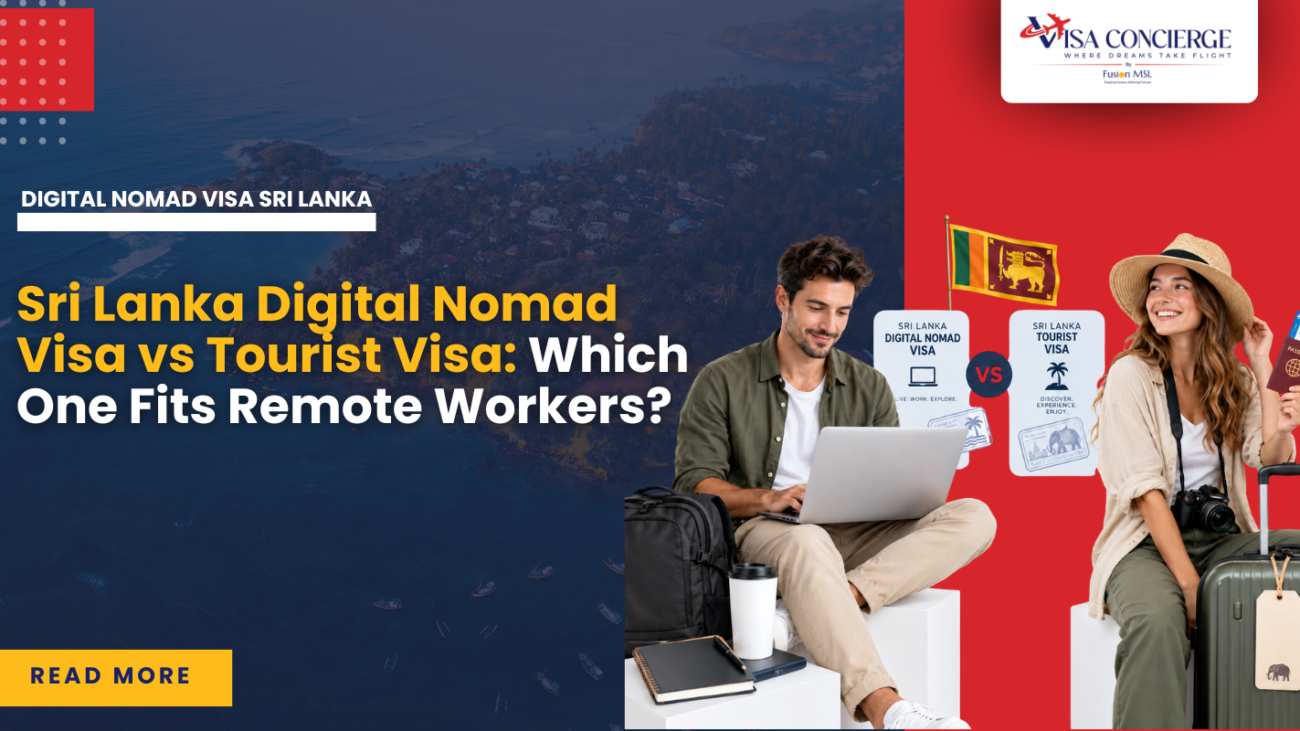

Sri Lanka Digital Nomad Visa vs Tourist Visa Which One Fits Remote Workers

Sri Lanka Digital Nomad Visa vs Tourist Visa | Which One Fits Remote Workers?

Last reviewed: 15 September 2026  |  Reviewed by: M S M Nilam, Senior Executive – Global Compliance & Reporting (GCR) Immigration Services

Sri Lanka Digital Nomad Visa vs Tourist Visa: Which One Fits Remote Workers?

Sri Lanka has become one of the most attractive destinations for remote workers, freelancers, entrepreneurs, and digital nomads.

The country offers what many global professionals are searching for: tropical beaches, coworking spaces, a lower cost of living compared to many Western cities, strong cultural experiences, wellness options, surf towns, tea country, and a growing remote work lifestyle.

But before you book your flight and set up your laptop by the beach, there is one important question to answer:

Should you enter Sri Lanka on a tourist visa, or should you consider the Sri Lanka Digital Nomad Visa?

This is where many remote workers get confused. A tourist visa may be suitable for a holiday or a short visit. But if your real intention is to live in Sri Lanka while working remotely for overseas clients, employers, or your own foreign-registered business, the visa purpose needs to be checked carefully.

The Sri Lanka Digital Nomad Visa is designed for remote workers, but it also comes with specific eligibility expectations, including a monthly income remittance requirement.

This guide explains the key difference between a Sri Lanka Digital Nomad Visa and a Sri Lanka Tourist Visa in a simple, practical way. It is not a document checklist. Instead, it will help you understand which pathway may fit your purpose — and when to speak to Visa Concierge before you apply.

Why Remote Workers Are Looking at Sri Lanka

Sri Lanka is not just a holiday destination anymore. For many foreign professionals, it is becoming a serious remote work base.

Popular locations such as Colombo, Galle, Weligama, Ahangama, Hiriketiya, Kandy, Ella, and the southern coast are already attracting remote workers who want a lifestyle that blends work, travel, culture, and wellness.

For digital nomads, Sri Lanka offers:

  • Beach and surf towns
  • City access in Colombo
  • Boutique villas and serviced apartments
  • Cafés and coworking spaces
  • Wellness, yoga, and Ayurveda experiences
  • Access to nature, wildlife, and heritage sites
  • A convenient base in South Asia

But enjoying Sri Lanka as a remote worker is not only about where you stay. It is also about whether your visa category matches your actual purpose.

That is why the comparison between the Sri Lanka Digital Nomad Visa and Tourist Visa matters.

What Is a Sri Lanka Tourist Visa?

A Sri Lanka Tourist Visa is generally meant for foreign nationals visiting Sri Lanka for short-term tourism-related purposes.

According to Sri Lanka Immigration, a Tourist Visa is issued to genuine tourists who enter Sri Lanka for purposes such as sightseeing, holidays, visiting friends and relatives, medical treatment including Ayurvedic and yoga-related treatment, sports events, competitions, and cultural performance-related activities.

In simple terms, a tourist visa is for visiting Sri Lanka — not for setting up a long-term remote work lifestyle.

A tourist visa may be suitable if you are:

  • Visiting Sri Lanka for a holiday
  • Exploring the country for a short period
  • Visiting friends or relatives
  • Coming for wellness or medical-related travel
  • Attending permitted cultural or sports-related activities
  • Testing Sri Lanka as a possible future destination before making a longer plan

However, if your real purpose is to live in Sri Lanka while continuing your remote work, you should be careful about assuming that a tourist visa is the best route.

What Is the Sri Lanka Digital Nomad Visa?

The Sri Lanka Digital Nomad Visa is designed for foreign professionals who want to live in Sri Lanka while working remotely for employers, clients, or businesses based outside Sri Lanka.

The official Digital Nomad Visa category describes the visa as being for foreign professionals who wish to live and work remotely from Sri Lanka while serving clients or companies based outside the country. It also identifies eligible applicants as foreign nationals aged 18 or above, with spouse and dependents of the main applicant also considered under the category.

One important eligibility point is the income requirement. The main applicant is required to show a minimum monthly income remittance of USD 2,000. If the dependent count increases beyond two, an additional USD 500 per month should be remitted for each additional dependent.

This pathway is different from a tourist visa because the purpose is not simply holiday travel. The purpose is remote work from Sri Lanka while income and work activity remain connected to overseas sources.

The Digital Nomad Visa may be suitable for:

  • Remote employees working for overseas companies
  • Freelancers serving international clients
  • Online business owners with businesses registered outside Sri Lanka
  • Consultants working remotely for overseas clients
  • Digital entrepreneurs
  • Remote workers planning a longer stay in Sri Lanka
  • Families relocating temporarily under a remote work lifestyle

This makes the Digital Nomad Visa more purpose-aligned for foreign nationals who want Sri Lanka to be their remote work base.

Tourist Visa vs Digital Nomad Visa: The Main Difference

The biggest difference is purpose.

A tourist visa is for visiting Sri Lanka as a tourist.

A Digital Nomad Visa is for living in Sri Lanka while working remotely for foreign income sources.

This is an important distinction because Sri Lanka Immigration states that visit visa holders should not engage in any form of paid or unpaid employment, or in trade or business other than what is specified in the visa. It also states that visit visa holders should not live in Sri Lanka for a long period through frequent or successive visits.

For remote workers, this creates a practical question:

Are you coming mainly to travel, relax, and explore Sri Lanka for a short period?

Or are you planning to base yourself in Sri Lanka while continuing your professional work online?

If the second answer sounds closer to your situation, you should consider whether the Digital Nomad Visa is the more suitable pathway.

Can You Work Remotely on a Sri Lanka Tourist Visa?

This is one of the most common questions asked by digital nomads.

The safest answer is: do not assume a tourist visa gives you the right pathway for remote work.

A tourist visa is meant for tourism-related purposes. It is not designed as a long-stay remote work visa. Sri Lanka Immigration’s general visit visa conditions restrict paid or unpaid employment and business or trade activities outside the visa conditions.

Remote work can sometimes feel different because the employer or client is outside Sri Lanka. But from a visa planning perspective, the question is not only “Where is the income coming from?” It is also “What is the purpose of your stay?”

If your real purpose is to live in Sri Lanka while working online, then the Digital Nomad Visa may be a more appropriate category to assess.

At Visa Concierge, we help remote workers understand the difference between visiting Sri Lanka as a tourist and staying in Sri Lanka as a remote professional.

Who Should Consider the Sri Lanka Digital Nomad Visa?

You should consider getting guidance on the Sri Lanka Digital Nomad Visa if:

  • You want to stay in Sri Lanka longer than a short holiday
  • You will continue working online while in Sri Lanka
  • Your clients, employer, or business are based outside Sri Lanka
  • You can meet the minimum monthly income requirement
  • You want a visa pathway that better matches remote work
  • You plan to live in Sri Lanka with your spouse or dependents
  • You are a freelancer, consultant, founder, or online professional
  • You are already in Sri Lanka and unsure whether your current visa fits your purpose
  • You want to avoid confusion between tourist travel and remote work

The official Digital Nomad Visa category refers to remote employment, freelancing, or owning a business not registered in Sri Lanka that serves clients outside Sri Lanka. It also refers to the minimum monthly income remittance requirement for the main applicant.

Because the category is purpose-specific and includes an income/remittance requirement, applicants should avoid relying on general advice from social media, travel groups, or outdated blog posts.

Who May Still Use a Tourist Visa?

A tourist visa may still be suitable for foreign nationals who are genuinely visiting Sri Lanka for tourism or short-term travel purposes.

For example, a tourist visa may fit if you are:

  • Coming for a holiday
  • Visiting beaches, cultural sites, wildlife parks, or wellness retreats
  • Visiting friends or family
  • Exploring Sri Lanka before deciding whether to relocate later
  • Attending permitted short-term tourism-related activities
  • Travelling without the intention of staying long-term as a remote worker
The key point is that the visa should match the real purpose of stay.

If your visit is tourism-focused, a tourist visa may be enough. If your visit is remote work-focused, the Digital Nomad Visa should be reviewed.

Why Visa Purpose Matters

Visa purpose is not just a formality.

It affects how your stay is understood, what conditions apply, how long you may remain, whether renewal or extension is suitable, and whether your future plans are aligned with immigration expectations.

Choosing the wrong visa pathway can create issues such as:

  • Confusion during arrival or extension
  • Questions about your true purpose of stay
  • Difficulty planning a longer stay
  • Issues when dependents are involved
  • Problems when moving from short-term travel to long-term residence
  • Compliance concerns if your activities do not match your visa category

Sri Lanka Immigration also notes that residence visa holders should not engage in any form of activity other than the condition of their visa.

This is why remote workers should not treat visa selection as a quick travel form. The visa pathway should support your actual lifestyle plan in Sri Lanka.

What If You Are Already in Sri Lanka?

Many remote workers first arrive in Sri Lanka as tourists. After a few weeks, they realise they want to stay longer.

This is common.

You may have arrived for a holiday, discovered a lifestyle that works for you, started staying in a surf town or coworking community, and then decided that Sri Lanka could become your remote work base.

If that happens, the next step should not be guesswork.

You should review:

  • Your current visa status
  • Your purpose of stay
  • Whether your work is remote and foreign-sourced
  • Whether you meet the Digital Nomad Visa income requirement
  • Whether you plan to include dependents
  • Whether you need a longer-term visa pathway
  • Whether a Digital Nomad Visa or another residence category is more suitable

At Visa Concierge, we assist foreign nationals who are already in Sri Lanka and want to understand their next visa steps before their current stay becomes complicated.

Digital Nomad Visa for Families

The Digital Nomad Visa is not only for solo travellers.

Many remote professionals want to move with a spouse, partner, or children. Some want to spend a year in Sri Lanka as a family. Others want to combine remote work with international schooling, slow travel, wellness, or a lifestyle break.

The official Digital Nomad Visa category includes spouse and dependents of the main applicant under eligible persons. It also states that if the dependent count increases beyond two, an additional USD 500 per month should be remitted for each additional dependent.

That said, family cases should be planned carefully. Dependents can affect financial planning, stay arrangements, schooling decisions, insurance considerations, and the overall visa pathway.

This is where personalised guidance becomes important. A solo freelancer’s process may not look the same as a family relocating with children.

Tourist Visa, Business Visa, or Digital Nomad Visa?

Some applicants are confused because they are not only working remotely — they may also have meetings, partnerships, or business interests in Sri Lanka.

This is where professional visa guidance becomes very important.

A Business Purpose Visa is generally for short-term business visits such as meetings, negotiations, seminars, conferences, workshops, short-term training, religious events, symposiums, and certain event participation. However, the official visa conditions state that visit visa holders should not engage in paid or unpaid employment or other activities outside the specified visa purpose.

So the question is not simply:

“Am I working?”

It is:

“What exactly will I be doing in Sri Lanka?”

“Who is the work connected to?”

“Is my income foreign-sourced?”

“Am I meeting clients locally?”

“Am I setting up or running a business in Sri Lanka?”

“Am I staying short-term or long-term?”

Depending on the answers, the suitable pathway may differ.

Visa Concierge can help you understand whether your case is closer to a tourist visit, business visit, digital nomad stay, investor pathway, employment route, or another residence visa category.

Why Remote Workers Should Not Depend Only on Online Advice

Digital nomad forums and travel groups can be helpful for lifestyle tips. They are good for finding cafés, coworking spaces, apartment recommendations, and city comparisons.

But visa advice is different.

A comment from another traveller may not apply to your nationality, income source, family situation, current visa status, or intended stay period. Immigration rules, procedures, forms, and interpretations can also change over time.

Online advice can give you a general idea, but it cannot assess whether your personal situation is suitable for the Digital Nomad Visa, Tourist Visa, Business Visa, or another residence pathway.

That is why a short consultation before applying can save time, avoid confusion, and help you move forward with a clearer plan.

How Visa Concierge Helps Digital Nomads and Remote Workers

At Visa Concierge, we support foreign nationals, remote workers, freelancers, entrepreneurs, and families who want to understand the correct Sri Lanka visa pathway.

Our support may include:

  • Identifying whether your purpose fits a tourist, business, digital nomad, or residence pathway
  • Reviewing your remote work and income situation in a practical way
  • Helping you understand the monthly income/remittance requirement
  • Explaining the process without overwhelming you
  • Supporting applicants already in Sri Lanka
  • Guiding families and dependents
  • Helping you avoid wrong-category applications
  • Coordinating the visa process with the relevant authorities
  • Supporting future renewal or long-stay planning

We do not simply ask, “Which visa do you want?”

We help you understand which visa pathway matches your actual purpose.

When Should You Contact Visa Concierge?

You should speak to Visa Concierge if:

  • You are planning to work remotely from Sri Lanka
  • You are unsure whether a tourist visa is enough
  • You are already in Sri Lanka and want to stay longer
  • You are a freelancer or consultant serving overseas clients
  • You work for a foreign employer and want to live temporarily in Sri Lanka
  • You own an overseas business and want to operate remotely from Sri Lanka
  • You want to understand whether you meet the income requirement
  • You want to bring your spouse or dependents
  • You are confused between tourist, business, digital nomad, investor, or residence visa options
  • You want to understand your visa pathway before making travel or accommodation commitments
Getting guidance early is always easier than fixing a wrong visa decision later.

Quick Comparison: Sri Lanka Tourist Visa vs Digital Nomad Visa

Tourist Visa

A Sri Lanka Tourist Visa is generally suitable for short-term travel, holidays, sightseeing, visiting friends or relatives, medical or wellness travel, and permitted sports or cultural activities.

It is not designed for long-term residence or employment-related activity.

Digital Nomad Visa

A Sri Lanka Digital Nomad Visa is designed for eligible foreign nationals who want to live in Sri Lanka while working remotely for overseas employers, clients, or foreign-registered businesses.

It is more suitable for remote workers who want their visa purpose to reflect their actual lifestyle in Sri Lanka.

The main applicant is required to meet the minimum monthly income remittance requirement of USD 2,000, with additional remittance requirements applying if there are more than two dependents.

Final Thoughts

Sri Lanka is a beautiful place to visit — and for many remote workers, it can also become a meaningful temporary home.

But the visa you choose should match the way you actually plan to stay.

If you are coming only for a holiday, a tourist visa may be suitable. If you are planning to live in Sri Lanka while working remotely for overseas clients, employers, or your own foreign business, the Digital Nomad Visa may be the better pathway to explore.

The monthly income/remittance requirement is also an important point to consider before applying. A strong application starts with understanding your purpose, your work arrangement, your income position, your stay plan, and your visa options.

The safest first step is not to guess. It is to get proper guidance before applying.

Planning to work remotely from Sri Lanka?

Speak to Visa Concierge for clear, professional guidance before you apply.

Call or WhatsApp: +94 77 962 9672

Website: www.visaconcierge.lk

Visa Concierge by Fusion MSL

Your Journey, Our Priority.

Frequently Asked Questions

1. What is the main difference between the Sri Lanka Digital Nomad Visa and Tourist Visa?

The main difference is purpose. A Tourist Visa is generally for short-term tourism-related travel. A Digital Nomad Visa is designed for eligible remote workers who want to live in Sri Lanka while working for overseas employers, clients, or businesses.

2. Can I work remotely from Sri Lanka on a tourist visa?

You should not assume that a tourist visa is suitable for remote work. A tourist visa is for tourism-related purposes, while remote work from Sri Lanka may need to be assessed under the Digital Nomad Visa or another suitable pathway.

3. What is the monthly income requirement for the Sri Lanka Digital Nomad Visa?

The official Digital Nomad Visa category requires the main applicant to show a minimum monthly income remittance of USD 2,000. If the dependent count increases beyond two, an additional USD 500 per month should be remitted for each additional dependent. Because income, remittance, and dependent situations can vary from applicant to applicant, it is better to get your profile reviewed before applying.

4. Who is the Sri Lanka Digital Nomad Visa for?

It is generally for foreign nationals who are 18 or above and engaged in remote employment, freelancing, or an overseas business that serves clients outside Sri Lanka, subject to meeting the applicable requirements.

5. Can I apply for the Digital Nomad Visa with my family?

The official Digital Nomad Visa category includes spouse and dependents of the main applicant under eligible persons. However, family cases should be reviewed carefully before applying.

6. Is a Business Visa the same as a Digital Nomad Visa?

No. A Business Visa is generally for short-term business visits such as meetings, negotiations, conferences, workshops, or training. A Digital Nomad Visa is for remote workers who want to live in Sri Lanka while working for foreign income sources.

7. What if I am already in Sri Lanka on a tourist visa?

If you are already in Sri Lanka and want to stay longer while working remotely, you should get your situation reviewed before assuming your current visa is suitable. Visa Concierge can help you understand the available options based on your purpose of stay.

8. Does Visa Concierge provide a public document checklist?

We recommend case-specific guidance instead of relying on a generic checklist. Requirements can vary depending on nationality, family situation, visa purpose, current status, income/remittance position, and the latest authority process.

9. Can Visa Concierge help digital nomads choose the right visa route?

Yes. Visa Concierge can help remote workers, freelancers, entrepreneurs, families, and foreign professionals understand whether their case fits a Tourist Visa, Business Visa, Digital Nomad Visa, or another Sri Lanka residence visa pathway.
About the Reviewer

M S M Nilam
Senior Executive
Global Compliance & Reporting (GCR) Immigration Services

Visa decisions are made by the relevant Sri Lankan authorities. Visa Concierge does not guarantee visa approval.

491-vs-190-vs-189-Which-Skilled-Migration-Pathway-Should-Sri-Lankan-Applicants-Consider.webp

491 vs 190 vs 189 Australia Visa Guide for Sri Lankan Applicants

Last reviewed: 14 September 2026  |  Reviewed by: Nimesha Perera, Senior Consultant – Skilled Migration and Student Visa Services

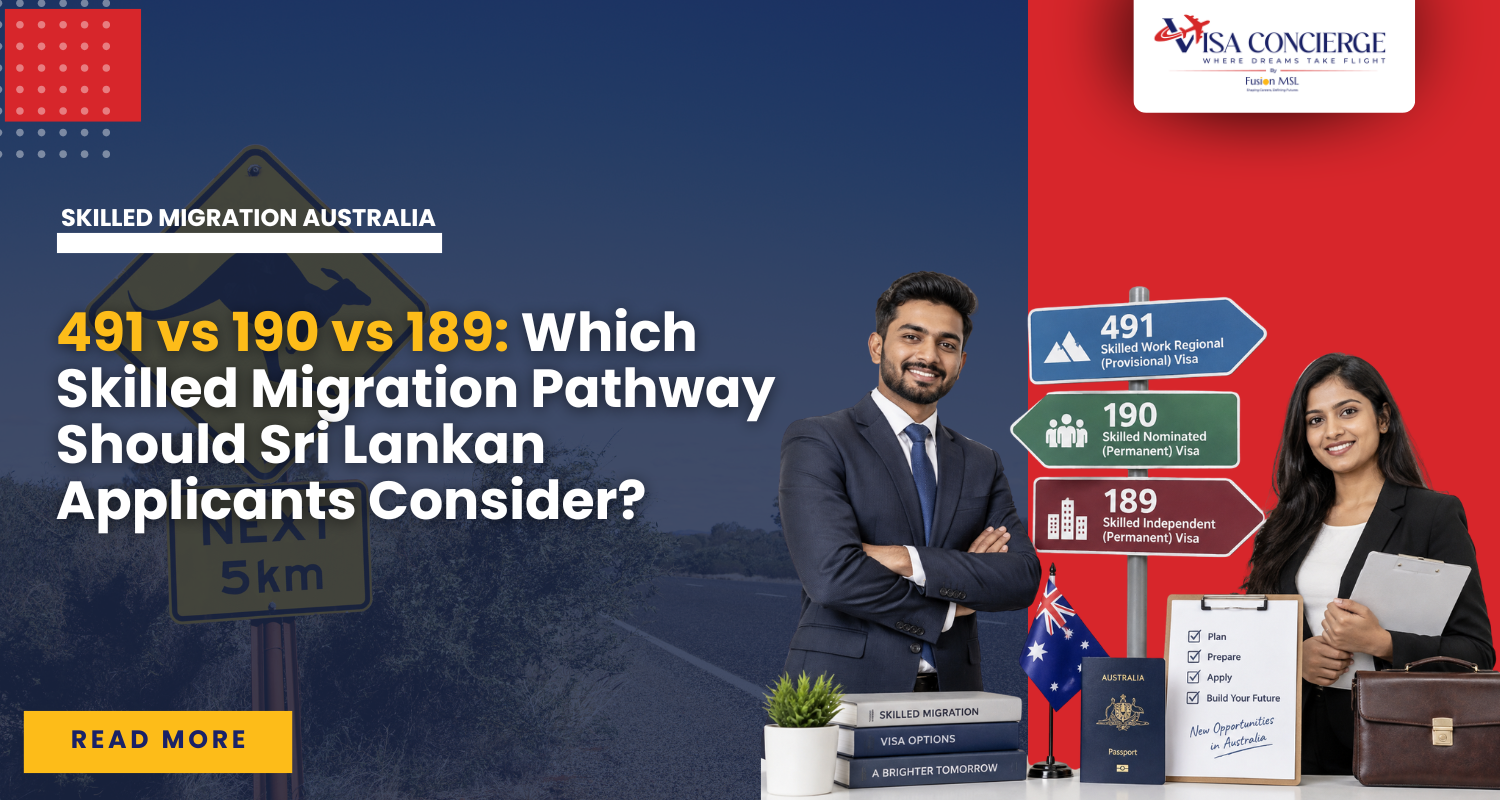
491 vs 190 vs 189: Which Skilled Migration Pathway Should Sri Lankan Applicants Consider?

If you are planning Australia skilled migration from Sri Lanka, you may have already come across three popular visa subclasses:

Subclass 189 Skilled Independent Visa

Subclass 190 Skilled Nominated Visa

Subclass 491 Skilled Work Regional Visa

At first, these pathways may look similar because they are all connected to skilled migration. But they are not the same.

Each pathway has a different purpose, different nomination requirements, different level of competition and different long-term planning approach.

This is where many applicants get confused.

Some applicants only want 189 because they hear it is independent. Some prefer 190 because it is a permanent visa. Some ignore 491 because it is regional, without properly understanding how it works.

But the right question is not, “Which visa is the best?”

The better question is:

“Which pathway is suitable for my profile?”

At Visa Concierge by Fusion MSL, we help Sri Lankan professionals review their profile, occupation, skills assessment pathway, English score, points and documents before deciding whether 189, 190 or 491 should be considered.

This article gives you a clear and simple comparison without making the process unnecessarily technical.

Why This Comparison Matters

Australia skilled migration is not a one-size-fits-all process.

Two applicants may have the same age and education level, but their pathway options can be very different because of their occupation, work experience, English score, points, family situation or state nomination possibilities.

For example, one applicant may have a strong profile for 189. Another may be more suitable for 190 because their occupation matches a state requirement. Another may have better opportunities through 491 because they are open to regional Australia.

This is why choosing a visa based only on what a friend did, what you saw online or what sounds attractive can be risky.

A skilled migration pathway should be selected after a proper profile review.

What Is the Subclass 189 Skilled Independent Visa?

The Subclass 189 Skilled Independent Visa is one of the most attractive Australia skilled migration pathways because it does not require state nomination, employer sponsorship or family sponsorship.

It is a permanent visa pathway for eligible skilled workers who receive an invitation to apply.

Many Sri Lankan applicants like the 189 visa because it offers more flexibility compared to nomination-based or regional pathways.

However, because it is independent, it can also be highly competitive.

To consider the 189 pathway, applicants usually need a strong overall profile. This may include a suitable occupation, positive skills assessment, strong English results, accurate documents and competitive points.

The 189 visa may be suitable for applicants who have a strong skilled migration profile and can compete without depending on state or regional nomination.

But it is important to remember that wanting 189 and being competitive for 189 are not the same thing.

What Is the Subclass 190 Skilled Nominated Visa?

The Subclass 190 Skilled Nominated Visa is a permanent skilled migration pathway that requires nomination by an Australian state or territory.

This means your profile must not only meet general skilled migration requirements, but also match the nomination requirements of a state or territory.

For many Sri Lankan applicants, 190 can be a strong pathway because it allows them to explore state nomination opportunities based on occupation demand and profile suitability.

However, state nomination is not automatic. Each state or territory can have its own criteria. These may change depending on occupation demand, available places, applicant location, work experience, English score and other requirements.

The 190 pathway may be suitable for applicants whose occupation and profile are attractive to a specific state or territory.

This is why proper state nomination research and pathway planning are important before moving forward.

What Is the Subclass 491 Skilled Work Regional Visa?

The Subclass 491 Skilled Work Regional Visa is a provisional regional skilled migration pathway.

It is usually connected to state or territory nomination, or sponsorship by an eligible family member living in a designated regional area of Australia.

Some applicants hesitate when they hear the word “regional.” But regional Australia does not always mean remote or isolated. Many regional areas include developed cities and growing communities with education, healthcare, employment and lifestyle opportunities.

The 491 visa is not a direct permanent visa like 189 or 190. However, it can support a long-term permanent residence pathway if the applicant meets the relevant conditions later.

For Sri Lankan applicants who are open to living and working in regional Australia, 491 can be a practical option to review.

It should not be dismissed without checking whether your profile fits the pathway.

189 vs 190 vs 491: Simple Comparison

Here is a simple way to understand the difference.

Subclass 189

This is an independent skilled visa pathway.

It does not require state nomination or family sponsorship. It is permanent, but it can be very competitive. It may suit applicants with strong points, suitable occupations and strong overall profiles.

Subclass 190

This is a state-nominated skilled visa pathway.

It is permanent, but you need nomination from an Australian state or territory. It may suit applicants whose occupations and profiles match state requirements.

Subclass 491

This is a regional skilled visa pathway.

It is provisional and requires regional commitment. It may suit applicants who are open to regional Australia and want to build a long-term skilled migration plan.

Which Visa Is Better?

There is no single answer.

The 189 visa may sound attractive because it is independent. But if your points are not competitive, waiting only for 189 may not be the best strategy.

The 190 visa may be strong if your occupation matches state nomination requirements. But if no suitable state option is available, it may not be realistic at that time.

The 491 visa may be practical if you are open to regional Australia. But it requires understanding the conditions and planning for the long term.

So instead of asking which visa is better, ask:

  • Which pathway fits my occupation?
  • Which pathway matches my points score?
  • Which pathway is realistic for my English level?
  • Which pathway supports my family plan?
  • Which pathway gives me a better chance based on my profile?
  • Which pathway can I support with proper documents?

This is where professional guidance can help.

Why Occupation Comes First

Before comparing 189, 190 and 491, your occupation must be reviewed properly.

Your job title alone is not enough.

Australian skilled migration looks at your actual duties, qualifications, work experience and supporting documents.

For example, two people may both work in IT, but one may be closer to Software Engineer while another may be closer to ICT Business Analyst or Developer Programmer.

Similarly, someone with a management title may not automatically fit a management occupation. Someone working in construction may need to check whether their profile matches an engineering, technician, trade or project-related occupation.

If your occupation is not matched correctly, your entire skilled migration plan can be affected.

That is why Visa Concierge usually starts with a profile and occupation review before discussing which visa pathway may be suitable.

Why Skills Assessment Matters

A skills assessment is an important step in many Australia skilled migration pathways.

The relevant assessing authority reviews whether your education and work experience support your nominated occupation.

For Sri Lankan applicants, this stage needs careful preparation. Employment letters, salary evidence, EPF/ETF records, academic documents, job duties and work experience claims should be consistent.

A weak skills assessment plan can delay the process or affect your pathway.

Before deciding whether to focus on 189, 190 or 491, applicants should understand whether their skills assessment pathway is realistic.

English Score Can Change the Strategy

English is not just a requirement. It can affect your skilled migration points and overall competitiveness.

Many Sri Lankan applicants delay English preparation because they think they can do it later. But this can slow down the whole process.

A stronger English score may improve your points and open better planning options. A lower score may mean you need to improve first before submitting an EOI or reviewing nomination pathways.

This is why English planning should start early.

At Visa Concierge, we encourage applicants to look at English as part of the full strategy, not as a last-minute step.

Points Are Important, But They Are Not Everything

The 189, 190 and 491 pathways are points-based.

Points may come from age, English, education, work experience, partner factors and other eligible factors.

However, one common mistake is thinking that reaching the minimum points is enough.

It is not.

Your points must be accurate and supported by documents. You must also consider competition, occupation demand, state nomination options and invitation trends.

Some applicants overestimate their points by assuming they can claim work experience or partner points without proper evidence.

This can create problems later.

A realistic points review is always better than an inflated score.

EOI Is Not a Visa Application

For 189, 190 and 491 pathways, applicants usually submit an Expression of Interest through SkillSelect.

Many applicants misunderstand this stage.

An EOI is not the same as a visa application. It is your way of showing interest and presenting your skilled migration profile for possible invitation.

If your EOI is not prepared properly, your claims may not reflect your real profile. If you receive an invitation, you must be able to prove what you claimed.

This is why applicants should avoid submitting an EOI blindly.

A good EOI strategy should be based on proper occupation matching, skills assessment, English score, points calculation and pathway review.

Why Some Applicants Should Not Focus Only on 189

The 189 visa is attractive, but it may not be realistic for every applicant.

Some Sri Lankan applicants spend months waiting for an independent pathway without checking whether 190 or 491 may be more suitable.

This can waste valuable time.

If your occupation has limited independent invitation chances, or your points are not competitive enough, it may be better to review state nomination or regional options.

This does not mean giving up on 189. It means being practical.

A smart migration plan should compare all suitable options instead of depending on only one pathway.

Why Some Applicants Should Not Choose 190 Without Research

The 190 visa is a strong permanent pathway, but it depends on state or territory nomination.

Not every occupation is in demand in every state. Not every applicant will meet state requirements.

Some applicants assume they can choose any state and apply. But the reality is more detailed than that.

Each state may have different rules, occupation lists, work experience requirements, English expectations and nomination priorities.

Before planning a 190 strategy, you should review whether your profile matches suitable state options.

Why Some Applicants Should Not Ignore 491

The 491 visa is sometimes misunderstood.

Because it is provisional and regional, some applicants reject it immediately. But for certain profiles, 491 may be a practical pathway.

If you are open to living and working in regional Australia, and your profile matches nomination or sponsorship requirements, 491 may be worth considering.

The key is to understand the conditions properly.

It should not be selected carelessly, and it should not be rejected blindly.

Common Mistakes Sri Lankan Applicants Make

Many applicants make mistakes because they start without a proper strategy.

Common mistakes include:

  • Choosing a visa based on what a friend applied for
  • Selecting the wrong occupation
  • Overestimating points
  • Delaying English preparation
  • Starting skills assessment without checking the full pathway
  • Submitting an EOI without proper review
  • Ignoring state nomination rules
  • Rejecting 491 without understanding regional options
  • Using weak employment documents
  • Trying to manage the process alone without guidance

These mistakes can lead to delays, wasted money and wrong expectations.

What Visa Concierge Reviews Before Recommending a Pathway

At Visa Concierge by Fusion MSL, we do not recommend a visa pathway only because it sounds popular.

We review your profile first.

This may include:

  • Your age
  • Your occupation
  • Your qualifications
  • Your work experience
  • Your English test status
  • Your points estimate
  • Your spouse or family details
  • Your skills assessment direction
  • Your employment documents
  • Your state nomination possibilities
  • Your willingness to consider regional Australia
  • Your long-term migration goal

After reviewing these areas, we can discuss whether 189, 190 or 491 may be suitable.

This helps applicants avoid confusion and make a more informed decision.

How Visa Concierge Can Help

Australia skilled migration can feel confusing, especially when different people give different advice.

One person may say 189 is the best. Another may say 190 is easier. Another may say 491 is the only option.

But your pathway should not be decided by general opinions.

It should be decided by your profile.

Visa Concierge by Fusion MSL helps Sri Lankan professionals understand their Australia skilled migration options in a structured and realistic way.

Our assistance may include:

  • Initial profile review
  • Occupation matching guidance
  • 189, 190 and 491 pathway comparison
  • Skills assessment document guidance
  • Points calculation discussion
  • English test planning guidance
  • EOI preparation support
  • State or territory nomination guidance where applicable
  • Family document planning
  • Coordination with qualified migration professionals where required

We do not give false promises or guaranteed outcomes.

Our goal is to help clients understand their real options before they spend money on the wrong process.

Final Thoughts

The 189, 190 and 491 visas are all important Australia skilled migration pathways.

But the best pathway depends on your profile.

The 189 visa may be suitable for strong independent skilled migration profiles.

The 190 visa may be suitable for applicants who match state nomination requirements.

The 491 visa may be suitable for applicants who are open to regional Australia and long-term planning.

For Sri Lankan applicants, the most important step is not choosing the visa name first.

The most important step is understanding your occupation, points, skills assessment, English score, EOI strategy and document strength.

A proper pathway review can save time, reduce mistakes and help you move forward with more confidence.

Planning Australia skilled migration from Sri Lanka?

Speak to Visa Concierge by Fusion MSL for a professional 189, 190 and 491 pathway review.

Call or WhatsApp: +94 77 962 9672

Website: www.visaconcierge.lk

Visa Concierge by Fusion MSL

Where your dreams take flight.

Frequently Asked Questions

1. What is the main difference between the 189, 190 and 491 visas?

Subclass 189 is an independent permanent skilled pathway, Subclass 190 is a state-nominated permanent pathway, and Subclass 491 is a provisional regional pathway connected to state or territory nomination or eligible family sponsorship.

2. Which visa is better: 189, 190 or 491?

There is no single best visa for everyone. The suitable pathway depends on your occupation, points, English score, skills assessment, state nomination possibilities, family circumstances and willingness to consider regional Australia.

3. Is the Subclass 189 visa more competitive?

Yes, it can be highly competitive because it does not rely on state nomination, employer sponsorship or family sponsorship. Applicants generally need a strong overall profile and competitive points.

4. Is Subclass 190 a permanent visa?

Yes. Subclass 190 is a permanent skilled migration pathway that requires nomination by an Australian state or territory.

5. Is Subclass 491 a permanent visa?

No. Subclass 491 is a provisional regional skilled migration pathway. It can support a longer-term permanent residence plan if the relevant future requirements are met.

6. Why should occupation matching be reviewed before choosing a visa?

Australian skilled migration looks beyond job titles. Your actual duties, qualifications, work experience and supporting evidence need to support the nominated occupation.

7. Can Visa Concierge help compare 189, 190 and 491 for my profile?

Yes. Visa Concierge reviews your occupation, qualifications, work experience, English status, points, skills assessment direction, state nomination possibilities, family details, documents and regional preferences before discussing suitable pathways.

About the Reviewer

Nimesha Perera is a Senior Consultant – Skilled Migration and Student Visa Services at Visa Concierge by Fusion MSL. She supports clients with profile reviews, occupation and pathway discussions, skilled migration planning and document preparation.

Visa invitations and decisions are made by the relevant Australian authorities. Visa Concierge does not guarantee an invitation or visa approval.

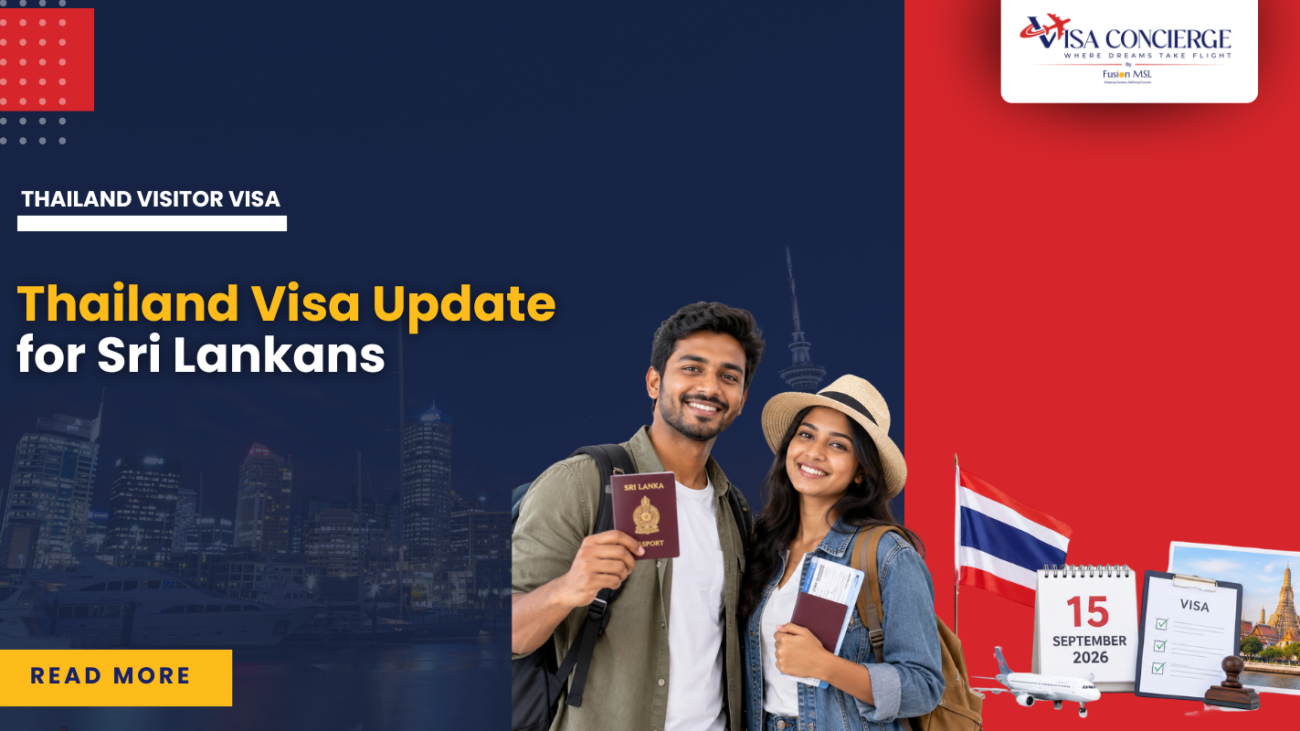
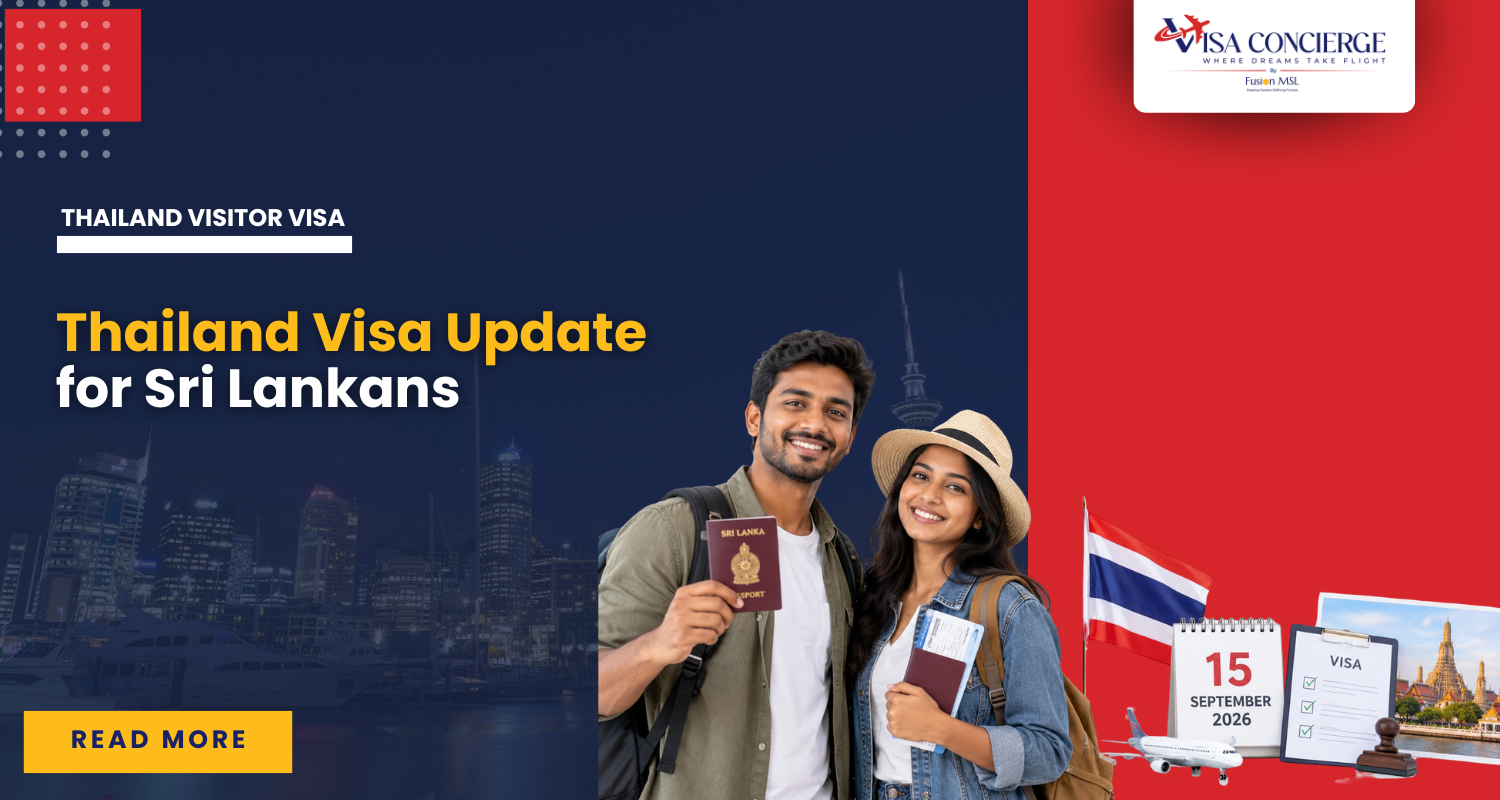
Thailand Visa Update for Sri Lankans

Thailand Visa Update for Sri Lankans: Visa Required from 15 September 2026

Last reviewed: 11 September 2026  |  Reviewed by: Nimesha Perera, Senior Consultant – Skilled Migration and Student Visa Services

Thailand Visa Update for Sri Lankans: Visa Required from 15 September 2026

Planning a holiday to Thailand from Sri Lanka? There is an important visa change you need to know before booking your trip.

From 15 September 2026, Sri Lankan ordinary passport holders travelling to Thailand will need to obtain a visa before travelling.

This means Sri Lankan travellers will no longer be able to rely on the previous visa-free entry arrangement for tourism under Thailand’s revised visa measures.

For Sri Lankans who regularly travel to Bangkok, Phuket, Krabi, Pattaya, Chiang Mai and other popular destinations, this is a significant change. But it does not mean travelling to Thailand has suddenly become complicated. It simply means your visa needs to become part of your travel preparation rather than something you think about at the airport.

What Has Changed for Sri Lankan Travellers to Thailand?

Thailand has revised its visa exemption and Visa on Arrival arrangements, with the new measures taking effect on 15 September 2026.

Under the revised rules, the previous 60-day visa exemption arrangement has been withdrawn and Thailand has introduced updated lists of nationalities eligible for its new visa-exemption schemes. Sri Lankan ordinary passport holders travelling for tourism will now need to obtain the appropriate Thai visa before departure.

In simple terms, if you hold a Sri Lankan ordinary passport and are planning to enter Thailand on or after 15 September 2026, you should arrange your visa before you travel.

This is particularly important for anyone planning upcoming holidays, family trips, group tours, honeymoon travel or short breaks to Thailand.

Do Sri Lankans Need a Visa for Thailand in 2026?

Yes.

From 15 September 2026 onwards, Sri Lankan ordinary passport holders travelling to Thailand for tourism should obtain a Thai visa before departure.

Previously, many Sri Lankan travellers could make their Thailand plans without going through a full visa application beforehand. That convenience changes under the new rules.

So, if Thailand is on your travel calendar for the coming months, do not leave the visa until the last moment.

How Can Sri Lankans Apply for a Thailand Visa?

The good news is that the application process is handled online.

Applicants who require a Thai visa must submit their applications through Thailand’s official e-Visa system. The Royal Thai Embassy in Colombo states that visa applications are no longer accepted through an in-person application process and that applications and relevant payments should be completed through the online system.

Applicants will generally need to complete their online application, provide the necessary travel and supporting documents and make the required visa payment.

The exact documents required can depend on your circumstances and the purpose of your visit. This is why it is important to prepare your application based on your individual travel profile rather than simply copying another traveller’s checklist.

How Long Does a Thailand Tourist Visa Take from Sri Lanka?

According to the Royal Thai Embassy in Colombo, tourist visa applications for Sri Lankan passport holders are generally processed within 3–7 working days from the date all required documents have been properly completed and submitted.

However, travellers should not treat seven working days as a guaranteed maximum.

The Embassy may request additional documentation or information when required, and applicants may also be asked to attend an interview on a case-by-case basis. These circumstances can increase the overall processing time.

For that reason, applying only a few days before your flight is not a good travel strategy.

If you already know your intended travel dates, start preparing early.

What If You Are Travelling to Thailand Before 15 September 2026?

There is an important distinction for travellers whose trips fall around the changeover date.

Thailand's Ministry of Foreign Affairs has confirmed that travellers who enter Thailand before 15 September 2026 under the existing visa exemption arrangements can continue to stay until the end of the permitted period shown on their immigration record or passport stamp.

In other words, the introduction of the new rules does not mean that someone who legally enters Thailand before the effective date suddenly becomes illegal on 15 September.

The important date is when you are entering Thailand.

If your arrival is on or after 15 September 2026, make sure you check the new visa requirement before travelling.

Why Is Thailand Changing Its Visa Rules?

The change affecting Sri Lankan travellers is part of a wider review of Thailand's visa policies rather than a change aimed only at Sri Lanka.

Thailand's Ministry of Foreign Affairs has explained that the review considered several factors, including national security, tourism and economic interests, reciprocity between countries, simplifying overlapping visa-exemption arrangements and the increased convenience of Thailand's e-Visa system.

Thailand remains one of the most popular destinations in Asia, and the new requirement does not prevent Sri Lankans from travelling there. It simply means there is now an additional step to complete before departure.

Planning a Thailand Holiday? Start With the Visa, Not the Suitcase

Thailand remains an easy destination to fall in love with.

Bangkok for shopping and nightlife. Phuket and Krabi for beaches. Chiang Mai for something quieter. Pattaya for a quick getaway. And, of course, Thai food is sometimes enough of a reason to book the ticket on its own.

The destination has not changed.

What has changed is the preparation required before getting on the plane.

If you are planning a Thailand trip after 15 September 2026, make your visa one of the first things on your checklist instead of leaving it until everything else has been booked.

A missing document, an incorrect application detail or a last-minute submission can create unnecessary stress, particularly when your flights and hotels have already been paid for.

Thailand e-Visa Assistance from Sri Lanka

If you are unsure about the new Thailand visa requirements for Sri Lankan passport holders, Visa Concierge can assist you with preparing and submitting your Thailand visa application.

Our team can review your travel plans and documentation, identify what is required for your application and guide you through the visa submission process.

Rather than trying to work everything out a few days before departure, getting your documents checked early gives you more time to address any issues before your intended travel date.

Planning to visit Thailand?

Contact Visa Concierge by Fusion MSL for assistance with your Thailand visitor visa application.

Call or WhatsApp: +94 77 962 9672

Website: www.visaconcierge.lk

Final Reminder for Sri Lankan Travellers

The biggest takeaway is simple:

Travelling to Thailand from 15 September 2026? Check and arrange your visa before you fly.

Thailand is still very much open for Sri Lankan travellers. There is simply a new visa step to complete before your holiday begins.

Preparing early can save you from unnecessary last-minute stress and give you more time to focus on the part that actually matters — enjoying your trip.

Visa requirements and procedures can change. Travellers should always check the latest instructions issued by the Royal Thai Embassy in Colombo and relevant Thai authorities before travelling.

Frequently Asked Questions

1. Is Thailand visa-free for Sri Lankans after 15 September 2026?

No. Under the revised Thailand visa measures, Sri Lankan ordinary passport holders travelling for tourism will need to obtain a visa before travelling from 15 September 2026 onwards.

2. Can Sri Lankans apply for the Thailand visa online?

Yes. Thailand operates an e-Visa system, and applicants who require visas can submit their applications online through the official Thai e-Visa platform.

3. How long does a Thailand tourist visa take for Sri Lankans?

The Royal Thai Embassy in Colombo currently states a processing period of approximately 3–7 working days for tourist visa applications from Sri Lankan passport holders once all required documents have been correctly submitted. Additional processing may be necessary in some cases.

4. Should I apply for my Thailand visa before booking my flight?

Your travel plans and visa application need to be coordinated carefully. Since processing can vary and additional documents may be requested, it is sensible to begin visa preparation early and avoid relying on a last-minute application.

5. What happens if I enter Thailand before 15 September 2026?

Travellers entering Thailand before the new measures take effect can continue their permitted stay according to the period granted when they entered the country.

About the Reviewer

Nimesha Perera is a Senior Consultant – Skilled Migration and Student Visa Services at Visa Concierge by Fusion MSL and reviews visa guidance prepared for Sri Lankan travellers.

Visa requirements and decisions are determined by the relevant Thai authorities. Visa Concierge does not guarantee visa approval.

Australia Skilled Migration CV Guide for Sri Lankan Applicants

Last reviewed: 8 September 2026  |  Reviewed by: Nimesha Perera, Senior Consultant – Skilled Migration and Student Visa Services

How to Prepare a Strong CV for Australian Skilled Migration

If you are planning Australia skilled migration from Sri Lanka, your CV is one of the first documents you should prepare properly.

Many applicants think a CV is only needed to apply for jobs. But in skilled migration planning, your CV plays a much bigger role.

It helps show your professional background, qualifications, work experience, career progression, job duties and possible occupation pathway. It can also help a consultant understand whether your profile may be suitable for pathways such as 189, 190, 491, 186 or 482.

At Visa Concierge by Fusion MSL, we often ask skilled migration clients to share their CV at the very beginning. This is not just for record purposes. It helps us understand your profile before discussing the most suitable direction.

A well-prepared CV can make the first stage of your migration journey clearer. A weak or confusing CV can create unnecessary doubts, delays and wrong assumptions.

Why Your CV Matters in Australia Skilled Migration

Australian skilled migration is not based only on your job title.

Your occupation, duties, qualifications, experience, skills assessment pathway, points, employer sponsorship options and documents must be reviewed together.

Your CV helps connect these areas.

For example, if you are planning a points-tested pathway such as 189, 190 or 491, your CV can help review your occupation direction, work history and possible skills assessment route.

This is why your CV should not be written casually. It should be clear, consistent and aligned with your actual professional experience.

A Migration CV Is Different from a Job-Hunting CV

A job-hunting CV is usually written to impress an employer quickly. It may highlight achievements, keywords and career goals.

A migration-focused CV should be more structured.

It should clearly explain:

  • What you studied
  • Where you worked
  • What roles you held
  • What duties you performed
  • How long you worked in each role
  • Whether your work was full-time or part-time
  • What technical or professional responsibilities you handled
  • Whether your experience supports a skilled occupation pathway

This does not mean your CV should be overloaded with unnecessary details. It means the right information should be presented clearly.

For migration planning, clarity is more important than fancy wording.

Start with a Clear Professional Summary

Your CV should begin with a short professional summary.

This section should explain who you are professionally, your industry background, years of experience and main areas of expertise.

For example, instead of writing something very general like:

“I am a hardworking and dedicated professional looking for growth opportunities,”

it is better to write something more specific, such as:

“Experienced finance professional with over six years of experience in accounting operations, financial reporting and audit coordination within the private sector.”

This gives a clearer picture of your background.

However, avoid exaggeration. Your summary should match the rest of your CV and supporting documents.

Mention Your Employment History Clearly

Your employment history is one of the most important parts of your CV.

For each role, include:

  • Company name
  • Job title
  • Employment period
  • Location
  • Full-time or part-time status, if relevant
  • Short company or department context, where helpful
  • Main duties and responsibilities
  • Key achievements, if relevant

The dates should be accurate. If there are gaps, overlapping roles or career changes, they should be presented clearly.

Many Sri Lankan applicants have worked in different roles, changed industries or had promotions within the same company. If this is not shown clearly, it can make the profile difficult to assess.

Your CV should help the reader understand your career journey without confusion.

Focus on Actual Duties, Not Just Job Titles

One of the biggest mistakes applicants make is listing only job titles.

For Australian skilled migration, your actual duties matter.

For example, a title such as “Executive,” “Manager,” “Coordinator,” “Analyst” or “Consultant” can mean different things depending on the company and industry.

A “Manager” in one company may handle strategic decision-making. In another company, the same title may involve mostly administrative tasks.

This is why your CV should explain what you actually did in each role.

Your duties should be truthful, specific and connected to your real work. Do not copy duties from the internet or from another person’s CV. If your duties are not genuine, they may not match your employment evidence later.

Keep Your Occupation Direction in Mind

A strong migration CV should make it easier to understand your possible occupation direction.

This does not mean you should force your CV to fit an occupation. It means your experience should be written accurately so that the correct occupation can be reviewed.

For example:

  • An IT applicant may need to show whether their work is closer to software development, business analysis, systems support, cybersecurity, networking or data.
  • An engineering applicant may need to show technical responsibilities, project involvement and industry exposure.
  • A finance applicant may need to show accounting, auditing, reporting, taxation or analytical duties.
  • A chef or hospitality applicant may need to show kitchen operations, menu planning, food preparation, team supervision or compliance-related duties.
  • A construction applicant may need to show site coordination, cost control, project planning, technical drawings, supervision or quantity-related duties.

Each profile is different. That is why occupation matching should be done carefully.

Include Your Education and Professional Qualifications

Your education section should include your academic and professional qualifications.

Mention:

  • Qualification name
  • Institution name
  • Country
  • Study period or completion year
  • Main area of study
  • Professional memberships or licences, if relevant

For Sri Lankan applicants, this may include university degrees, diplomas, higher national diplomas, NVQ qualifications, professional qualifications and industry certifications.

Do not leave out important qualifications simply because you think they are not relevant. A consultant can review whether they support your profile.

At the same time, avoid adding unrelated short courses that do not add value to your skilled migration profile.

Make Your CV Consistent with Your Documents

Your CV should match your supporting documents.

This is very important.

Your employment dates should match your employment letters. Your job titles should match your appointment or promotion letters. Your qualifications should match your certificates and transcripts. Your claimed experience should be supported by salary evidence, EPF/ETF records, bank statements or other relevant documents where applicable.

If your CV says one thing and your documents say something else, it can create confusion.

Before moving forward, check whether your CV is consistent with:

  • Employment reference letters
  • Appointment letters
  • Promotion letters
  • Salary slips
  • Bank statements
  • EPF/ETF records
  • Academic certificates
  • Transcripts
  • Professional qualification documents

This is one of the areas where Visa Concierge can help clients identify gaps before they proceed further.

Do Not Overcomplicate the CV

Some applicants think a longer CV is better.

That is not always true.

A strong CV should be detailed enough to explain your profile, but not so lengthy that the important information gets lost.

For most applicants, a clear and structured CV is better than a heavily designed document with too many graphics, colours or unnecessary personal details.

Avoid:

  • Overdesigned layouts
  • Long paragraphs without structure
  • Unclear job duties
  • Missing employment dates
  • Repeated responsibilities
  • Exaggerated claims
  • Unrelated personal information
  • Spelling and grammar mistakes
  • Inconsistent formatting
Your CV should be professional, easy to read and easy to review.

Common CV Mistakes Sri Lankan Applicants Make

1. Using a Generic CV for Every Purpose

A job application CV and a migration review CV are not always the same. For skilled migration, your CV should clearly show experience, duties, qualifications and occupation direction.

2. Not Explaining Duties Properly

Many applicants only list job titles and company names. This is not enough to understand whether the work experience supports a skilled occupation.

3. Adding Duties That Are Not True

Trying to make your CV look stronger by adding duties you did not perform can create problems later. Your CV should match your real work and documents.

4. Leaving Out Older Relevant Experience

Some applicants remove older experience because they think it is not important. But older skilled experience may still help understand your career pathway.

5. Not Showing Promotions Clearly

If you were promoted, your CV should show the different roles and periods clearly. Otherwise, your experience may look confusing.

6. Ignoring Employment Gaps

If there are gaps, career breaks or overseas work periods, they should be handled clearly and honestly.

7. Using Poor Grammar or Unclear Wording

Your CV is often the first document reviewed. Poor wording can make a strong profile look weak.

CV and Skills Assessment Planning

For many skilled migration pathways, skills assessment may be an important step.

Your CV can help identify which occupation and assessing authority may be relevant. It can also help identify what employment documents may be needed later.

However, a CV alone is not enough for a skills assessment. It should be supported by proper documents.

This is why applicants should not prepare a CV in isolation. It should be part of a complete profile review.

At Visa Concierge, we help applicants understand whether their CV, job duties and documents are moving in the same direction.

Should You Prepare the CV Yourself?

You can prepare your first CV yourself. In fact, it is helpful because you know your work history better than anyone else.

But before using it for skilled migration planning, it is better to have it reviewed professionally.

A consultant can help identify:

  • Whether your duties are clear
  • Whether your occupation direction is understandable
  • Whether your work experience is properly presented
  • Whether your education section is complete
  • Whether your documents may support the CV
  • Whether the CV creates any confusion
  • Whether your profile should be reviewed for 189, 190 or 491

This can save time before you spend money on the wrong step.

What to Send Visa Concierge for a CV Review

If you are planning Australia skilled migration, you can send us:

  • Your updated CV
  • A short summary of your current job duties
  • Your highest qualification details
  • Total years of work experience
  • Current English test status, if available
  • Spouse’s basic profile, if applicable
  • Any employer interest or job offer, if applicable
  • Your preferred migration goal

You do not need to know the correct pathway before contacting us. That is what the review is for.

Our role is to help you understand where your profile may stand and what next steps should be considered.

How Visa Concierge Can Help

At Visa Concierge by Fusion MSL, we help Sri Lankan professionals prepare for Australia skilled migration with a structured approach.

Our support may include:

  • Initial CV and profile review
  • Occupation matching discussion
  • Skilled migration pathway comparison
  • Skills assessment document guidance
  • Employment evidence checklist
  • English test planning guidance
  • EOI preparation support where applicable
  • Family document planning
  • Coordination with qualified migration professionals where required

We do not believe in giving false promises. We believe in helping clients understand their real options before they spend money on the wrong process.

A strong CV is often the first step. But the real value is in connecting that CV with your occupation, documents and migration pathway.

Final Thoughts

Your CV is more than a career document. For Australia skilled migration, it can be the starting point of your entire pathway review.

A well-prepared CV can help identify your occupation direction, skills assessment pathway, employment evidence gaps and possible visa options.

A weak CV can create confusion and lead to wrong assumptions.

If you are serious about Australia skilled migration from Sri Lanka, do not use a generic CV and hope for the best. Prepare it properly, review it carefully and connect it with the right migration strategy.

Planning Australia skilled migration from Sri Lanka?

Send your CV to Visa Concierge by Fusion MSL for a professional profile review and pathway discussion.

Call or WhatsApp: +94 77 962 9672

Website: www.visaconcierge.lk

Visa Concierge by Fusion MSL

Where your dreams take flight.

Frequently Asked Questions

1. Why is a CV important for Australian skilled migration?

It helps present your qualifications, work history, duties, career progression and possible occupation direction so your skilled migration profile can be reviewed more clearly.

2. Is a migration CV different from a job application CV?

Yes. A migration-focused CV should clearly show your education, employment periods, duties, responsibilities and how your experience may relate to a skilled occupation.

3. Should I copy occupation duties from the internet into my CV?

No. Your duties should truthfully reflect the work you actually performed and should be consistent with your supporting employment evidence.

4. What documents should match my CV?

Your CV should be consistent with employment reference letters, appointment and promotion letters, salary evidence, EPF or ETF records, bank statements, academic certificates and transcripts where applicable.

5. How long should a migration CV be?

There is no fixed length. It should be detailed enough to explain your profile clearly without unnecessary graphics, repeated content or unrelated personal information.

6. Can my CV help identify the right skilled occupation?

Yes. A properly prepared CV can help a consultant review your duties, qualifications and experience and discuss possible occupation directions as part of a full profile assessment.

7. Can Visa Concierge review my CV before I start the migration process?

Yes. Visa Concierge can review your CV and profile, discuss occupation direction, compare skilled migration pathways and identify possible document gaps before later stages.

About the Reviewer

Nimesha Perera is a Senior Consultant – Skilled Migration and Student Visa Services at Visa Concierge by Fusion MSL. She supports clients with profile reviews, occupation and pathway discussions, skilled migration planning and document preparation.

Visa invitations and decisions are made by the relevant Australian authorities. Visa Concierge does not guarantee an invitation or visa approval.

Bachelor’s Pathway After A/Ls to Canada | Guide for Sri Lankan Students

Last reviewed: 4 September 2026  |  Reviewed by: Priyadharshan, Head of Visa Concierge

Bachelor’s Pathway After A/Ls to Canada: Guide for Sri Lankan Students

Completing A/Ls is a major step for every Sri Lankan student. After results, many students and parents start thinking about the next stage: local higher education, private university options in Sri Lanka, or studying abroad.

For students who want international exposure, practical education and a globally recognised qualification, Canada is one of the countries many Sri Lankan families consider for bachelor’s studies.

However, studying in Canada after A/Ls is not only about selecting a course and applying online. Students need to understand the right study level, suitable institution, course direction, financial planning and student visa requirements before making a decision.

At Visa Concierge by Fusion MSL, we guide Sri Lankan students and parents through the Canada study process, from pathway selection to institution application guidance and student visa documentation support.

Why Do Sri Lankan Students Consider Canada After A/Ls?

Canada is popular among international students because of its recognised education system, multicultural environment and wide range of study options. For Sri Lankan students, Canada can be attractive because it offers bachelor’s degree programs, diplomas, pathway programs and career-focused study options in different provinces.

Students often consider Canada after A/Ls for reasons such as:

  • Quality education
  • International exposure
  • Multicultural student life
  • Bachelor’s and diploma pathways
  • Career-focused programs
  • Future study or work planning depending on eligibility

But Canada is also a country where students must plan carefully. The rules around study permits, institution selection and financial documents can change. That is why students should not choose a course only because it is popular or because a friend selected it.

Can Sri Lankan Students Study in Canada After A/Ls?

Yes. Sri Lankan students can apply to study in Canada after completing A/Ls if they meet the academic, English language, financial and visa requirements.

Students must usually apply to a Designated Learning Institution, also known as a DLI. A DLI is an institution approved by a Canadian provincial or territorial government to host international students. IRCC states that if a student applies for a study permit with a letter of acceptance from an institution that is not designated for international students, the application will be refused.

This makes institution selection very important. Before applying, students should check whether the selected institution is suitable for international study and future planning.

Main Study Options After A/Ls

After A/Ls, Sri Lankan students may have several study options in Canada depending on their results, subject stream, budget and long-term goals.

1. Bachelor’s Degree Programs

A bachelor’s degree is a common option for students who want a full undergraduate qualification in Canada.

Students may explore bachelor’s programs in areas such as:

Business, Accounting, Finance, Marketing, Computer Science, Information Technology, Engineering, Psychology, Health Sciences, Hospitality, Tourism, Environmental Studies, Data Analytics and Social Sciences.

Bachelor’s degrees are suitable for students who have a clear academic direction and want to build a strong foundation for future career or postgraduate studies.

2. Diploma or Advanced Diploma Programs

Some students consider diploma or advanced diploma programs after A/Ls, especially when they want more practical and career-focused education.

These programs may be available in areas such as:

Business Administration, Computer Programming, Hospitality Management, Early Childhood Education, Supply Chain, Design, Healthcare Administration and Engineering Technology.

However, students should not choose a diploma only because it looks affordable or easier. The program should match the student’s education background, future goals and visa profile.

3. Pathway or Foundation Options

Some students may need a pathway program before entering a full bachelor’s degree, depending on academic results, English level or course requirements.

Pathway options should be reviewed carefully because progression rules, total study duration and costs can differ from one institution to another.

This is one area where professional guidance is very important, especially for students and parents comparing multiple offers.

---

How to Choose the Right Program After A/Ls

Choosing the right program is one of the most important parts of the Canada study journey.

Students should ask:

  • Does this course match my A/L stream?
  • Does it support my future career goal?
  • Is the institution suitable for international students?
  • Can my family manage the full cost?
  • Does the program make sense for my study permit application?
  • Does it support my future academic or career direction?

For example, a student from the Commerce stream may look at Business, Accounting, Finance, Marketing or Supply Chain. A student from the Maths stream may consider IT, Computer Science, Engineering Technology, Data Analytics or Business Analytics. A Science stream student may explore Health Sciences, Psychology, Biotechnology, Public Health or related fields depending on eligibility.

The course should not be selected only based on trend. It should create a logical and genuine study plan.

Why DLI Selection Matters

In Canada, institution selection is very important because students usually need a letter of acceptance from a DLI before applying for a study permit. IRCC explains that a study permit is the document issued to foreign nationals allowing them to study at designated learning institutions in Canada.

Students should be careful when selecting a college or university. The institution, program, location and future pathway should be reviewed before accepting an offer.

At Visa Concierge, we help students and parents understand the importance of choosing the right institution instead of applying randomly.

Understanding PAL/TAL for Canada Study Permits

Many Canada study permit applicants may need a Provincial Attestation Letter or Territorial Attestation Letter, commonly known as PAL or TAL.

IRCC explains that a PAL/TAL is a letter from the province or territory where the student plans to study, confirming there is a space for the student under that province or territory’s allocation. The official IRCC page also notes validity details for the 2026 study permit cap year.

Students should not leave this stage until the last moment. PAL/TAL requirements can affect the overall application timeline, so students should begin early and follow the correct process through the institution.

Financial Planning for Canada Studies

Studying in Canada requires proper financial planning. Students and parents should understand the full cost before applying.

This may include tuition fees, living expenses, accommodation, travel, insurance, visa-related costs and other personal expenses.

IRCC’s financial support guidance explains that study permit applicants must show they meet financial capacity requirements. It lists accepted types of financial evidence such as bank documents, education loans and scholarship evidence, depending on the student’s situation.

For Sri Lankan families, this stage should not be rushed. Sudden fund arrangements, unclear sources or incomplete financial explanations can create concerns during visa preparation.

At Visa Concierge, we guide families on financial document preparation in a structured way without making students guess what to submit.

Can Students Work While Studying in Canada?

Many Sri Lankan students and parents ask about part-time work in Canada.

Canada allows eligible international students to work off campus if they meet the required conditions. IRCC states that eligible students may work up to 24 hours per week off campus while classes are in session, and full-time during regular scheduled breaks if they meet the criteria.

However, students should not depend fully on part-time work to fund their education. Canada’s immigration regulations require students to have sufficient and available financial resources without relying on work in Canada.

Part-time work can support student exposure and experience, but the main financial plan should be prepared before applying.

Student Visa Planning After A/Ls

A Canada study permit application is not just a form submission. The student’s course, institution, funds, academic history and future intention should all connect clearly.

Students should be ready to explain why they selected Canada, why the chosen program is suitable, how it connects to their A/L background and future goals, and how they will manage their studies financially.

This is why applying through proper guidance is important. A weak course choice or unclear financial plan can affect the strength of the overall application.

Common Mistakes Sri Lankan Students Should Avoid

Many students make mistakes because they start without a proper plan.

Common mistakes include choosing a course only because a friend chose it, selecting the cheapest option without checking future relevance, ignoring DLI importance, misunderstanding PAL/TAL, depending too much on part-time work, waiting too long to prepare funds, and applying without checking whether the course fits the student’s background.

A Canada study application should not be rushed. It should be planned carefully from the beginning.

When Should Students Start?

Students planning to study in Canada after A/Ls should start as early as possible, ideally several months before the intended intake.

Early planning gives students more time to compare institutions, check course suitability, prepare documents, arrange finances, understand PAL/TAL requirements and prepare the study permit application properly.

Late planning can reduce options and create unnecessary stress for both students and parents.

Why Choose Visa Concierge?

At Visa Concierge by Fusion MSL, we help Sri Lankan students and parents understand the Canada bachelor’s pathway after A/Ls.

Our support includes:

  • Student profile assessment
  • Course and pathway guidance
  • DLI selection guidance
  • Institution application support
  • Offer process guidance
  • Financial document guidance
  • PAL/TAL process guidance where applicable
  • Canada study permit documentation support

Our goal is to help students make informed decisions before investing in their education abroad.

Canada can be a strong option, but the right pathway depends on the student’s individual profile.

Are Students at Public–Private Partnership Colleges in Canada Eligible for a PGWP?

For many Sri Lankan students planning to study in Canada, the opportunity to obtain a Post-Graduation Work Permit (PGWP) is an important consideration. However, not every Canadian college, campus or study program leads to PGWP eligibility.

One area that often causes confusion is studying through a public–private partnership, commonly known as a PPP college arrangement.

What is a public–private partnership college program?

Under this arrangement, a public college licenses its curriculum to a private college. Students normally attend classes at the private college campus but may receive a qualification connected to the public institution.

Although the qualification may carry the name of a public college, this does not automatically make the student eligible for a PGWP.

Are PPP college graduates eligible for a PGWP?

According to Immigration, Refugees and Citizenship Canada (IRCC), students who began a college program delivered through a public–private curriculum licensing arrangement after May 15, 2024, are generally not eligible for a Post-Graduation Work Permit.

The rule can be summarised as follows:

  • Students who started the PPP program on or before May 15, 2024, may still qualify for a PGWP if they meet all the other eligibility requirements.
  • Students who started the PPP program after May 15, 2024, are not eligible for a PGWP under this arrangement.
  • Separate rules and earlier cut-off dates may apply to certain programs delivered through partnerships between different provinces.

The important date is normally when the student began the study program—not simply the date they applied to the college or received the offer letter.

What about public universities and public colleges?

A student studying directly at an eligible public university or public college may qualify for a PGWP, but eligibility is not automatic.

The student must confirm:

  • Whether the institution is a Designated Learning Institution
  • Whether the specific program is PGWP-eligible
  • Whether the program is delivered at an eligible campus
  • Whether the student meets the applicable language requirement
  • Whether a field-of-study requirement applies
  • Whether all study, attendance and application requirements are satisfied

A college appearing on Canada’s DLI list does not necessarily mean that every course or campus operated under its name is eligible for a PGWP.

Why students must check before accepting an offer

Choosing a Canadian institution based only on tuition fees, location or the name of the awarding college can create serious problems later.

Before paying a deposit, students should verify the institution, program, delivery campus and PGWP status. Written confirmation from the institution may also be helpful, but the final decision on a PGWP application is made by IRCC.

If post-study work opportunities are part of your long-term plan, selecting the correct program from the beginning is essential.

Planning to study in Canada from Sri Lanka?

At Visa Concierge by Fusion MSL, we help Sri Lankan students evaluate their Canadian study options before proceeding with an application. Our guidance covers institution and program selection, admission preparation, study-permit documentation and the overall application process.

Final Thoughts

Studying in Canada after A/Ls can be a valuable opportunity for Sri Lankan students, but the process should be planned carefully.

The right pathway is not always the cheapest course or the most popular institution. It should match the student’s academic background, career goal, financial plan and study permit profile.

If you have completed A/Ls and are planning to study in Canada, start with a proper profile review before applying.

Start your Canada study journey with Visa Concierge today.

Call or WhatsApp: +94 77 962 9672

Visa Concierge by Fusion MSL

No. 14, Sir Baron Jayathilake Mawatha, Colombo 01

Website: www.visaconcierge.lk

Frequently Asked Questions

1. Can Sri Lankan students study in Canada after A/Ls?

Yes. Sri Lankan students can apply for bachelor’s, diploma, advanced diploma or pathway programs in Canada after A/Ls, depending on their academic results, English language ability, budget and the admission requirements of the selected institution.

2. Are Sri Lankan A/L qualifications accepted for Canadian bachelor’s programs?

Many Canadian institutions assess Sri Lankan A/L qualifications for undergraduate admission. However, entry requirements vary by institution and program, so students should confirm their eligibility before applying.

3. What is a DLI in Canada?

A DLI is a Designated Learning Institution approved by a Canadian provincial or territorial government to host international students. Students generally need a letter of acceptance from a DLI when applying for a Canada study permit.

4. What are PAL and TAL for Canada study permits?

PAL and TAL refer to a Provincial Attestation Letter or Territorial Attestation Letter. Many study permit applicants may need one from the province or territory where they plan to study, depending on the applicable requirements.

5. Can international students work while studying in Canada?

Eligible international students may work up to 24 hours per week off campus while classes are in session and may work full-time during regular scheduled breaks, subject to the applicable IRCC conditions.

6. Should I choose a diploma or a bachelor’s degree after A/Ls?

The better option depends on your academic background, career goals, budget, chosen field and overall study permit profile. Students should compare the program level, institution, future pathway and course relevance before making a decision.

7. Are students at public–private partnership colleges eligible for a PGWP?

Students who began a college program delivered through a public–private curriculum licensing arrangement after May 15, 2024 are generally not eligible for a Post-Graduation Work Permit under that arrangement. Students who began on or before that date may still qualify if they meet the other applicable PGWP requirements. Program, campus and institution eligibility should be checked carefully before accepting an offer.

8. Can Visa Concierge help with Canada study applications?

Yes. Visa Concierge by Fusion MSL supports Sri Lankan students with course and pathway guidance, DLI selection, institution applications, financial document preparation, PAL/TAL guidance where applicable, and Canada study permit documentation support.

About the Reviewer

Priyadharshan is the Head of Visa Concierge at Visa Concierge by Fusion MSL and supports students and families with international study pathway guidance, application planning and visa documentation coordination.

Admission, study permit and post-graduation work permit decisions are made by the relevant Canadian education providers and immigration authorities. Visa Concierge does not guarantee admission, visa approval or PGWP eligibility.

Sri Lanka Spouse and Dependent Visa Guide for Foreign Nationals

Sri Lanka Spouse Visa Guide | Dependent Visa Support for Foreign Families

Last reviewed: 3 September 2026  |  Reviewed by: Priyadharshan, Head of Visa Concierge

Sri Lanka Spouse and Dependent Visa Guide

Love, family, and relocation are deeply personal decisions. But when your family life involves two nationalities, immigration planning becomes just as important as travel planning.

If you are married to a Sri Lankan citizen, planning to relocate to Sri Lanka with your family, or already living in Sri Lanka and need to regularize your stay, you may need to understand the correct Sri Lankan spouse visa or dependent visa pathway.

This guide explains the basics in a simple way without overwhelming you with unnecessary details. If you need case-specific support, Visa Concierge can help you understand the right pathway and prepare the process properly.

What Is a Sri Lanka Spouse Visa?

A Sri Lanka spouse visa generally refers to a residence visa pathway available to a foreign national who is married to a Sri Lankan citizen.

Sri Lanka’s immigration framework includes residence visa categories for special purposes, and one of the recognised areas is family-related residence. The Department of Immigration and Emigration refers to “Family Members of a Sri Lankan” and includes spouse and dependants under the residence visa framework.

In simple terms, this pathway is designed to help eligible foreign spouses live legally in Sri Lanka with their Sri Lankan family member, subject to the correct application process, documents, and authority approval.

A spouse visa is not the same as a tourist visa. A tourist visa is usually for a temporary visit, while a spouse or family-based residence visa is connected to long-term family residence.

What Is a Sri Lanka Dependent Visa?

A dependent visa in Sri Lanka generally refers to a visa route where eligible family members are linked to a main applicant or sponsor.

Depending on the situation, dependents may include:

  • A foreign spouse
  • Dependent children
  • Family members connected to an eligible residence visa holder
  • Dependents of certain employment, investor, student, digital nomad, or family-based residence visa applicants

For example, Sri Lanka’s official residence visa fee page includes references to spouses and dependent children under several residence visa categories, showing that dependents may be considered in different family and residence contexts.

However, dependent eligibility is not automatic in every case. The correct route depends on the main applicant’s visa category, the family relationship, the child’s age or dependency position, and the current requirements at the time of application.

Who Should Consider a Sri Lanka Spouse or Dependent Visa?

You may need professional guidance on a Sri Lanka spouse or dependent visa if:

  • You are a foreign national married to a Sri Lankan citizen
  • You are planning to move to Sri Lanka with your Sri Lankan spouse
  • You are already in Sri Lanka and need to move from a short-stay visa to a family-based residence route
  • You have foreign children who need legal residence in Sri Lanka
  • You are an expatriate employee moving to Sri Lanka with your family
  • You are an investor, business owner, student, or digital nomad planning to bring dependents
  • You are renewing an existing family or dependent visa
  • Your family situation has changed through marriage, childbirth, relocation, separation, or other personal circumstances

Family visa matters can feel sensitive because they involve personal documents, marriage records, children, and long-term residence planning. That is why the process should be handled carefully and confidentially.

Spouse Visa vs Dependent Visa: What Is the Difference?

A spouse visa usually focuses on the relationship between a foreign spouse and a Sri Lankan citizen, or in some cases a spouse connected to another eligible residence visa holder.

A dependent visa is broader. It may apply to eligible family members who depend on a main applicant, such as a spouse or children connected to another visa route.

For example, a foreign spouse of a Sri Lankan citizen may follow one type of family residence pathway. But the spouse or child of a foreign employee, investor, student, or digital nomad may need to be assessed under a different dependent route linked to the main applicant’s visa category.

This is why it is important not to use a generic “family visa checklist” from the internet. The right pathway depends on your exact family structure and immigration position.

Can a Foreign Spouse Live in Sri Lanka Long-Term?

In many cases, yes. But the stay must be supported by the correct visa category and approval process.

A foreign spouse should not rely on repeated tourist visas if the real intention is to live in Sri Lanka with family. A visit visa is for short-term purposes, while long-term family residence normally requires the appropriate residence visa pathway.
Sri Lanka Immigration describes a residence visa as a permit for non-Sri Lankans to obtain residence facilities for special purposes.

If your purpose is family residence, the visa route should reflect that purpose clearly.

Can Dependent Children Stay in Sri Lanka?

Dependent children may be eligible for a Sri Lanka dependent visa depending on the family situation and the main applicant’s visa route.

This may apply where:

  • A foreign spouse of a Sri Lankan citizen has dependent children
  • A foreign employee relocates to Sri Lanka with family
  • An investor or business applicant includes eligible family members
  • A student, digital nomad, or other residence visa holder has eligible dependents
  • A child of Sri Lankan parents holds a foreign passport

Sri Lanka’s visa fee page separately refers to dependent children of a non-Sri Lankan spouse and children of Sri Lankan parents holding foreign passports, indicating that child residence situations may be assessed under specific residence visa categories.

Because children’s cases can involve birth records, parentage, custody, nationality, and travel status, families should get guidance before applying or renewing.

Can a Foreign Spouse Work in Sri Lanka?

This is one of the most common questions foreign spouses ask.

The answer depends on the specific visa category, approval conditions, and the applicant’s circumstances. Some spouse-related residence categories may refer to employment approval, but that does not mean every foreign spouse automatically receives unrestricted work permission.

Sri Lanka’s official visa fee page refers to certain spouse-related residence visa classes connected with employment approval, which shows that work permission can be a separate and case-specific issue.

If you are a foreign spouse planning to work, freelance, start a business, or support a family business in Sri Lanka, it is important to check your visa conditions before taking action.

At Visa Concierge, we help clients understand the difference between family residence, employment approval, business activity, and long-term stay planning.

Why Family Visa Applications Need Careful Handling

Family visa applications are not just administrative forms. They often involve personal circumstances that need to be presented clearly and respectfully.

A small inconsistency can create delays or additional questions. For example:

  • Names may appear differently across passports and certificates
  • Marriage records may have been issued overseas
  • Children may hold a different nationality from one or both parents
  • The applicant may already be in Sri Lanka under another visa category
  • A renewal may need updated relationship or residence evidence
  • A family may be planning to relocate permanently but still be using short-term visas

These are not always “problems,” but they need to be managed properly.

That is why many families prefer to work with a visa consultancy instead of trying to interpret the process alone.

Common Documentation Considerations

The required documents for a Sri Lanka spouse or dependent visa can vary depending on the applicant’s nationality, relationship type, current visa status, residence category, and the latest authority requirements.

Visa Concierge helps families review the situation first and then prepare the required document pathway according to the correct visa category.

This keeps the process more organised and reduces the risk of submitting an incomplete or unsuitable file.

First-Time Application vs Renewal

A first-time family or spouse visa application is usually focused on proving the relationship, confirming eligibility, and matching the applicant’s purpose of stay with the correct visa category.

A renewal is different. It may involve confirming that the applicant still meets the conditions of the visa, that the family situation remains valid, and that the residence purpose continues.

Families sometimes make the mistake of thinking renewal is automatic because the first visa was approved. In reality, renewals still need proper timing, updated information, and careful preparation.

If your spouse or dependent visa is approaching expiry, it is better to plan early instead of waiting until the last few days.

Why You Should Not Depend Only on Online Information

Online information can be useful, but it is not enough for family immigration planning.

Visa categories, document expectations, fees, government procedures, and interpretation of requirements can change from time to time. Even when the general category remains the same, the way your personal situation is assessed may differ.

This is especially important for:

  • Mixed-nationality marriages
  • Foreign documents
  • Children with foreign passports
  • Long gaps in residence
  • Previous visa issues
  • Dependents linked to employment or investment visas
  • Applicants already in Sri Lanka on a different visa
  • Families planning future work, study, or business activity

A search result can tell you the general topic. It cannot assess your family situation.

How Visa Concierge Supports Spouse and Dependent Visa Cases

At Visa Concierge, we understand that family visa matters are personal. Our role is to make the process clearer, more organised, and less stressful for the applicant and the family.

We assist with:

  • Family visa pathway assessment
  • Spouse and dependent visa guidance
  • First-time application planning
  • Renewal planning
  • Document preparation guidance
  • Confidential document review
  • Coordination support with relevant authorities
  • Guidance for foreign spouses already in Sri Lanka
  • Support for families relocating to Sri Lanka
  • Dependent planning for employment, investor, student, digital nomad, and residence visa cases

We do not just look at the visa form. We look at the full situation such as the relationship, purpose of stay, dependent needs, timing, and possible renewal pathway.

When Should You Contact Visa Concierge?

You should speak to Visa Concierge if:

  • You are married to a Sri Lankan citizen and want to live in Sri Lanka
  • Your foreign spouse is already in Sri Lanka and needs visa guidance
  • Your child holds a foreign passport and needs residence support
  • You are relocating to Sri Lanka with your spouse or dependents
  • You are unsure whether to apply under a spouse, family, dependent, employment, investor, student, or another residence category
  • Your current visa is expiring soon
  • You want your case reviewed before approaching the authorities
  • Your family documents were issued overseas and you are unsure how to proceed
The earlier you get guidance, the easier it is to plan the correct route.

Frequently Asked Questions

Can a foreign spouse apply for residence in Sri Lanka?

A foreign spouse married to a Sri Lankan citizen may be eligible to apply under the relevant family residence pathway, subject to the correct conditions and current authority requirements. The official residence visa framework includes family members of a Sri Lankan, including spouse and dependents.

Is a spouse visa the same as a tourist visa?

No. A tourist visa is for a short-term visit. A spouse or family-based residence route is generally connected to longer-term family residence in Sri Lanka.

Can children apply as dependents?

Dependent children may be eligible depending on the family situation, nationality, age, and the main applicant’s visa route. Child-related cases should be reviewed carefully before submission.

Can a foreign spouse work in Sri Lanka?

Work permission depends on the specific spouse visa category and approval conditions. A foreign spouse should not assume automatic work rights without checking the visa conditions first.

How long does the process take?

The timeline can vary depending on the visa route, documents, current authority process, and whether additional clarification is requested. Visa Concierge can guide you on realistic planning after reviewing your case.

Can Visa Concierge help if I am already in Sri Lanka?

Yes. Visa Concierge supports foreign spouses and dependents who are already in Sri Lanka, as well as families planning to move to Sri Lanka from overseas.

Final Thoughts

A Sri Lanka spouse or dependent visa is more than a visa category. It is about helping families stay together legally, confidently, and with the right long-term plan.

Whether you are a foreign spouse of a Sri Lankan citizen, a parent planning your child’s residence, or an expatriate family relocating to Sri Lanka, the right visa pathway matters.

The safest first step is not to guess. It is to understand your category, prepare your case properly, and get guidance before applying.

Need support with a Sri Lanka spouse or dependent visa?

Speak to Visa Concierge for confidential family visa guidance.

Call or WhatsApp: +94 77 962 9672

Visa Concierge by Fusion MSL

Your Journey, Our Priority.

About the Reviewer

Priyadharshan is the Head of Visa Concierge at Visa Concierge by Fusion MSL and supports clients with Sri Lanka residence visa pathway guidance, application planning and document coordination.

Visa decisions are made by the relevant Sri Lankan authorities. Visa Concierge does not guarantee visa approval.

Sri Lanka Student Visa Guide for Foreign Students

Sri Lanka Student Visa Guide | Student Residence Visa for Foreign Students

Last reviewed: 2 September 2026  |  Reviewed by: Priyadharshan, Head of Visa Concierge

Sri Lanka Student Visa Guide for Foreign Students

Studying in another country is exciting, but it also comes with important visa responsibilities.

If you are a foreign student planning to study in Sri Lanka, your visa should match your purpose of stay. A short-term visit visa may be suitable for tourism, family visits, or temporary travel, but it is not always the correct option when your main purpose is education.

Sri Lanka has a student-related residence visa pathway for eligible foreign students. This can apply to students attending approved educational institutions, training programmes, internships, volunteer programmes, or other recognised study-related purposes, depending on the case.

Many students and parents search online for terms like Sri Lanka student visa, study in Sri Lanka visa, student residence visa Sri Lanka, or visa for foreign students in Sri Lanka. But the right answer depends on the student’s nationality, institution, course, duration, current visa status, and the latest authority requirements.

This guide explains the basics in a simple way, while helping you understand when professional visa support can make the process easier.

What Is a Sri Lanka Student Visa?

A Sri Lanka Student Visa generally falls under the Residence Visa – Student Category.

Sri Lanka Immigration describes a residence visa as a permit issued to a non-Sri Lankan foreign national to obtain residence facilities for a special purpose. The official general visa information also lists a Student Category under residence visas, including students in educational institutions approved by the government.

In simple terms, if your main reason for staying in Sri Lanka is study, training, internship, volunteering, or an education-related activity, your visa pathway should be assessed under the correct student or education-related route.

This is different from entering Sri Lanka only for sightseeing, visiting friends, attending a short event, or temporary travel.

Who May Need a Sri Lanka Student Visa?

A Sri Lanka student visa may be relevant for foreign nationals who are planning to study, train, intern, or participate in an approved education-related programme in Sri Lanka.

This may include:

  • International students joining Sri Lankan universities
  • Students enrolling in approved educational institutions
  • Foreign students joining recognised training programmes
  • Internship holders
  • Volunteers connected to approved programmes
  • Students moving from a short-term visa to a longer study-related stay
  • Education institutions recruiting foreign students into Sri Lanka

The correct visa pathway can depend on the institution, programme type, course duration, student background, and current immigration requirements.

That is why foreign students, parents, and institutions should get proper guidance before starting the process.

Student Visa vs Tourist Visa: Why the Difference Matters

A tourist visa is usually for temporary travel purposes such as holidays, sightseeing, visiting friends or relatives, medical visits, sports activities, or cultural activities.

A student visa is different because the purpose of stay is education.

This distinction matters because your visa purpose should match what you are actually doing in Sri Lanka. If you are coming to study, attend a long-term course, complete an internship, or remain in Sri Lanka as a foreign student, using the wrong visa category can create issues later.

Those issues may include delays, questions during the process, problems with renewal, or confusion between the student, institution, and authorities.

At Visa Concierge, we help students and institutions assess the right pathway before the application moves forward.

Can Foreign Students Study in Sri Lanka?

Yes, foreign students can study in Sri Lanka through the correct institution and visa pathway.

Sri Lanka can be an attractive destination for university studies, professional programmes, training, internships, language learning, research, volunteer-based learning, and specialised academic pathways.

However, students should make sure that the institution, programme, and intended stay are suitable for the correct visa category. The official immigration framework recognises student-related residence visa categories, including students in educational institutions approved by the government.

This is why students should not rely only on general online information. The correct route can depend on the type of institution, the programme duration, the student’s background, and the current process followed by the relevant authorities.

What Types of Study Purposes May Be Considered?

Student visa planning may apply to different education-related purposes, such as:

  • University degree programmes
  • Postgraduate studies
  • Professional education programmes
  • Approved institutional study
  • Training programmes
  • Internships
  • Volunteer-related educational placements
  • Exchange or academic mobility programmes

The official residence visa information refers to the education/student category and includes university students, students in government-approved educational institutions, volunteers, and internship holders.

However, every case should be reviewed carefully. A short programme, a university degree, an internship, and a volunteer placement may not follow the same process.

Why Parents Should Plan the Student Visa Early

For parents, the visa process is often one of the most stressful parts of sending a child to another country.

The student may already be focused on the course, accommodation, travel dates, and settling into a new environment. But the visa side should be handled carefully before the student begins their academic journey.

Parents should think about:

  • Whether the student’s visa category matches the course
  • Whether the institution is suitable for the visa route
  • Whether the intended stay period is clear
  • Whether renewal may be needed later
  • Whether the student is already in Sri Lanka under another visa category
  • Whether the student needs support during the process

At Visa Concierge, we work with students, parents, and institutions to make this process clearer and more organised.

Why Education Institutions Should Support Student Visa Planning

For universities, colleges, training providers, and educational institutions, foreign student visa planning is not just an administrative step. It is part of the student experience.

If visa guidance is unclear, students may feel uncertain before arrival. Parents may ask repeated questions. Admissions teams may face delays or confusion. Students may also struggle to understand what needs to happen after receiving an offer or confirmation.

A clear student visa support process can help institutions:

  • Improve the onboarding experience for foreign students
  • Reduce confusion after admission
  • Support parents with general visa guidance
  • Plan student arrivals more smoothly
  • Improve trust with international applicants
  • Avoid last-minute visa-related delays

Visa Concierge can support institutions that recruit foreign students by creating a smoother visa coordination pathway for their international applicants.

Common Visa Planning Challenges for Foreign Students

Foreign students often face challenges because the process is not always as simple as “apply online and travel.”

Some common challenges include:

  • Not knowing whether a short-stay visa is enough
  • Confusion between a visit visa and student residence visa
  • Unclear institution-side steps
  • Late planning close to the course start date
  • Misunderstanding renewal timelines
  • Difficulty coordinating between student, parent, and institution
  • Applying without understanding the correct visa purpose
  • Not knowing whether a change of visa category is needed

These challenges are manageable when the case is planned properly from the beginning.

Common Documentation Considerations

The documentation required for a Sri Lanka student visa can vary depending on the student’s nationality, institution, programme type, duration of stay, current visa status, and the latest requirements from the relevant authorities.

Rather than relying on a generic public checklist, students and parents should first confirm the correct visa route and understand which parties are involved in the process.

In general, the application may involve coordination between the student, the educational institution, and the relevant authorities. Sri Lanka Immigration also lists student-related application and security clearance forms under its official applications section, which shows that the process may involve category-specific formalities.

Visa Concierge assists by reviewing the student’s situation, guiding the correct pathway, and helping organise the process based on the applicable requirements at the time of application.

This helps reduce document gaps, avoid confusion, and support a more confident visa journey.

First-Time Student Visa vs Renewal

A first-time student visa application usually focuses on the student’s purpose of stay, institution, programme, and eligibility for the correct category.

A renewal is different. Renewal planning may depend on whether the student continues to meet the visa conditions, whether the study period is ongoing, and whether the institution or relevant authority provides the required support.

Students should avoid waiting until the last moment to think about renewal. A late renewal can create stress, affect travel plans, or cause unnecessary complications.

Visa Concierge can help students and institutions plan ahead so that the visa timeline supports the academic timeline.

Can a Student Work in Sri Lanka?

This is an important question, but the answer should not be assumed.

Foreign students should not treat a student visa as automatic permission to work. Work, internship, volunteering, training, and employment-related activities can have different implications depending on the visa condition and approval basis.

If a student is planning to work, intern, volunteer, or participate in any activity outside the main study purpose, the visa condition should be checked before proceeding.

At Visa Concierge, we guide students to understand the difference between study purpose, internship arrangements, volunteering, employment, and other residence visa categories.

Why You Should Not Depend Only on Online Information

Online information can give you a general idea, but it cannot assess your case.

Student visa requirements and processes may vary depending on:

  • Nationality
  • Institution type
  • Programme duration
  • Current visa status
  • Age of the student
  • Course start date
  • Renewal needs
  • Authority requirements at the time of application
  • Whether the student is applying directly or through an institution

This is why a general article should be used only as a starting point.

For actual application planning, it is safer to get the case reviewed properly before taking action.

How Visa Concierge Can Help

Visa Concierge supports foreign students, parents, guardians, and education institutions with Sri Lanka student visa guidance.

Our support may include:

  • Student visa pathway assessment
  • Guidance for foreign students planning to study in Sri Lanka
  • Parent and guardian guidance
  • Institution-side coordination support
  • First-time student visa planning
  • Renewal planning
  • Guidance for students already in Sri Lanka
  • Support for students moving from visit visa to a longer study-related pathway
  • Communication support between student, family, institution, and relevant authorities
  • Compliance-focused guidance on visa purpose and conditions

We do not simply look at the application form. We help understand the student’s full situation — the course, institution, timing, current visa status, and long-term plan.

When Should You Contact Visa Concierge?

You should contact Visa Concierge if:

  • You are a foreign student planning to study in Sri Lanka
  • You are a parent arranging your child’s student visa pathway
  • You are unsure whether the course requires a student residence visa
  • You are already in Sri Lanka and need to regularise your study-related stay
  • Your visa is close to expiry
  • You are joining an internship or training programme
  • You are an education institution recruiting foreign students
  • You want guidance before approaching the authorities
  • You are confused between tourist visa, student visa, volunteer route, internship route, or residence visa
The earlier you contact us, the easier it is to plan the correct route.

Frequently Asked Questions

1. What visa do foreign students need to study in Sri Lanka?

Foreign students generally need to check the student or education-related route under Sri Lanka’s residence visa framework. The correct pathway depends on the institution, course, duration, and student profile.

2. Can I study in Sri Lanka on a tourist visa?

A tourist visa is mainly for short-term visit purposes. If your primary purpose is study, training, internship, or long-term education, you should check whether a student residence visa is required.

3. What is the difference between a student visa and a residence visa?

A student visa is generally handled as part of the residence visa framework because it allows a foreign national to stay in Sri Lanka for a special approved purpose connected to study.

4. Can parents contact Visa Concierge on behalf of a student?

Yes. Visa Concierge can guide parents and guardians who are arranging student visa support for their children or family members.

5. Can education institutions partner with Visa Concierge?

Yes. Visa Concierge can support education institutions that recruit foreign students by helping create a clearer visa support pathway for their international applicants.

6. Can a foreign student renew a Sri Lanka student visa?

Renewal may be possible depending on the student’s continued eligibility, institution support, study period, and current authority requirements.

7. Does Visa Concierge provide a public document checklist?

We recommend a case-specific document assessment instead of relying on a generic checklist. Student visa requirements can vary depending on the institution, programme, nationality, and timing.

Final Thoughts

Studying in Sri Lanka can be a meaningful opportunity for foreign students, but the visa process should be planned carefully.

The right visa pathway depends on your purpose, institution, course duration, and current immigration status. A small misunderstanding at the beginning can create delays or stress later.

The safest first step is to understand the correct route before applying.

Need support with a Sri Lanka student visa?

Speak to Visa Concierge for clear, confidential, and professional student visa guidance.

Call or WhatsApp: +94 77 962 9672

Website: www.visaconcierge.lk

Visa Concierge by Fusion MSL

Your Journey, Our Priority.

8. Can Visa Concierge help students who are already in Sri Lanka?

Yes. Visa Concierge can assist foreign students who are already in Sri Lanka and need guidance on their student visa status, renewal, or next visa steps.

Information and Review Note

This article provides general information for foreign students, parents, guardians and education institutions considering study-related visa options in Sri Lanka. Visa categories, residence visa requirements, institution-side procedures, renewal requirements, work or internship conditions and authority processes may change and may differ according to individual circumstances. Applicants should confirm the latest requirements with the relevant Sri Lankan authorities before proceeding.

Last reviewed: 2 September 2026

About the Reviewer

Priyadharshan is the Head of Visa Concierge at Visa Concierge by Fusion MSL and supports clients with Sri Lanka visa pathway guidance, application planning and document coordination.

Visa decisions are made by the relevant Sri Lankan authorities. Visa Concierge does not guarantee visa approval.

Study Abroad Application Timeline for the Next Intake New Zealand Guide for Sri Lankan Students

New Zealand Study Abroad Application Timeline for Sri Lankan Students | Next Intake Guide

Last reviewed: 31 August 2026  |  Reviewed by: Shahla Reezar

Planning for the Next New Zealand Intake?

Planning to study in New Zealand is an exciting decision. For many Sri Lankan students, New Zealand offers quality education, a safe environment, practical learning and a peaceful lifestyle. But one of the most important parts of a successful study abroad journey is timing.

Many students start thinking about New Zealand only a few weeks before the intake. By that time, course options may be limited, financial documents may not be ready, and the student visa process may become stressful.

If you are planning for the next New Zealand intake, it is always better to start early.

At Visa Concierge by Fusion MSL, we guide Sri Lankan students and parents through the New Zealand study process, from course selection to university application guidance and student visa documentation support.

This article explains a simple application timeline to help you understand when to begin and why early planning matters.

Why Timing Matters for New Zealand Study Applications

Studying in New Zealand is not only about selecting a course and waiting for an offer. Students must also consider course availability, entry requirements, financial readiness, English language requirements, genuine study intention and student visa processing time.

Immigration New Zealand strongly encourages international students to apply for a student visa 3 months before their intended travel date. It also reminds students that late applications may not be processed in time before the intended study start date.

This is why students should not treat the student visa as the final small step. Visa preparation should be considered from the beginning of the study abroad plan.

What Is the Main New Zealand Intake?

New Zealand generally has two major academic intake periods for many international students:

February / March intake — usually the main intake

July intake — mid-year intake for selected programs

Some institutions may also offer other start dates depending on the course. However, the availability of programs can vary, especially for bachelor’s and master’s students.

For Sri Lankan students, the February/March intake is usually one of the most important planning periods because many programs begin during the first semester of the academic year. Immigration New Zealand has also stated that the peak student visa processing period typically runs from October to March, as many students prepare for first-half-of-the-year study.

Ideal Timeline for the Next New Zealand Intake

The best timeline depends on the course, institution and student profile. However, as a general guide, Sri Lankan students should begin planning at least 6 to 8 months before the intended intake.

Here is a simple timeline to understand the process.

6–8 Months Before Intake: Start with Profile Review

This is the best stage to begin.

At this point, students should review their academic background, previous study history, work experience if any, English level, budget and future career goals.

This stage helps answer important questions such as:

  • Which study level is suitable?
  • Which course direction makes sense?
  • Is New Zealand the right country for this student?
  • Is the student ready for the next intake?
  • Are there any academic or visa concerns to identify early?

Students should avoid choosing a course only because a friend selected it or because it sounds popular. The selected program should match the student’s background and future plan.

At Visa Concierge, this is where we help students understand whether their study plan is realistic before moving forward.

5–6 Months Before Intake: Course and Institution Selection

Once the student’s profile is reviewed, the next stage is choosing suitable course options.

New Zealand offers study options in areas such as business, IT, engineering, health sciences, hospitality, education, environmental studies, agriculture and management.

Students should compare programs based on entry requirements, course structure, location, tuition fees, career relevance and pathway suitability.

This is also the stage where parents should be involved, especially when planning finances and understanding the full study route.

Choosing the wrong course can create problems later. A weak course match may affect both the admission process and the student visa explanation.

4–5 Months Before Intake: Submit Applications

After selecting suitable options, students should begin submitting applications to education providers.

This stage may include reviewing academic documents, English requirements, course-specific conditions and offer processing timelines.

Students should not wait until the last moment to apply. Some courses may close early, and some institutions may need extra time to assess international applications.

Early applications also give students more time to compare offers instead of accepting the first available option under pressure.

3–4 Months Before Intake: Offer Review and Financial Planning

Once an offer is received, students and parents should carefully review the conditions before accepting it.

This is also the time to plan finances properly. New Zealand student visa applicants must be able to show that they have enough funds to support their tuition, living expenses and other study-related costs. Immigration New Zealand also provides guidance on student fund requirements, including information relevant to students from Sri Lanka through the Funds Transfer Scheme.

Financial planning should not be rushed. Sudden deposits, unclear fund sources or incomplete explanations can create concerns during visa preparation.

At Visa Concierge, we guide students and parents on how to approach financial preparation in a structured way.

Around 3 Months Before Travel: Student Visa Preparation

Immigration New Zealand encourages students to apply for their student visa around 3 months before their intended travel date. This gives students a better chance of receiving a decision before the course begins.

Visa preparation is not only about filling out an online form. Students must make sure their study plan, financial documents, academic history and future intentions are consistent.

Immigration New Zealand also checks whether applicants have genuine intentions to study in New Zealand. This means the selected course and study plan should make sense based on the student’s background and goals.

This is one of the main reasons why professional guidance can be valuable.

1–2 Months Before Intake: Final Preparation

If the visa process is on track, students can begin preparing for travel, accommodation, insurance, university orientation and pre-departure planning.

This stage should be less stressful if the application was started early.

Students who delay everything until this point may face unnecessary pressure, limited course options, rushed documentation and uncertainty about arrival timelines.

Why Students Should Not Wait Until the Last Month

Waiting until the final month is one of the most common mistakes students make.

Late planning can lead to:

  • Limited course options
  • delayed offers
  • rushed financial arrangements
  • visa processing pressure
  • missed intake deadlines and unnecessary stress for both students and parents

Immigration New Zealand has reminded prospective students that late applications may not have enough time to be processed before the intended study start date.

For Sri Lankan students, it is always safer to start early and prepare the application properly.

Can You Apply Very Early?

In some cases, students may begin planning even earlier than 6 months before intake. Immigration New Zealand has noted that when offshore students apply very early, for example 6 months or more before the study period, the application may be assessed and approved in principle, subject to later confirmation of funds and study details.

This does not mean every student should rush the visa application too early. The timing should be decided based on the student’s course start date, offer status, financial readiness and overall profile.

This is why guidance is important before deciding when to move to each stage.

Best Time to Start for the February/March Intake

For students targeting the February/March intake, planning should ideally start around the middle of the previous year.

This gives enough time for:

  • Profile assessment
  • course selection
  • institution applications
  • offer review
  • financial planning
  • student visa preparation and pre-departure arrangements

The October to March period can be a busy time for student visa processing, so students should avoid leaving everything to the last moment.

Best Time to Start for the July Intake

For students targeting the July intake, it is better to begin planning around January or February of the same year.

The July intake may have fewer course options compared with the main intake, depending on the institution and program. That is why early course selection is important.

Students who miss the February/March intake may still explore July options, but they should not delay the application process.

Why Choose Visa Concierge?

At Visa Concierge by Fusion MSL, we help Sri Lankan students and parents plan their New Zealand study journey with proper timing and guidance.

Our support includes:

  • Profile assessment
  • course selection guidance
  • education provider application support
  • offer review guidance
  • financial document guidance
  • student visa documentation support and application timeline planning

We do not recommend applying blindly. Our goal is to help students choose a study pathway that matches their academic background, budget, career goal and visa profile.

A successful New Zealand study journey begins with the right plan.

Frequently Asked Questions

When should I start applying to study in New Zealand?

Students should ideally start planning around 6 to 8 months before the intended intake. This gives enough time for course selection, applications, offer processing, financial planning and student visa preparation.

When should I apply for a New Zealand student visa?

Immigration New Zealand strongly encourages international students to apply around 3 months before their intended travel date.

What is the main intake for New Zealand?

The February/March intake is usually the main intake for many programs. The July intake is also available for selected courses and institutions.

Is July intake available in New Zealand?

Yes, many institutions offer a July intake for selected programs. However, course availability may be more limited than the main intake, so students should check options early.

Can I apply late for New Zealand study?

Late applications may be possible in some cases, but they can be risky. Immigration New Zealand has warned that late visa applications may not be processed in time before the intended study start date.

Final Thoughts

If you are planning to study in New Zealand for the next intake, the best decision is to start early.

A strong study abroad plan takes time. Students need to choose the right course, apply to the right institution, plan finances properly and prepare the student visa application with care.

Do not wait until the last month to start your New Zealand study journey.

Start your New Zealand intake planning with Visa Concierge today.

Call or WhatsApp: +94 77 962 9672

Visa Concierge by Fusion MSL

No. 14, Sir Baron Jayathilake Mawatha, Colombo 01

Website: www.visaconcierge.lk

Can Visa Concierge help with New Zealand student visa planning?

Yes. Visa Concierge by Fusion MSL supports Sri Lankan students with New Zealand course selection guidance, education provider application support and student visa documentation guidance.

Information and Review Note

This article provides general information for Sri Lankan students planning to study in New Zealand. Intake dates, course availability, education provider requirements, financial requirements, student visa processing guidance and Immigration New Zealand procedures may change and may differ according to individual circumstances. Students should check the latest requirements before applying.

Last reviewed: 31 August 2026

About the Reviewer

Shahla Reezar reviews study-abroad guidance prepared by Visa Concierge by Fusion MSL, including information for Sri Lankan students considering New Zealand study pathways.

Admission and visa decisions are made by the relevant education providers and New Zealand authorities. Visa Concierge does not guarantee admission or visa approval.

Subclass 189 Skilled Independent Visa What Sri Lankan Applicants Need to Know

189 Visa Australia from Sri Lanka | Skilled Independent Visa Guide

Last reviewed: 25 August 2026  |  Reviewed by: Nimesha Perera, Senior Consultant – Skilled Migration and Student Visa Services

Subclass 189 Skilled Independent Visa for Sri Lankan Applicants

For many Sri Lankan professionals, the dream of migrating to Australia often starts with one goal:

Australian Permanent Residency.

Among the skilled migration pathways, the Subclass 189 Skilled Independent Visa is one of the most attractive options because it does not require state nomination, employer sponsorship or family sponsorship.

However, it is also one of the most competitive skilled migration pathways.

Many applicants hear about the 189 visa and immediately think, “This is the best option for me.” But in reality, whether 189 is suitable depends on your occupation, points score, skills assessment, English results, work experience, documents and invitation chances.

At Visa Concierge by Fusion MSL, we help Sri Lankan professionals understand whether the 189 visa is realistic for their profile, while also reviewing other skilled migration pathways such as 190, 491, and 189 where suitable.

This article explains what Sri Lankan applicants should know before planning the Subclass 189 Skilled Independent Visa.

What Is the Subclass 189 Skilled Independent Visa?

The Subclass 189 Skilled Independent Visa is a permanent skilled migration visa for eligible applicants who have skills needed in Australia.

It is called “independent” because applicants do not need to be nominated by an Australian state or territory, sponsored by an employer or sponsored by a family member.

For many skilled professionals, this makes the 189 visa highly attractive.

If granted, the visa allows eligible applicants to live and work in Australia permanently. It may also allow eligible family members to be included in the application.

However, the 189 visa is not open to everyone. Applicants must meet specific requirements and receive an invitation before applying.

This is why professional guidance is important before starting the process.

Is the 189 Visa the Same as Australia PR?

The 189 visa is a permanent visa pathway. This is why many Sri Lankan applicants refer to it as an “Australia PR visa.”

However, it is important to understand that you cannot simply apply for it whenever you want.

The process usually involves checking your occupation, completing a skills assessment, preparing English test results, submitting an Expression of Interest and waiting for a possible invitation.

Only after receiving an invitation can you submit the visa application.

This is why the 189 visa should be planned carefully from the beginning.

Basic Eligibility Factors for the 189 Visa

Every applicant’s profile must be assessed individually. However, Sri Lankan applicants should usually review the following key areas.

1. Occupation Suitability

Your occupation must be relevant to the skilled migration pathway.

This is where many applicants make mistakes. Your job title alone is not enough. Your actual duties, qualifications, work experience and documents must support the occupation you want to nominate.

For example, two people may both work in IT, but one may be closer to Software Engineer while another may be closer to ICT Business Analyst, Developer Programmer, Systems Analyst or another occupation.

Choosing the wrong occupation can affect your skills assessment and overall skilled migration plan.

2. Skills Assessment

A skills assessment is one of the most important steps for Australia skilled migration.

The relevant assessing authority reviews whether your qualifications and work experience match the occupation you are nominating.

For Sri Lankan applicants, this stage must be planned properly because employment letters, salary evidence, EPF/ETF records, academic documents and job duties may need to be prepared carefully.

If your skills assessment pathway is weak, your 189 plan may not be realistic.

3. English Language

English results can play a major role in your skilled migration strategy.

A stronger English score may improve your points and make your profile more competitive. Many Sri Lankan applicants delay English test preparation, but this can create unnecessary delays later.

If you are serious about 189, English planning should start early.

4. Points Score

The 189 visa is points-tested. Points may be based on factors such as age, English ability, qualifications, skilled employment, partner factors and other eligible criteria.

Meeting the minimum points requirement does not guarantee an invitation.

This is one of the biggest misunderstandings among applicants. Your profile must be competitive enough to receive an invitation, and invitation chances can vary depending on occupation demand and government invitation rounds.

5. Expression of Interest

For the 189 visa, applicants must submit an Expression of Interest through SkillSelect.

An EOI is not a visa application. It is a way of expressing your interest and presenting your profile for possible invitation.

Your EOI must be accurate. The points and claims you include should be supported by documents. If you receive an invitation, you must be ready to prove the information you claimed.

Why Some Sri Lankan Applicants May Not Be Ready for 189 Yet

The 189 visa is attractive, but not every skilled applicant is ready for it immediately.

Some applicants may have a suitable occupation but a low English score. Some may have strong work experience but weak documents. Some may have a degree but their occupation match is unclear. Some may meet minimum points but still not be competitive.

This does not always mean Australia skilled migration is impossible.

It may mean your strategy needs to be adjusted.

For example, you may need to:

  • Improve your English score
  • Prepare stronger employment documents
  • Review a different occupation match
  • Compare 190 or 491 options
  • Consider employer-sponsored pathways
  • Prepare a stronger skills assessment file
  • Review spouse or partner points
  • Build a proper timeline before submitting an EOI

This is why a professional profile review is important before spending money on the wrong step.

Common Mistakes Applicants Make with the 189 Visa

1. Assuming 189 Is the Only Good Pathway

Many applicants focus only on 189 because it is independent and permanent. But for some profiles, 190, 491, 186 or 482 may be more suitable.

2. Choosing an Occupation Based Only on Job Title

Your job title does not automatically decide your occupation. Your actual duties and evidence matter.

3. Overestimating Points

Online points calculators can be useful, but applicants may misunderstand what they can actually claim. Points must be supported with proper evidence.

4. Delaying English Test Preparation

English can strongly affect your points. Waiting too long can delay your whole plan.

5. Submitting an EOI Without a Strategy

An EOI should not be submitted blindly. Your claims must be accurate and your documents should be ready.

6. Using Weak Employment Documents

Basic service letters may not be enough. Employment evidence should clearly support your role, duties, work period and salary history.

7. Trying to Handle Everything Alone

Many applicants research online and try to manage the full skilled migration process by themselves. While research is useful, Australian skilled migration involves occupation matching, points strategy, skills assessment, documents, EOI preparation and visa pathway comparison.

One wrong assumption at the beginning can affect the entire plan.

Why Professional Guidance Matters

The 189 visa may look simple from the outside because it does not require state nomination or employer sponsorship. But the process can still be complex.

You need to understand:

  • Which occupation matches your profile
  • Whether your skills assessment pathway is realistic
  • How many points you can claim
  • Whether your documents support your claims
  • Whether your EOI is prepared correctly
  • Whether 189 is realistic or another pathway should be considered
  • How your spouse or family documents may affect the plan
  • What risks should be addressed before moving forward

This is where Visa Concierge can support you.

We help applicants avoid guesswork and understand their real options before starting the process.

How Visa Concierge Can Help

Visa Concierge by Fusion MSL supports Sri Lankan professionals who are exploring Australia skilled migration options.

Our assistance may include:

  • Initial profile review
  • Occupation matching guidance
  • Skilled migration pathway comparison
  • 189, 190 and 491 review where suitable
  • 186 and 482 employer-sponsored pathway discussion where relevant
  • Skills assessment document guidance
  • Employment evidence checklist
  • CV and job duties review
  • English test planning guidance
  • Points discussion
  • EOI preparation support
  • Family document guidance
  • Coordination with qualified migration professionals where required

Our goal is to help applicants understand their realistic options before spending money on the wrong pathway.

We do not believe in giving false promises. Instead, we help clients plan carefully, prepare correctly and move forward with a clear understanding of the process.

Is the 189 Visa Right for You?

The 189 visa may be suitable if you have a strong skilled migration profile, a suitable occupation, a positive skills assessment pathway, strong English results, accurate documents and competitive points.

But if your profile is not ready yet, that does not mean your Australia migration dream is over.

It may mean you need to review other pathways or strengthen your profile before moving forward.

The best approach is to start with a proper profile assessment.

Final Thoughts

The Subclass 189 Skilled Independent Visa is one of the most attractive Australia skilled migration pathways for Sri Lankan professionals. It offers independence, flexibility and permanent residence opportunities for eligible applicants.

However, it is also competitive.

Before focusing only on 189, take time to understand your occupation, skills assessment, English score, points, EOI strategy and alternative pathways.

The right migration plan is not always the pathway that sounds best. It is the pathway that fits your profile.

Planning Australia skilled migration from Sri Lanka?

Speak to Visa Concierge by Fusion MSL for a professional profile assessment and pathway discussion.

Call or WhatsApp: +94 77 962 9672

Website: www.visaconcierge.lk

Visa Concierge by Fusion MSL

Where your dreams take flight.

Frequently Asked Questions

What is the Subclass 189 Skilled Independent Visa?

The Subclass 189 Skilled Independent Visa is a permanent skilled migration visa for eligible applicants who have skills needed in Australia. It does not require state or territory nomination, employer sponsorship or family sponsorship.

Does meeting the minimum points requirement guarantee an invitation?

No. Meeting the minimum points requirement does not guarantee an invitation. Applicants still need a competitive profile, and invitation chances can vary depending on occupation demand and government invitation rounds.

Do I need a skills assessment for the 189 visa?

A skills assessment is one of the key steps in Australia skilled migration. The relevant assessing authority reviews whether your qualifications and work experience match the occupation you are nominating.

Is an Expression of Interest the same as a visa application?

No. An EOI is not a visa application. It presents your profile for possible invitation, and the points and claims included should be accurate and supported by documents.

Why are English results important for the 189 pathway?

A stronger English score may improve your points and make your profile more competitive. The article recommends starting English planning early.

What if my profile is not competitive for 189 yet?

You may need to strengthen your English score, improve employment documents, review occupation matching, compare 190 or 491 options, consider employer-sponsored pathways or review partner points.

Can Visa Concierge guarantee a 189 invitation or visa approval?

No. Visa Concierge does not give false promises or guarantee outcomes. Its role is to help applicants understand realistic options, prepare correctly and plan the pathway carefully.

Information and Review Note

This article provides general information for Sri Lankan applicants exploring the Subclass 189 Skilled Independent Visa and related Australia skilled migration pathways. Occupation requirements, skills assessment criteria, points settings, invitation processes, visa requirements and government policies may change and may differ according to individual circumstances. Applicants should review the latest official requirements and obtain personalised guidance before proceeding.

Last reviewed: 25 August 2026

About the Reviewer

Nimesha Perera is a Senior Consultant – Skilled Migration and Student Visa Services at Visa Concierge by Fusion MSL. She supports clients with profile reviews, occupation and pathway discussions, skilled migration planning and document preparation.

Visa invitations and decisions are made by the relevant Australian authorities. Visa Concierge does not guarantee an invitation or visa approval.

How to Choose a Master’s Program in Australia Guide for Sri Lankan Students

How to Choose a Master’s Program in Australia | Guide for Sri Lankan Students

Last reviewed: 21 August 2026  |  Reviewed by: Shahla Reezar

Choosing a Master’s Program in Australia

Choosing a master’s program in Australia is a major decision for many Sri Lankan graduates and working professionals. Australia is popular among international students because of its recognised universities, practical education system, multicultural environment and wide range of postgraduate study options.

But choosing the right master’s program is not only about selecting a famous university or choosing the course your friend selected. Your decision should match your academic background, work experience, career goals, budget, English level and student visa profile.

At Visa Concierge by Fusion MSL, we guide Sri Lankan students step by step with Australia master’s program selection, university application guidance and student visa documentation support.

This guide explains what Sri Lankan students should check before choosing a master’s program in Australia.

Why Study a Master’s in Australia?

Australia offers many postgraduate study options for international students in areas such as business, information technology, engineering, healthcare, education, data analytics, cybersecurity, construction, project management, finance and hospitality.

The Australian Government states that students planning to study in Australia should use CRICOS to choose where and what to study. CRICOS is the official register of Australian education providers and courses available to international students.

This is important because international students applying for a Student visa must study a course registered on CRICOS. The Department of Home Affairs states that Student visa applicants must be enrolled in a full-time course registered on CRICOS and hold a valid Confirmation of Enrolment, known as CoE, when the visa is decided.

1. Start with Your Career Goal

Before choosing a master’s program, ask yourself:

What career do I want after this qualification?

Your master’s should support your future direction. For example, if you want to grow in the IT field, you may consider options such as:

  • Master of Information Technology
  • Master of Data Science
  • Master of Cyber Security
  • Master of Artificial Intelligence
  • Master of Software Engineering

If your goal is business or management, you may consider:

  • Master of Business Administration
  • Master of Management
  • Master of International Business
  • Master of Project Management
  • Master of Business Analytics
  • Master of Marketing

If your background is engineering, healthcare, education or finance, your course should be selected carefully based on your previous qualification and future plan.

Do not choose a master’s program only because it sounds popular. The course should make sense for your long-term career.

2. Check Whether the Course Matches Your Previous Studies

A strong master’s application should show a clear connection between your previous education and your chosen course.

Some Australian master’s programs require a related bachelor’s degree. This is common in fields such as engineering, health sciences, education, IT and professional programs.

Other programs may accept students from different academic backgrounds, especially in areas such as management, business, marketing or project management.

Before applying, check whether:

  • Your bachelor’s degree is relevant to the course
  • Your academic results meet the entry requirement
  • Work experience is required
  • The course allows students from different academic backgrounds
  • You need a bridging or pathway program

This step is important because a course mismatch can affect both admission and visa preparation.

3. Make Sure the Course Is CRICOS Registered

This is one of the most important checks for international students.

CRICOS is the official Australian Government register that lists education providers and courses approved for international students. The official CRICOS website states that it lists Australian education providers that offer courses to people studying in Australia on student visas.

Before accepting an offer, students should check whether:

  • The education provider is CRICOS registered
  • The selected course is CRICOS registered
  • The course duration and location are correct
  • The course level matches the student’s study plan

A course may look attractive online, but if it is not suitable for an international student visa pathway, it can create serious issues.

4. Compare Course Content, Not Only the Course Name

Two universities may offer master’s programs with similar names, but the content can be very different.

For example, one Master of Data Science may focus more on statistics and programming, while another may include artificial intelligence, machine learning or business analytics.

One Master of Project Management may focus on construction and engineering, while another may be more general and business-focused.

Before choosing, review:

  • Core modules
  • Elective subjects
  • Practical projects
  • Internship or placement options
  • Research or coursework structure
  • Industry relevance
  • Assessment methods

A strong course should not only sound good. It should teach skills that match your career goal.

5. Understand the Genuine Student Requirement

Australia student visa applications are assessed under the Genuine Student, or GS, requirement.

The Department of Home Affairs states that applicants should be able to demonstrate that studying in Australia is their primary reason for applying for a Student visa. The GS requirement also looks at areas such as why the student wants to study the selected course with that particular provider, whether the course is consistent with the student’s current education level, and whether it can help improve employment prospects.

This means your master’s program should be logical.

For example, if your bachelor’s degree, work experience and selected master’s program are not connected, you may need to explain your study plan very clearly.

A proper course choice can make your student visa story stronger.

6. Check Entry Requirements and English Requirements

Australian universities and institutions may have different entry requirements for master’s programs.

Students should check:

  • Minimum academic results
  • Required bachelor’s background
  • English language requirements
  • Work experience requirements
  • Portfolio or professional registration requirements, if applicable

For the Student visa, the Department of Home Affairs also provides English language guidance and notes that applicants may need to provide English evidence depending on their circumstances and course.

Do not assume that every university has the same requirements. A student may qualify for one university but not another.

7. Compare Tuition Fees and Living Costs

Budget is a major factor when choosing a master’s program in Australia.

Students and parents should calculate:

  • Tuition fees
  • Initial deposit
  • Living expenses
  • Accommodation
  • Transport
  • Overseas Student Health Cover
  • Visa application cost
  • Air tickets
  • Personal expenses

Study Australia explains that students must prove they have enough savings to cover costs connected with their course, including travel, course fees and rent. It also notes that living costs vary across Australia and may be higher than the minimum amount required for the visa application.

This is why students should not choose a university only based on tuition fees. Location and lifestyle costs also matter.

8. Think About Location

Australia has many study destinations, including Sydney, Melbourne, Brisbane, Perth, Adelaide, Canberra and regional areas.

Each location has different advantages.

Larger cities may offer more networking opportunities, larger student communities and more part-time work exposure. Regional areas may offer a calmer lifestyle, different cost structures and selected future pathway advantages depending on rules at the time.

When choosing the location, consider:

  • Cost of living
  • University reputation
  • Accommodation availability
  • Transport
  • Student support
  • Career opportunities
  • Lifestyle preference
  • Regional study considerations

The best city is not always the most popular city. It should fit your budget, course and long-term plan.

10. Understand Post-Study Options Carefully

Many Sri Lankan students consider Australia because of future career and post-study possibilities. However, students should not assume that every master’s program leads to the same outcome.

Study Australia explains that students with a bachelor’s, master’s or doctoral degree may be eligible for the Temporary Graduate visa, subclass 485, Post-Higher Education Work stream, depending on eligibility.

Rules can change, and eligibility depends on factors such as qualification type, course, location, visa conditions and government requirements at the time.

Students should choose a course because it fits their education and career goals first. Future migration or post-study planning should be considered carefully and realistically.

11. Do Not Choose a Course Only Because of PR

This is a common mistake among Sri Lankan students.

Some students choose courses only because they hear it may help with permanent residency. But this can be risky if the course does not match their background, interest or ability.

The correct approach is to choose a program that:

  • Matches your academic background
  • Supports your career goal
  • Makes sense for the student visa
  • Has genuine study value
  • Can support future employability
  • Fits your budget
A PR pathway should never be guessed. It should be planned carefully with updated rules and professional guidance.

12. Get Professional Guidance Before Applying

Choosing a master’s program in Australia involves more than searching course names online.

You need to check course suitability, CRICOS registration, entry requirements, English requirements, tuition fees, living costs, visa requirements, financial readiness and future plans.

At Visa Concierge by Fusion MSL, we help Sri Lankan students make informed decisions before applying.

Our support includes:

  • Australia master’s program guidance
  • University and course selection support
  • CRICOS course guidance
  • Application coordination
  • Document preparation guidance
  • Student visa documentation support
  • Financial document guidance
  • Intake planning

Our goal is to help students avoid unsuitable course choices, weak applications and unnecessary delays.

Frequently Asked Questions

How do I choose the right master’s program in Australia?

Start with your career goal, academic background, budget and visa profile. Then compare CRICOS-registered courses, course content, university support and future opportunities.

What is CRICOS and why is it important?

CRICOS is the official Australian Government register of institutions and courses approved for international students. Student visa applicants must be enrolled in a full-time CRICOS-registered course.

Can Sri Lankan students apply for master’s programs in Australia?

Yes. Sri Lankan graduates can apply for master’s programs in Australia if they meet the academic, English language, financial and visa requirements.

Should I choose a course based on PR options?

No. PR should not be the only reason for choosing a course. Your program should match your academic background, career goals and Genuine Student requirement.

What is the Genuine Student requirement?

The Genuine Student requirement is part of Australia’s Student visa assessment. Applicants should show that studying in Australia is their primary reason and explain why the chosen course and provider are suitable for their background and goals.

Can I work after completing a master’s in Australia?

Some graduates may be eligible for the Temporary Graduate visa, subclass 485, depending on their qualification and other eligibility requirements. Rules can change, so students should check current requirements before planning.

What are popular master’s programs in Australia for Sri Lankan students?

Popular areas include IT, Data Science, Cyber Security, Business Analytics, MBA, Project Management, Engineering Management, Public Health, Education, Accounting and Finance.

Final Thoughts

Choosing the right master’s program in Australia is an important decision that should be made carefully.

The best course is not always the most popular course. It is the course that fits your academic background, career goal, budget, visa profile and future plan.

If you are planning to study a master’s in Australia from Sri Lanka, start with a proper profile review before applying.

Start your Australia master’s journey with Visa Concierge today.

Call or WhatsApp: +94 77 962 9672

Visa Concierge by Fusion MSL

No. 14, Sir Baron Jayathilake Mawatha, Colombo 01

Website: www.visaconcierge.lk

When should I start applying for a master’s in Australia?

Students should ideally start several months before the intake to allow enough time for course selection, applications, offer processing, financial preparation, CoE issuance and visa documentation.

Information and Review Note

This article provides general information for Sri Lankan students considering a master’s degree in Australia. University entry requirements, CRICOS registrations, tuition fees, living costs, Genuine Student requirements, Student visa rules, English requirements, post-study options and migration settings may change and may differ according to individual circumstances. Students should check the latest requirements from their selected education provider and the Australian Department of Home Affairs before applying.

Last reviewed: 21 August 2026

About the Reviewer

Shahla Reezar reviews study-abroad guidance prepared by Visa Concierge by Fusion MSL, including information for Sri Lankan students considering Australia study pathways.

Admission and visa decisions are made by the relevant education providers and Australian authorities. Visa Concierge does not guarantee admission or visa approval.