Colombo Port City Investment Why Foreign Investors Should Consider It

Colombo Port City Investment: Benefits for Foreigners

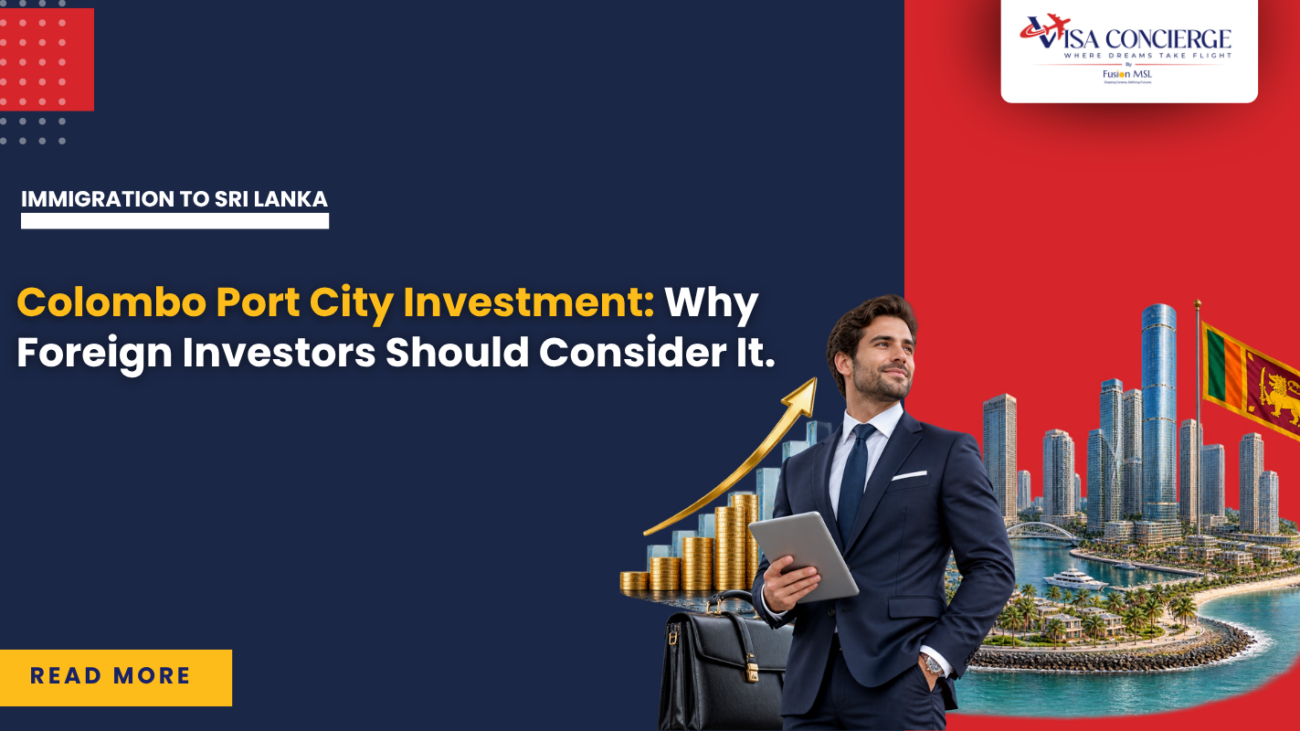
Colombo Port City Investment: Why Foreign Investors Should Consider It

Sri Lanka is increasingly being considered by international investors looking for opportunities in South Asia. Among its most ambitious developments, Colombo Port City stands out as a destination designed to accommodate international businesses, investment projects and companies seeking a regional presence.

But what makes Colombo Port City investment particularly attractive to foreigners?

From its strategic location and foreign-currency business framework to potential tax incentives and opportunities across multiple industries, Port City offers features that distinguish it from conventional business locations in Sri Lanka.

For investors planning to establish operations, expand into the region or relocate to Sri Lanka, understanding how these opportunities align with their business objectives is an important starting point.

Visa Concierge by Fusion MSL supports foreign investors with business establishment coordination, investment-related guidance and the immigration arrangements associated with operating in Sri Lanka.

This article explores the main investment advantages of Colombo Port City and the considerations foreign investors should understand before moving forward.

What Is Colombo Port City?

Colombo Port City is a Special Economic Zone (SEZ), a planned city built on reclaimed land adjacent to the central business district of Colombo

Built on approximately 269 hectares of reclaimed land, the project is being developed as an international business and lifestyle destination, bringing together commercial facilities, residential developments, hospitality, financial services and modern infrastructure.

This regulatory environment is intended to encourage foreign investment, support internationally oriented businesses and strengthen Sri Lanka's position as a regional commercial centre.

The development is progressing in phases, with opportunities spanning existing business activities and projects planned for future development.

Why Is Colombo Port City Investment Attractive to Foreigners?

Strategic Location Connecting International Markets

Sri Lanka's location in the Indian Ocean has historically supported its role in regional trade and commerce.

Situated along major international maritime routes, the country connects important commercial markets across Asia, the Middle East, Africa and Europe.

Colombo Port City builds on this geographical advantage by creating a dedicated business environment next to Sri Lanka's principal commercial centre.

For international companies, this location may be particularly valuable when establishing regional headquarters, managing overseas clients or coordinating services across multiple markets.

Businesses can also benefit from access to Colombo's existing professional services, commercial infrastructure and workforce.

For an investor considering expansion into South Asia, Port City presents an opportunity to evaluate Sri Lanka as a regional operating base rather than solely as a domestic market.

Opportunities to Conduct Business in Foreign Currencies

Foreign-currency transactions are a significant consideration for companies operating internationally.

Colombo Port City's regulatory framework allows qualifying businesses to conduct permitted transactions in designated foreign currencies, subject to applicable requirements.

This may be particularly attractive to companies that receive revenue from international clients, manage cross-border contracts or operate across several countries.

Potential beneficiaries include:

  • International trading and service companies
  • IT and software development businesses
  • Business Process Outsourcing (BPO) companies
  • Regional headquarters and corporate service providers
  • International consultancy and professional service firms

For these businesses, the ability to structure qualifying operations around foreign-currency transactions may support more effective financial and commercial planning.

However, foreign-currency privileges depend on the authorised business activity and relevant banking and regulatory conditions.

Visa Concierge by Fusion MSL can help foreign investors consider how their proposed business structure and operating plans fit within Sri Lanka's business establishment framework, with specialist input where required.

Potential Tax Incentives for Qualifying Investments

One of the most frequently discussed advantages of investing in Colombo Port City is its potential tax benefits.

The Special Economic Zone provides a framework through which eligible investments may receive specified tax incentives and concessions.

These benefits can be especially relevant to investors planning substantial commercial projects or internationally oriented business activities.

However, the availability and extent of incentives depend on the business category, investment proposal and applicable regulatory approval.

Not every company established in Port City automatically qualifies for tax exemptions.

The investment framework was updated through regulations introduced in September 2025, followed by further legislative amendments in 2026.

For prospective investors, the key consideration is whether their intended business activity and investment structure may qualify for the benefits available under the current framework.

An appropriate assessment before committing capital can help distinguish genuine opportunities from assumptions based on general promotional claims.

A Business Environment Designed for International Companies

One of the key objectives of Colombo Port City is to attract businesses that operate beyond Sri Lanka's domestic market.

Its dedicated Special Economic Zone framework includes coordinated investment facilitation and provisions intended to support qualifying foreign-owned businesses.

This may appeal to overseas entrepreneurs who want to establish a presence in Sri Lanka without necessarily focusing on local consumer markets.

For example, an international consultancy, technology company or professional services firm may wish to serve overseas customers while maintaining a regional team in Colombo.

Such arrangements require careful consideration of the company's activities, foreign ownership, business location, operational arrangements and immigration requirements.

The advantage of Port City is not simply the availability of a new business address. It is the opportunity to explore a dedicated environment developed around international commercial activity.

Growing Opportunities in Technology and Professional Services

Colombo Port City's investment proposition extends well beyond large-scale infrastructure and property development.

Technology and internationally traded services are among the sectors relevant to the Special Economic Zone.

Potential business opportunities include:

Information Technology and IT-Enabled Services

Software development, technology consulting, digital services, data-related activities and outsourced technology operations.

Business Process Outsourcing and Corporate Services

International customer support, administrative services, business support operations and selected professional outsourcing activities.

International Trading and Regional Operations

Business activities involving overseas clients, international commercial relationships and regional corporate management.

Financial and Professional Services

Certain financial, advisory, consultancy and professional activities, subject to applicable sector-specific regulatory requirements.

For overseas companies looking to establish an international service operation, Colombo Port City provides another option to compare with conventional investment locations in Sri Lanka.

The suitability of the zone depends on the particular business model rather than the industry name alone.

Commercial Property and Long-Term Development Potential

Real estate and infrastructure form another significant part of Colombo Port City's long-term investment proposition.

Its master plan incorporates commercial spaces, residential properties, hospitality developments, recreational facilities and waterfront infrastructure.

These developments may create opportunities for investors interested in commercial property, approved development projects and related business activities.

However, foreign property investment in Sri Lanka requires careful consideration of the nature of ownership, contractual terms and the particular investment arrangement.

The commercial performance of an individual property also depends on demand, completion schedules, operating costs and broader market conditions.

Port City's location and long-term development vision can make it worth investigating, but projected rental income or capital appreciation should never be treated as guaranteed.

Foreign investors considering property-related opportunities should have the proposed arrangement independently reviewed before committing capital.

Increasing Investment Activity and Commercial Interest

Colombo Port City is continuing to develop as an international investment destination.

In June 2026, the Colombo Port City Economic Commission reported Cabinet approvals granted to 77 Businesses of Strategic Importance, covering a range of commercial and development activities.

The announcement included major development projects alongside companies operating in internationally oriented service sectors.

This activity reflects ongoing interest in the Special Economic Zone, although approved investments should not be confused with completed projects or guaranteed commercial success.

For prospective investors, the development's growing business ecosystem may create opportunities to participate in a market at an earlier stage of its long-term expansion.

Which Foreign Investors Should Consider Colombo Port City?

Colombo Port City may be particularly relevant to foreign investors and businesses with international operations or plans to establish a presence in Sri Lanka.

Examples include:

  • International entrepreneurs considering a new company or business venture in Sri Lanka.
  • Overseas companies planning regional headquarters, administrative functions or service delivery operations.
  • Technology businesses looking to establish IT, software development or outsourcing operations.
  • Professional service providers exploring internationally focused consulting or business-support activities.
  • Property and development investors evaluating eligible commercial, residential or mixed-use projects.
  • Foreign business owners and executives who intend to manage an approved business while residing in Sri Lanka.

The most suitable investment arrangement will depend on the proposed activity, ownership structure, commercial objectives and the investor's plans for working or living in Sri Lanka.

What Should Foreign Investors Consider Before Establishing a Business?

Although Colombo Port City offers several potential advantages, an attractive business environment does not automatically mean that every investment proposal is suitable.

Foreign investors should consider the broader implications of establishing an operation in another country.

Understanding the Appropriate Business Structure

An overseas company establishing a regional office may have different requirements from an individual entrepreneur launching a new business.

The nature of the activities, company ownership, proposed location and intended business operations can all influence the appropriate establishment structure.

Selecting an unsuitable arrangement can create complications when the business later expands, recruits employees or requires immigration support.

Assessing Investment Benefits and Regulatory Requirements

The potential benefits of operating within Port City need to be assessed against the company's intended activities.

Tax incentives, business privileges and regulatory conditions may differ between investment categories.

Investors should obtain appropriate advice before making financial commitments based on an assumed concession or benefit.

Planning for Foreign Directors and Employees

If the investor intends to relocate, manage the company personally or employ overseas professionals, immigration planning should be considered alongside business establishment.

Company ownership and immigration permission are separate matters.

A foreign national's ability to reside, manage operations or undertake employment in Sri Lanka depends on the appropriate immigration status and applicable conditions.

Addressing these considerations before the business becomes operational can help prevent administrative and staffing complications.

Can Foreign Investors Live and Work in Sri Lanka Through Port City?

For some investors, establishing a company is only one part of their plan.

They may also wish to relocate to Sri Lanka, become actively involved in managing their investment or bring foreign employees and family members.

Sri Lanka provides immigration pathways for qualifying foreign investors, company representatives and expatriate personnel, including categories relevant to authorised Colombo Port City activities.

However, the appropriate visa or residence arrangement depends on the individual's role, the nature of the approved business and their personal circumstances.

Simply investing in property or owning shares in a company does not automatically provide the right to live or work in Sri Lanka.

This distinction is particularly important for foreign investors who intend to participate in daily business management.

Visa Concierge assists foreign investors and companies with immigration pathway assessments, supporting documentation, relevant visa applications and coordination where applicable.

Our team can also support eligible foreign employees and family members who require immigration arrangements connected with the business.

How Visa Concierge Supports Foreign Investors in Colombo Port City

Establishing a business in a foreign country involves more than identifying an attractive investment opportunity.

Business establishment, regulatory considerations and immigration arrangements must fit the investor's objectives.

At Visa Concierge by Fusion MSL, we provide Sri Lanka-based support to foreign entrepreneurs, overseas companies and investors planning to establish or manage business operations.

Rather than approaching every enquiry with the same standard procedure, we begin by understanding the investor's intended activity, business background and plans for Sri Lanka.

Business Establishment and Investment Coordination

We help clients assess suitable business establishment options, coordinate incorporation-related requirements and consider where Port City authorisation or other investment-related arrangements may be relevant.

Where specialised legal, tax or regulatory advice is required, we can help coordinate with appropriate professionals as part of the wider planning process.

Investor and Business Visa Assistance

Foreign investors intending to reside or work in Sri Lanka may require an immigration pathway aligned with their approved activities.

Our team assists with assessing the relevant visa category, preparing supporting documentation and coordinating applicable immigration procedures.

Foreign Employee and Executive Relocation

International companies may require foreign directors, managers or technical professionals to work in Sri Lanka.

We support eligible corporate clients and foreign personnel with employment-related immigration documentation, application coordination and related dependant arrangements.

Ongoing Immigration Support

Business requirements do not necessarily end once an initial visa is issued.

Visa Concierge can also assist with eligible immigration renewals, extensions and related documentation requirements for investors, employees and their families.

Our objective is to give investors a coordinated point of contact for the business-establishment support and immigration services relevant to their plans.

All regulatory, company and visa approvals remain subject to the decisions of the responsible authorities.

Planning to Invest in Colombo Port City? Speak to Visa Concierge

Colombo Port City offers opportunities for internationally focused businesses and foreign investors considering Sri Lanka as a destination for expansion, investment or long-term operations.

Understanding whether those opportunities suit your particular objectives is essential before making a commitment.

Visa Concierge by Fusion MSL is here to help you explore the next stage.

Our Sri Lanka-based team supports foreign investors with business establishment coordination, relevant visa pathways and immigration arrangements for entrepreneurs, executives and employees.

Considering a business or investment in Colombo Port City?

Contact our team: Visit our Contact Page

Website: www.visaconcierge.lk

Frequently Asked Questions

1. Is Colombo Port City a Good Investment Opportunity for Foreigners?

Colombo Port City may be attractive to foreigners because of its strategic location, internationally focused business environment, foreign-currency provisions and potential incentives for qualifying investments. However, the suitability of an investment depends on the particular business, commercial risks and applicable regulations.

2. Can Foreigners Establish a Company in Colombo Port City?

Yes. Foreign investors and overseas companies can pursue eligible business establishment opportunities within the Colombo Port City framework, subject to the relevant authorisation and business requirements. Visa Concierge can assist with establishment-related coordination and immigration planning based on the proposed business activity.

3. What Types of Businesses Can Foreign Investors Consider?

Opportunities may include information technology, digital services, outsourcing, professional services, international trading and selected development activities. The appropriate framework depends on the nature of the business and applicable sector-specific requirements.

4. Are There Tax Benefits for Foreign Investors in Colombo Port City?

Certain qualifying investments may be eligible for tax incentives under the applicable Port City regulatory framework. However, these benefits are not automatic and vary according to the business classification and approval. Investors should obtain an assessment of the relevant tax implications before relying on any proposed concessions.

5. Can Foreign Investors Obtain a Sri Lankan Residence Visa?

Qualifying foreign investors, company representatives and employees may be eligible for relevant visa or residence categories, depending on their approved activities and personal circumstances. A business investment does not guarantee immigration approval. Visa Concierge provides assistance with assessing suitable immigration pathways and preparing applications.

6. Can an Overseas Company Expand Its Operations to Colombo Port City?

Yes, eligible overseas companies may explore establishing a presence within the Special Economic Zone. The appropriate structure depends on the company's business model and intended activities. Visa Concierge can support preliminary establishment planning, relevant coordination and immigration arrangements for foreign personnel.

7. How Can Visa Concierge Help With a Colombo Port City Investment?

Visa Concierge assists foreign investors with business establishment coordination, immigration planning, visa documentation and related application support. We begin by reviewing the intended business activity and investor's objectives to identify the areas requiring assistance and any specialist professional input.
Sri Lanka Investor Visa vs Business Visa Key Differences

Sri Lanka Investor Visa vs Business Visa: Key Differences

Sri Lanka Investor Visa vs Business Visa: Key Differences

Your first business meeting in Colombo and your move to live in Sri Lanka require different immigration planning. Choosing the right visa early helps you align your investment, travel and family plans before committing funds.

A Sri Lanka Business Visit Visa is intended for foreign nationals visiting the country for permitted short-term activities such as business meetings, negotiations and conferences. An Investor Visa, on the other hand, is designed for qualifying foreign investors who intend to reside in Sri Lanka while managing their investments.

The difference becomes particularly relevant when an initial business visit develops into plans for company ownership, business operations or relocation.

This guide compares the two routes and explains what to check before you travel, invest or relocate.

Investor Visa and Business Visit Visa at a Glance

Comparison Investor Visa Business Visit Visa
Main purposeResiding in Sri Lanka while managing qualifying investmentsVisiting Sri Lanka for permitted business-related activities
Visa classificationInvestor-related residence categoryShort-term visit category
Suitable applicantsQualifying foreign investors and entrepreneursOverseas business representatives, potential investors and conference attendees
Business meetingsMay be undertaken in connection with the approved investment purposePermitted
Managing investmentsPermitted within the approved visa conditionsNot a general authorisation for ongoing business operations
Local employmentSeparate employment authorisation may be necessary for activities outside the approved investment purposeNot permitted
Investment requirementsMust satisfy the applicable investment eligibility and documentation conditionsNo qualifying capital investment is required simply to attend permitted business meetings
Family membersEligible spouse and dependants may be considered under the programmeDoes not itself provide investor-related dependant residence rights
Intended stayResidence connected to an approved investmentTemporary business visit
The key consideration is not simply whether the applicant is a businessperson. It is what the applicant intends to do while physically present in Sri Lanka.
The practical question is: are you visiting to explore an opportunity, or planning to live in Sri Lanka and oversee an investment?

What Is a Sri Lanka Investor Visa?

The Sri Lanka Investor Visa is a residence pathway administered by the Department of Immigration and Emigration for qualifying foreign nationals investing in the country.

Under the Department's published Investor Visa Category, eligible individuals may enter and reside in Sri Lanka while managing their investments, subject to the relevant requirements and visa conditions.

Applicants must meet the minimum investment requirements applicable at the time of application. The qualifying amount, permitted investment structure and residence period depend on the program’s prevailing conditions. Confirm these requirements before transferring funds or making investment commitments.

Government visa fees apply separately to the main applicant and eligible family members. Confirm the applicable fees when preparing the application and budget separately for investment capital and professional costs.

Who Can Apply for a Sri Lanka Investor Visa?

The Investor Visa Category is intended for foreign nationals who meet the applicable investment requirements.

Depending on the proposed investment and individual circumstances, potential applicants may include:

  • Overseas entrepreneurs investing in eligible Sri Lankan businesses.
  • Foreign shareholders making qualifying investments in Sri Lankan companies.
  • Investors establishing a permitted business presence through an overseas company.
  • Foreign nationals undertaking other investment types recognized under the program.
  • Eligible spouses and dependants of principal applicants.

Not every company shareholder, director or business owner automatically qualifies.

An applicant's immigration eligibility must be considered separately from their legal ability to invest in or own shares in a Sri Lankan company.

What Types of Investments May Be Considered?

The Department's published guidelines recognize different investment structures, subject to the applicable conditions.

These include qualifying investments involving:

  • Voting shares in Sri Lankan companies, with the applicant holding at least 10% of voting share capital and meeting applicable sector restrictions.
  • Registered overseas companies establishing permitted business operations.
  • Qualifying government or Central Bank debt securities with a minimum five-year maturity.
  • Eligible term deposits with licensed commercial banks.
  • Certain immovable property investments, subject to Sri Lankan law.

Property investments must comply with Sri Lankan ownership laws. A property purchase should never be presented as an automatic residence entitlement.

An investment that is commercially legitimate does not necessarily satisfy the requirements of the Investor Visa program.

Banking and Investment Documentation

The published Investor Visa guidelines specify an investment-fund transfer framework involving an Inward Investment Account (IIA) and a Visa Programme Foreign Currency Account (VPFCA), maintained with a licensed commercial bank in Sri Lanka.

Funds are credited to the IIA and subsequently invested through the VPFCA. Existing IIA balances may be used. Confirm the banking sequence before transferring money.

This is particularly relevant when an applicant has already incorporated a company or transferred funds into Sri Lanka before considering the immigration implications.

What Is a Sri Lanka Business Visit Visa?

A Sri Lanka Business Visit Visa is a short-stay visa intended for foreign nationals travelling to Sri Lanka for approved business-related activities.

It supports an approved temporary visit; it does not authorise local employment or the operation of a business. The official ETA guidance describes a 30-day, double-entry business ETA, while other business permissions may have different entry arrangements. Follow the duration and entry conditions actually granted.

What Activities Are Allowed Under a Business Visit Visa?

The Department of Immigration and Emigration identifies several permitted business-visit activities, including:

  • Attending business meetings and negotiations.
  • Participating in conferences, seminars and workshops.
  • Attending qualifying short-term training programmes; the ETA guidance specifies programmes lasting less than one month.
  • Participating in relevant professional symposiums and other activities recognised under the business-visit category.

For an overseas entrepreneur exploring Sri Lanka as an investment destination, this category may suit an initial visit focused on discussions and commercial evaluation.

However, attending meetings should not be confused with taking up ongoing operational responsibilities in Sri Lanka.

What Is Not Permitted Under a Business Visit Visa?

A Business Visit Visa should not be treated as permission to:

  • Take up paid or unpaid employment in Sri Lanka.
  • Undertake self-employment or engage in business or trading operations in Sri Lanka.
  • Reside in Sri Lanka through repeated visits instead of obtaining appropriate residence permission.

A foreign company director may need to attend negotiations in Sri Lanka, but a plan to relocate and personally manage the company's daily operations requires a different immigration assessment.

Which Visa Should Foreign Investors and Entrepreneurs Consider?

The appropriate category depends on the applicant's immediate objective and proposed activities in Sri Lanka.

Scenario 1: Exploring Investment Opportunities

An investor from the United Arab Emirates wants to visit Colombo to meet prospective partners and discuss an investment with professional advisers.

A Business Visit Visa may be suitable, provided the intended activities fall within the permitted category and the applicant satisfies the relevant entry requirements.

Scenario 2: Relocating to Manage a Sri Lankan Investment

A European entrepreneur plans to make a qualifying investment in a Sri Lankan company and reside locally while overseeing that investment.

An Investor Visa may be the more relevant pathway, subject to the proposed investment meeting the programme's requirements.

Scenario 3: An Overseas Company Establishing Operations

An international business plans to establish a local presence in Sri Lanka and appoint foreign personnel to oversee its operations.

The immigration requirements may differ for the overseas investor, local company director and foreign employees.

Depending on the company's structure, activities and regulatory position, investor-related residence, employment-related residence or a Board of Investment (BOI) supported pathway may need to be considered.

Key Requirements for Sri Lanka Investor Visa Applicants

Investor Visa applications involve a more detailed assessment than temporary business visits because they relate to residence and qualifying investment activity.

The published Investor Visa guidance identifies supporting documents including:

  • Completed visa application and applicant request letter.
  • Passport copy with at least six months’ validity and two recent passport photographs.
  • Investment proposal.
  • Required security clearance documentation.
  • Medical clearance report.
  • Police clearance from the home country or country of residence, issued within the preceding three months.
  • Bank confirmation identifying the applicant, VPFCA account number, account category and balance.
  • Marriage and birth certificates where eligible family members are included.

Foreign Ownership and Business Activity Restrictions

Foreign investment in Sri Lanka is regulated separately from immigration permission.

The relevant regulatory framework includes the Foreign Exchange Act and its applicable regulations.

Certain business sectors are subject to foreign-ownership restrictions or additional approval requirements. Activities such as travel agencies, freight forwarding, education and some agricultural operations may require particular attention.

For example, an investor proposing to establish a software development business may face different investment restrictions from someone planning a travel agency.

The company's actual business activity, rather than simply its registered name, is therefore relevant when evaluating the investment structure.

Assess foreign ownership, sector approvals and immigration eligibility together before deciding how to structure the business.

Key Documents for a Sri Lanka Business Visit Visa

Business Visit Visa applications are primarily supported by evidence demonstrating the legitimate purpose of the visit.

The Department identifies an invitation or request letter from a relevant institution among the documents required for the business-visit category.

Depending on the applicant's nationality, circumstances and applicable submission route, relevant supporting information may include:

  • Valid passport and applicant details.
  • Invitation or request letter from the relevant Sri Lankan organisation.
  • Details of the business meetings, conference or intended activities.
  • Information about the inviting company or institution.
  • Travel arrangements and evidence of financial means where required.

An invitation should reflect the applicant's actual purpose of travel.

For example, an invitation to attend commercial negotiations should not be used to present an ongoing employment or management assignment as a temporary business visit.

The official ETA guidance directs business ETA applicants to Sri Lankan overseas missions or the Department’s head office. Confirm the submission route, nationality-specific requirements and fees before travel.

How to Approach the Sri Lanka Visa Application Process

For foreign investors, the practical starting point is to define the purpose of the visit or residence before preparing the application.

Step 1: Establish the Intended Activities

Clarify whether the applicant is coming to attend meetings, explore investment opportunities, establish an investment, reside in Sri Lanka or undertake employment.

Step 2: Review the Relevant Visa Pathway

For temporary business travel, confirm the activities permitted under the Business Visit Visa.

For investment-related residence, assess the proposed investment against the Department's Investor Visa framework.

Where the project is connected to a BOI-approved enterprise or requires other regulatory approval, those circumstances should also be reviewed.

Step 3: Prepare the Supporting Documents

The application should be supported by consistent information about the applicant, intended activities and relevant business arrangements.

Investor cases may require investment and banking evidence, while business-visit cases generally focus on the nature and purpose of the visit.

Step 4: Follow the Applicable Submission Procedure

Confirm the correct entry arrangements before travelling for residence. Submit the Investor Visa application and supporting documents to the Department’s Residence Visa Division for evaluation; an investment alone does not secure approval.

Step 5: Comply With the Approved Visa Conditions

Keep your activities within the visa conditions. Investor projects are reviewed every two years, and material changes must be notified in writing within two months.

If the applicant's circumstances change, such as moving from preliminary investment discussions to establishing a local business presence, their immigration position should be reviewed before undertaking activities outside the approved scope.

Can You Start a Business in Sri Lanka on a Business Visit Visa?

A Business Visit Visa does not, by itself, authorise a foreign national to operate a business or undertake employment in Sri Lanka.

A foreign national may be able to establish or hold an interest in a Sri Lankan company, subject to the applicable foreign-investment rules, without automatically obtaining the right to reside or work in the country.

Similarly, foreign nationals being recruited or assigned to local operational roles may need to consider the employment-related residence framework rather than assuming that investor status or company directorship provides unrestricted employment permission.

Common Mistakes When Choosing Between These Visas

Assuming Business Ownership Automatically Provides Residence Rights

Being a shareholder or director of a Sri Lankan company does not automatically establish eligibility for an Investor Visa.

Using Repeated Business Visits for Ongoing Residence

The Business Visit Visa is intended for temporary activities, not as a substitute for a residence category.

Overlooking Banking and Investment Evidence

The Investor Visa requires the prescribed investment and banking arrangements.

Investors who organise their financial arrangements without considering the immigration requirements may need to review how their records support the intended application.

Confusing BOI Approval With Immigration Permission

A project supported by the Board of Investment may have a dedicated immigration facilitation process.

However, investment approval, company registration and visa permission remain distinct matters.

The correct immigration route depends on the nature of the project, the applicant's role and the relevant authority requirements.

How Visa Concierge Can Assist Foreign Investors

A successful relocation starts with a visa route that fits the way you intend to invest and live.

Visa Concierge by Fusion MSL provides immigration and visa application support for foreign investors, entrepreneurs and international companies considering Sri Lanka.

Our assistance can include:

  • Reviewing the applicant's intended travel, investment and residence purpose.
  • Identifying the relevant business-visit, investor or other immigration pathway.
  • Explaining documentation and eligibility requirements.
  • Reviewing application documents for completeness and consistency.
  • Assisting with application preparation and relevant submission guidance.
  • Coordinating with relevant parties and supporting application follow-up where applicable.

Where company incorporation, investment approvals or specialised regulatory matters are involved, coordination with appropriate licensed or authorised professionals may also be necessary.

Visa Concierge is an independent immigration consultancy. Visa decisions and approvals remain with the relevant Sri Lankan authorities.

Planning to Invest or Establish a Business in Sri Lanka?

Before transferring investment funds or committing to relocation, establish which immigration route fits your plans.

Share your nationality, proposed business or investment, indicative budget, intended length of stay and whether family members will accompany you. Visa Concierge by Fusion MSL can assess the relevant pathway and explain the documents and next steps.

Contact Visa Concierge for an Investor or Business Visa Assessment

Planning to Invest or Establish a Business in Sri Lanka?

Before transferring investment funds or committing to relocation, establish which immigration route fits your plans.

Visa Concierge by Fusion MSL can review your intended travel, investment and residence purpose and explain the relevant visa pathway and next steps.

Contact our team: Visit our Contact Page

Website: www.visaconcierge.lk

Frequently Asked Questions

1. What Is the Main Difference Between a Sri Lanka Investor Visa and a Business Visit Visa?

The Investor Visa is intended for qualifying foreign nationals seeking residence in Sri Lanka while managing investments. A Business Visit Visa is designed for temporary activities such as business meetings, negotiations and conferences. The appropriate category depends on the intended purpose of travel and stay.

2. Can I Open a Company in Sri Lanka With a Business Visit Visa?

Company incorporation and visa permission are separate matters. An eligible foreign national may establish or hold an interest in a Sri Lankan company, subject to applicable corporate and foreign-investment regulations. However, a Business Visit Visa does not itself authorise the holder to carry out ongoing business operations in Sri Lanka.

3. Is an Investor Visa Required for Every Foreigner Investing in Sri Lanka?

Not necessarily. Making an investment and obtaining residence permission are different matters. Foreign nationals who invest without residing in Sri Lanka may have different immigration needs from those intending to live locally and manage their investments. The correct route depends on the person's intended activities and circumstances.

4. Can I Work in Sri Lanka With an Investor Visa?

An Investor Visa permits activities connected to the approved investment within the visa's conditions. It should not automatically be treated as unrestricted permission to take up unrelated employment. A foreign national planning to work for a Sri Lankan employer may require a separate employment-related immigration assessment.

5. Can I Convert a Business Visit Visa Into an Investor Visa?

Applicants should not assume that a Business Visit Visa or Business ETA can automatically be converted into investor residence status. The relevant entry and residence procedures must be confirmed with the Department of Immigration and Emigration before proceeding. A change in business plans does not itself change an existing visa's conditions.

6. Can My Family Accompany Me Under the Sri Lanka Investor Visa?

The Department's Investor Visa programme recognises eligible spouses and dependants of the principal applicant. Family applications are subject to the applicable eligibility conditions, supporting relationship documents and immigration approval.

7. Does a BOI-Approved Company Automatically Qualify Its Investors for Residence Visas?

No. BOI-approved enterprises may have access to dedicated investor and expatriate visa facilitation arrangements, but the relevant immigration requirements and recommendations must still be satisfied. Approval of an investment project should not be treated as automatic residence permission for every shareholder or employee.

8. Can Visa Concierge Help With Both Business Visit and Investor Visa Applications?

Yes. We assist with visa assessment, documentation, application preparation and immigration coordination, based on your intended activities and circumstances.

Sri Lanka Digital Nomad Visa vs Tourist Visa Which One Fits Remote Workers

Sri Lanka Digital Nomad Visa vs Tourist Visa | Which One Fits Remote Workers?

Sri Lanka Digital Nomad Visa vs Tourist Visa: Which One Fits Remote Workers?

Sri Lanka has become one of the most attractive destinations for remote workers, freelancers, entrepreneurs, and digital nomads.

The country offers what many global professionals are searching for: tropical beaches, coworking spaces, a lower cost of living compared to many Western cities, strong cultural experiences, wellness options, surf towns, tea country, and a growing remote work lifestyle.

But before you book your flight and set up your laptop by the beach, there is one important question to answer:

Should you enter Sri Lanka on a tourist visa, or should you consider the Sri Lanka Digital Nomad Visa?

This is where many remote workers get confused. A tourist visa may be suitable for a holiday or a short visit. But if your real intention is to live in Sri Lanka while working remotely for overseas clients, employers, or your own foreign-registered business, the visa purpose needs to be checked carefully.

The Sri Lanka Digital Nomad Visa is designed for remote workers, but it also comes with specific eligibility expectations, including a monthly income remittance requirement.

This guide explains the key difference between a Sri Lanka Digital Nomad Visa and a Sri Lanka Tourist Visa in a simple, practical way. It is not a document checklist. Instead, it will help you understand which pathway may fit your purpose — and when to speak to Visa Concierge before you apply.

Why Remote Workers Are Looking at Sri Lanka

Sri Lanka is not just a holiday destination anymore. For many foreign professionals, it is becoming a serious remote work base.

Popular locations such as Colombo, Galle, Weligama, Ahangama, Hiriketiya, Kandy, Ella, and the southern coast are already attracting remote workers who want a lifestyle that blends work, travel, culture, and wellness.

For digital nomads, Sri Lanka offers:

  • Beach and surf towns
  • City access in Colombo
  • Boutique villas and serviced apartments
  • Cafés and coworking spaces
  • Wellness, yoga, and Ayurveda experiences
  • Access to nature, wildlife, and heritage sites
  • A convenient base in South Asia

But enjoying Sri Lanka as a remote worker is not only about where you stay. It is also about whether your visa category matches your actual purpose.

That is why the comparison between the Sri Lanka Digital Nomad Visa and Tourist Visa matters.

What Is a Sri Lanka Tourist Visa?

A Sri Lanka Tourist Visa is generally meant for foreign nationals visiting Sri Lanka for short-term tourism-related purposes.

According to Sri Lanka Immigration, a Tourist Visa is issued to genuine tourists who enter Sri Lanka for purposes such as sightseeing, holidays, visiting friends and relatives, medical treatment including Ayurvedic and yoga-related treatment, sports events, competitions, and cultural performance-related activities.

In simple terms, a tourist visa is for visiting Sri Lanka — not for setting up a long-term remote work lifestyle.

A tourist visa may be suitable if you are:

  • Visiting Sri Lanka for a holiday
  • Exploring the country for a short period
  • Visiting friends or relatives
  • Coming for wellness or medical-related travel
  • Attending permitted cultural or sports-related activities
  • Testing Sri Lanka as a possible future destination before making a longer plan

However, if your real purpose is to live in Sri Lanka while continuing your remote work, you should be careful about assuming that a tourist visa is the best route.

What Is the Sri Lanka Digital Nomad Visa?

The Sri Lanka Digital Nomad Visa is designed for foreign professionals who want to live in Sri Lanka while working remotely for employers, clients, or businesses based outside Sri Lanka.

The official Digital Nomad Visa category describes the visa as being for foreign professionals who wish to live and work remotely from Sri Lanka while serving clients or companies based outside the country. It also identifies eligible applicants as foreign nationals aged 18 or above, with spouse and dependents of the main applicant also considered under the category.

One important eligibility point is the income requirement. The main applicant is required to show a minimum monthly income remittance of USD 2,000. If the dependent count increases beyond two, an additional USD 500 per month should be remitted for each additional dependent.

This pathway is different from a tourist visa because the purpose is not simply holiday travel. The purpose is remote work from Sri Lanka while income and work activity remain connected to overseas sources.

The Digital Nomad Visa may be suitable for:

  • Remote employees working for overseas companies
  • Freelancers serving international clients
  • Online business owners with businesses registered outside Sri Lanka
  • Consultants working remotely for overseas clients
  • Digital entrepreneurs
  • Remote workers planning a longer stay in Sri Lanka
  • Families relocating temporarily under a remote work lifestyle

This makes the Digital Nomad Visa more purpose-aligned for foreign nationals who want Sri Lanka to be their remote work base.

Tourist Visa vs Digital Nomad Visa: The Main Difference

The biggest difference is purpose.

A tourist visa is for visiting Sri Lanka as a tourist.

A Digital Nomad Visa is for living in Sri Lanka while working remotely for foreign income sources.

This is an important distinction because Sri Lanka Immigration states that visit visa holders should not engage in any form of paid or unpaid employment, or in trade or business other than what is specified in the visa. It also states that visit visa holders should not live in Sri Lanka for a long period through frequent or successive visits.

For remote workers, this creates a practical question:

Are you coming mainly to travel, relax, and explore Sri Lanka for a short period?

Or are you planning to base yourself in Sri Lanka while continuing your professional work online?

If the second answer sounds closer to your situation, you should consider whether the Digital Nomad Visa is the more suitable pathway.

Can You Work Remotely on a Sri Lanka Tourist Visa?

This is one of the most common questions asked by digital nomads.

The safest answer is: do not assume a tourist visa gives you the right pathway for remote work.

A tourist visa is meant for tourism-related purposes. It is not designed as a long-stay remote work visa. Sri Lanka Immigration’s general visit visa conditions restrict paid or unpaid employment and business or trade activities outside the visa conditions.

Remote work can sometimes feel different because the employer or client is outside Sri Lanka. But from a visa planning perspective, the question is not only “Where is the income coming from?” It is also “What is the purpose of your stay?”

If your real purpose is to live in Sri Lanka while working online, then the Digital Nomad Visa may be a more appropriate category to assess.

At Visa Concierge, we help remote workers understand the difference between visiting Sri Lanka as a tourist and staying in Sri Lanka as a remote professional.

Who Should Consider the Sri Lanka Digital Nomad Visa?

You should consider getting guidance on the Sri Lanka Digital Nomad Visa if:

  • You want to stay in Sri Lanka longer than a short holiday
  • You will continue working online while in Sri Lanka
  • Your clients, employer, or business are based outside Sri Lanka
  • You can meet the minimum monthly income requirement
  • You want a visa pathway that better matches remote work
  • You plan to live in Sri Lanka with your spouse or dependents
  • You are a freelancer, consultant, founder, or online professional
  • You are already in Sri Lanka and unsure whether your current visa fits your purpose
  • You want to avoid confusion between tourist travel and remote work

The official Digital Nomad Visa category refers to remote employment, freelancing, or owning a business not registered in Sri Lanka that serves clients outside Sri Lanka. It also refers to the minimum monthly income remittance requirement for the main applicant.

Because the category is purpose-specific and includes an income/remittance requirement, applicants should avoid relying on general advice from social media, travel groups, or outdated blog posts.

Who May Still Use a Tourist Visa?

A tourist visa may still be suitable for foreign nationals who are genuinely visiting Sri Lanka for tourism or short-term travel purposes.

For example, a tourist visa may fit if you are:

  • Coming for a holiday
  • Visiting beaches, cultural sites, wildlife parks, or wellness retreats
  • Visiting friends or family
  • Exploring Sri Lanka before deciding whether to relocate later
  • Attending permitted short-term tourism-related activities
  • Travelling without the intention of staying long-term as a remote worker
The key point is that the visa should match the real purpose of stay.

If your visit is tourism-focused, a tourist visa may be enough. If your visit is remote work-focused, the Digital Nomad Visa should be reviewed.

Why Visa Purpose Matters

Visa purpose is not just a formality.

It affects how your stay is understood, what conditions apply, how long you may remain, whether renewal or extension is suitable, and whether your future plans are aligned with immigration expectations.

Choosing the wrong visa pathway can create issues such as:

  • Confusion during arrival or extension
  • Questions about your true purpose of stay
  • Difficulty planning a longer stay
  • Issues when dependents are involved
  • Problems when moving from short-term travel to long-term residence
  • Compliance concerns if your activities do not match your visa category

Sri Lanka Immigration also notes that residence visa holders should not engage in any form of activity other than the condition of their visa.

This is why remote workers should not treat visa selection as a quick travel form. The visa pathway should support your actual lifestyle plan in Sri Lanka.

What If You Are Already in Sri Lanka?

Many remote workers first arrive in Sri Lanka as tourists. After a few weeks, they realise they want to stay longer.

This is common.

You may have arrived for a holiday, discovered a lifestyle that works for you, started staying in a surf town or coworking community, and then decided that Sri Lanka could become your remote work base.

If that happens, the next step should not be guesswork.

You should review:

  • Your current visa status
  • Your purpose of stay
  • Whether your work is remote and foreign-sourced
  • Whether you meet the Digital Nomad Visa income requirement
  • Whether you plan to include dependents
  • Whether you need a longer-term visa pathway
  • Whether a Digital Nomad Visa or another residence category is more suitable

At Visa Concierge, we assist foreign nationals who are already in Sri Lanka and want to understand their next visa steps before their current stay becomes complicated.

Digital Nomad Visa for Families

The Digital Nomad Visa is not only for solo travellers.

Many remote professionals want to move with a spouse, partner, or children. Some want to spend a year in Sri Lanka as a family. Others want to combine remote work with international schooling, slow travel, wellness, or a lifestyle break.

The official Digital Nomad Visa category includes spouse and dependents of the main applicant under eligible persons. It also states that if the dependent count increases beyond two, an additional USD 500 per month should be remitted for each additional dependent.

That said, family cases should be planned carefully. Dependents can affect financial planning, stay arrangements, schooling decisions, insurance considerations, and the overall visa pathway.

This is where personalised guidance becomes important. A solo freelancer’s process may not look the same as a family relocating with children.

Tourist Visa, Business Visa, or Digital Nomad Visa?

Some applicants are confused because they are not only working remotely — they may also have meetings, partnerships, or business interests in Sri Lanka.

This is where professional visa guidance becomes very important.

A Business Purpose Visa is generally for short-term business visits such as meetings, negotiations, seminars, conferences, workshops, short-term training, religious events, symposiums, and certain event participation. However, the official visa conditions state that visit visa holders should not engage in paid or unpaid employment or other activities outside the specified visa purpose.

So the question is not simply:

“Am I working?”

It is:

“What exactly will I be doing in Sri Lanka?”

“Who is the work connected to?”

“Is my income foreign-sourced?”

“Am I meeting clients locally?”

“Am I setting up or running a business in Sri Lanka?”

“Am I staying short-term or long-term?”

Depending on the answers, the suitable pathway may differ.

Visa Concierge can help you understand whether your case is closer to a tourist visit, business visit, digital nomad stay, investor pathway, employment route, or another residence visa category.

Why Remote Workers Should Not Depend Only on Online Advice

Digital nomad forums and travel groups can be helpful for lifestyle tips. They are good for finding cafés, coworking spaces, apartment recommendations, and city comparisons.

But visa advice is different.

A comment from another traveller may not apply to your nationality, income source, family situation, current visa status, or intended stay period. Immigration rules, procedures, forms, and interpretations can also change over time.

Online advice can give you a general idea, but it cannot assess whether your personal situation is suitable for the Digital Nomad Visa, Tourist Visa, Business Visa, or another residence pathway.

That is why a short consultation before applying can save time, avoid confusion, and help you move forward with a clearer plan.

How Visa Concierge Helps Digital Nomads and Remote Workers

At Visa Concierge, we support foreign nationals, remote workers, freelancers, entrepreneurs, and families who want to understand the correct Sri Lanka visa pathway.

Our support may include:

  • Identifying whether your purpose fits a tourist, business, digital nomad, or residence pathway
  • Reviewing your remote work and income situation in a practical way
  • Helping you understand the monthly income/remittance requirement
  • Explaining the process without overwhelming you
  • Supporting applicants already in Sri Lanka
  • Guiding families and dependents
  • Helping you avoid wrong-category applications
  • Coordinating the visa process with the relevant authorities
  • Supporting future renewal or long-stay planning

We do not simply ask, “Which visa do you want?”

We help you understand which visa pathway matches your actual purpose.

When Should You Contact Visa Concierge?

You should speak to Visa Concierge if:

  • You are planning to work remotely from Sri Lanka
  • You are unsure whether a tourist visa is enough
  • You are already in Sri Lanka and want to stay longer
  • You are a freelancer or consultant serving overseas clients
  • You work for a foreign employer and want to live temporarily in Sri Lanka
  • You own an overseas business and want to operate remotely from Sri Lanka
  • You want to understand whether you meet the income requirement
  • You want to bring your spouse or dependents
  • You are confused between tourist, business, digital nomad, investor, or residence visa options
  • You want to understand your visa pathway before making travel or accommodation commitments
Getting guidance early is always easier than fixing a wrong visa decision later.

Quick Comparison: Sri Lanka Tourist Visa vs Digital Nomad Visa

Tourist Visa

A Sri Lanka Tourist Visa is generally suitable for short-term travel, holidays, sightseeing, visiting friends or relatives, medical or wellness travel, and permitted sports or cultural activities.

It is not designed for long-term residence or employment-related activity.

Digital Nomad Visa

A Sri Lanka Digital Nomad Visa is designed for eligible foreign nationals who want to live in Sri Lanka while working remotely for overseas employers, clients, or foreign-registered businesses.

It is more suitable for remote workers who want their visa purpose to reflect their actual lifestyle in Sri Lanka.

The main applicant is required to meet the minimum monthly income remittance requirement of USD 2,000, with additional remittance requirements applying if there are more than two dependents.

Final Thoughts

Sri Lanka is a beautiful place to visit — and for many remote workers, it can also become a meaningful temporary home.

But the visa you choose should match the way you actually plan to stay.

If you are coming only for a holiday, a tourist visa may be suitable. If you are planning to live in Sri Lanka while working remotely for overseas clients, employers, or your own foreign business, the Digital Nomad Visa may be the better pathway to explore.

The monthly income/remittance requirement is also an important point to consider before applying. A strong application starts with understanding your purpose, your work arrangement, your income position, your stay plan, and your visa options.

The safest first step is not to guess. It is to get proper guidance before applying.

Planning to work remotely from Sri Lanka?

Speak to Visa Concierge for clear, professional guidance before you apply.

Contact our team: Visit our Contact Page

Website: www.visaconcierge.lk

Visa Concierge by Fusion MSL

Your Journey, Our Priority.

Frequently Asked Questions

1. What is the main difference between the Sri Lanka Digital Nomad Visa and Tourist Visa?

The main difference is purpose. A Tourist Visa is generally for short-term tourism-related travel. A Digital Nomad Visa is designed for eligible remote workers who want to live in Sri Lanka while working for overseas employers, clients, or businesses.

2. Can I work remotely from Sri Lanka on a tourist visa?

You should not assume that a tourist visa is suitable for remote work. A tourist visa is for tourism-related purposes, while remote work from Sri Lanka may need to be assessed under the Digital Nomad Visa or another suitable pathway.

3. What is the monthly income requirement for the Sri Lanka Digital Nomad Visa?

The official Digital Nomad Visa category requires the main applicant to show a minimum monthly income remittance of USD 2,000. If the dependent count increases beyond two, an additional USD 500 per month should be remitted for each additional dependent. Because income, remittance, and dependent situations can vary from applicant to applicant, it is better to get your profile reviewed before applying.

4. Who is the Sri Lanka Digital Nomad Visa for?

It is generally for foreign nationals who are 18 or above and engaged in remote employment, freelancing, or an overseas business that serves clients outside Sri Lanka, subject to meeting the applicable requirements.

5. Can I apply for the Digital Nomad Visa with my family?

The official Digital Nomad Visa category includes spouse and dependents of the main applicant under eligible persons. However, family cases should be reviewed carefully before applying.

6. Is a Business Visa the same as a Digital Nomad Visa?

No. A Business Visa is generally for short-term business visits such as meetings, negotiations, conferences, workshops, or training. A Digital Nomad Visa is for remote workers who want to live in Sri Lanka while working for foreign income sources.

7. What if I am already in Sri Lanka on a tourist visa?

If you are already in Sri Lanka and want to stay longer while working remotely, you should get your situation reviewed before assuming your current visa is suitable. Visa Concierge can help you understand the available options based on your purpose of stay.

8. Does Visa Concierge provide a public document checklist?

We recommend case-specific guidance instead of relying on a generic checklist. Requirements can vary depending on nationality, family situation, visa purpose, current status, income/remittance position, and the latest authority process.

9. Can Visa Concierge help digital nomads choose the right visa route?

Yes. Visa Concierge can help remote workers, freelancers, entrepreneurs, families, and foreign professionals understand whether their case fits a Tourist Visa, Business Visa, Digital Nomad Visa, or another Sri Lanka residence visa pathway.

5 Business Opportunities in Sri Lanka for Foreigners

5 Business Opportunities in Sri Lanka for Foreigners

5 Promising Business Opportunities in Sri Lanka for Foreigners

Sri Lanka attracts foreign investors for several different reasons. Some see opportunities linked to tourism. Others are interested in technology, outsourcing, value-added exports or using the island as a base for regional business.

But finding a promising sector is only half of the decision.

A foreign national who wants to start a business in Sri Lanka also needs to consider foreign ownership rules, company structure, banking arrangements, industry licences, tax obligations and the immigration status required to live and manage the investment in Sri Lanka.

Based on sectors currently highlighted by the Board of Investment of Sri Lanka (BOI), export activity recognised by the Sri Lanka Export Development Board (EDB), tourism performance and Sri Lanka's foreign-investment framework, five areas stand out for international investors:

  1. Tourism and hospitality
  2. IT, software and digital services
  3. Export-oriented trading and value-added products
  4. Food processing and agribusiness
  5. Logistics and supply-chain-related services
This is not an official government ranking of the five most profitable businesses in Sri Lanka. Commercial viability will depend on capital, location, experience, market demand and the regulatory structure of the proposed business.

Can Foreigners Start a Business in Sri Lanka?

Yes. Foreign investors may own up to 100% of the voting shares of a Sri Lankan company in many business activities, provided the activity is not subject to exclusions, limitations or approval requirements under Sri Lanka's foreign-exchange regulations.

That distinction matters.

Sri Lanka is open to foreign investment, but the rules are not identical across every industry. Certain activities are restricted, some require approval and others impose limits on foreign shareholding.

For example, the Department of Foreign Exchange states that non-resident investment in areas including travel agencies, freight forwarding, shipping agencies, education, mass communication and certain agricultural activities is generally limited to 40% of voting shares unless a higher level has been permitted by the BOI.

Foreign investment is prohibited in certain activities, including pawn broking and coastal fishing. Foreign participation in retail trade is also restricted where the foreign capital contribution is below USD 5 million.

This means a foreign investor should assess the exact business activity, rather than simply asking whether foreigners can own companies in Sri Lanka.

1. Tourism and Hospitality Businesses

Tourism remains one of the most visible business opportunities in Sri Lanka for foreign investors.

The BOI identifies tourism and leisure as one of its key investment sectors, while the Sri Lanka Tourism Development Authority (SLTDA) maintains a dedicated Investor Relations Unit to facilitate tourism-related projects.

Sri Lanka recorded 1,535,122 tourist arrivals between January and August 2026, according to SLTDA's official monthly statistics.

Potential Tourism Business Models

Depending on investment level, location and approvals, opportunities may include:

  • Boutique hotels
  • Villas and serviced accommodation
  • Eco-tourism properties
  • Wellness retreats
  • Adventure-tourism operations
  • Tourism experiences
  • Restaurants and cafés connected to hospitality projects
  • Destination-focused accommodation concepts

The BOI's investment material also identifies areas such as agro-tourism, eco-tourism, adventure tourism, luxury hotels and MICE tourism among tourism-related opportunities.

Foreign Ownership Requires Careful Structuring

Foreign investors should not assume that every tourism business has the same ownership rules.

For example, the foreign-investment framework treats a hotel differently from a travel agency. Travel agencies are among the activities normally subject to a 40% foreign-equity limitation, unless a different level is specifically approved.

SLTDA registration or approval may also be required depending on the type of tourism establishment or service.

Who Might Consider This Sector?

Tourism may be particularly relevant to investors who already have experience in:

  • Hospitality
  • Hotel or villa management
  • Wellness
  • Food and beverage
  • Destination experiences
  • International travel markets

The opportunity should still be assessed against seasonality, property costs, location, infrastructure, staffing and licensing requirements before capital is committed.

2. IT, Software and Digital Services

For investors who want a business that is less dependent on physical property, Sri Lanka's technology and digital-services sector deserves consideration.

The BOI describes information technology as one of Sri Lanka's faster-growing industries and identifies opportunities in:

  • Software development
  • Business Process Outsourcing (BPO)
  • Knowledge Process Outsourcing (KPO)
  • Fintech and insurtech
  • Cybersecurity
  • Data science

The Export Development Board also recognises ICT and BPM/KPM as established export-service sectors.

Business Ideas in This Sector

A foreign entrepreneur could consider models such as:

  • Software development companies
  • Web or mobile application development
  • SaaS products
  • Outsourced back-office operations
  • Digital marketing services
  • Software testing
  • Data analytics
  • Design and creative services
  • Cybersecurity services
  • International customer-support operations

For many investors, one attraction is the possibility of building a Sri Lankan operation while serving customers overseas.

BOI Investment Considerations

Investors should distinguish between starting a normal Sri Lankan company and qualifying as a BOI-approved project.

The BOI currently publishes a minimum investment criterion of USD 150,000 for qualifying IT, IT-enabled services and BPO projects under its new-investor framework.

That figure should not be interpreted as a universal minimum amount required for every foreign-owned IT company in Sri Lanka. It relates to the BOI qualifying framework described on the BOI's investment portal.

The company structure, investment route and regulatory position should therefore be confirmed before assuming that a particular BOI threshold applies.

3. Export-Oriented Trading and Value-Added Products

Sri Lanka's geographical position and established export industries create opportunities for businesses designed around international rather than purely domestic customers.

Possible models include:

  • Sourcing Sri Lankan products for international markets
  • Developing export brands
  • Packaging and value addition
  • Regional procurement operations
  • E-commerce exports
  • Business-to-business export distribution
  • Hub and entrepot-related activities where permitted

The EDB recognises a broad range of Sri Lankan export industries including apparel, rubber products, gems and jewellery, ceramics, electronics, processed food, spices, coconut products and multiple service sectors.

Why Value Addition Matters

Simply buying and reselling a commodity is not the only model.

A foreign investor could, for example, work with Sri Lankan producers and build an international-facing brand around:

  • Packaged spices
  • Coconut-based products
  • Speciality foods
  • Handicrafts
  • Lifestyle products
  • Wellness products
  • Manufactured components

The commercially stronger proposition may sometimes be the branding, processing, packaging, quality control and overseas distribution rather than primary production itself.

Watch the Difference Between Export Trade and Retail Trade

Investors should be particularly careful about business definitions.

Sri Lanka's foreign-exchange regulations restrict foreign investment in retail trade where the foreign capital contribution is less than USD 5 million.

An international export operation may therefore have a very different regulatory position from a foreign investor opening a small retail shop for the local market.

The proposed activity should be classified correctly before incorporation and investment funds are transferred.

4. Food Processing and Value-Added Agribusiness

Sri Lanka already has international recognition for products such as tea, spices, coconut and tropical food products. For foreign investors, however, the more interesting opportunities may lie in processing and value addition rather than conventional farming alone.

The BOI identifies food processing as a key investment sector and lists opportunities including:

  • Processed fruits and vegetables
  • Aquaculture and fish processing
  • Value-added coconut products
  • Value-added spice products
  • Confectionery and bakery products
  • Ready-to-eat foods
  • Beverages and other processed food products

The Export Development Board separately recognises export sectors including processed food, processed fruits and vegetables, seafood, spices, coconut products and organic agricultural products.

Examples of Possible Business Models

An investor might consider:

  • Coconut-based food products
  • Spice blends and packaged seasonings
  • Dehydrated tropical fruits
  • Speciality foods for export
  • Plant-based products
  • Processed seafood
  • Premium packaged Sri Lankan ingredients
  • Food brands targeting overseas consumers

Foreign Ownership Rules Are Especially Important Here

Agriculture is one area where the precise activity matters.

Under the current foreign-investment framework, foreign investment in growing and primary processing of tea, rubber, coconut, cocoa, rice, sugar and spices is among the activities subject to foreign-equity restrictions.

That does not mean all food-processing businesses carry the same restriction.

A facility producing a value-added consumer product can have a different regulatory position from a business primarily growing or initially processing a restricted agricultural commodity.

This is exactly why the business model needs to be reviewed before deciding on shareholding.

5. Logistics, Warehousing and Supply-Chain Services

Sri Lanka sits close to major Indian Ocean shipping routes and has long positioned its ports and related infrastructure as part of its regional economic proposition.

The BOI specifically identifies logistics as a key investment sector and lists warehousing, logistics, supply-chain management and cold storage within its qualifying investment categories.

The EDB also identifies logistics and hub operations as established service-export categories.

Potential opportunities can include:

  • Warehousing
  • Cold-chain infrastructure
  • Distribution technology
  • Fulfilment operations
  • Supply-chain management
  • Logistics software
  • Export-support services
  • Specialised storage

Do Not Assume All Logistics Businesses Are Unrestricted

This sector again illustrates why terminology matters.

Foreign investment in freight forwarding is subject to a 40% voting-share limitation unless a higher level has been specifically approved by the BOI. Shipping agency activities are also restricted.

Those restrictions do not necessarily mean every business connected with logistics is capped at 40%.

A warehouse operation, logistics-technology platform or other supply-chain business may fall under a different regulatory category.

Before investing, the exact scope of operations should therefore be mapped against the applicable foreign-investment rules and sector licences.

Quick Comparison: Five Business Opportunities

Sector Examples Why Investors May Consider It Key Regulatory Point
Tourism and hospitalityVillas, hotels, wellness, eco-tourismEstablished tourism economy and continued visitor demandTourism licences may apply. Travel agencies have foreign-equity restrictions
IT and digital servicesSoftware, SaaS, BPO, cybersecurityExportable services and skilled workforceGenerally more open to foreign ownership, subject to the exact activity
Export-oriented businessExport brands, sourcing, value-added productsAccess to established Sri Lankan export industriesRetail trade rules differ from export operations
Food processingCoconut, spices, processed foods, seafoodStrong local raw-material and export basePrimary agriculture can carry foreign-equity restrictions
Logistics and supply chainWarehousing, cold storage, fulfilmentStrategic maritime position and export activityFreight forwarding and shipping agencies have ownership restrictions

Sri Lanka Investor Visa: Current Requirements

Sri Lanka's Department of Immigration and Emigration currently operates an Investor Visa Category for qualifying foreign nationals.

The published minimum investments are:

  • USD 100,000 for a 5-year Investor Visa
  • USD 200,000 for a 10-year Investor Visa

The Department states that the programme can also cover the main applicant's spouse and dependants.

How Must the Investment Be Transferred?

According to the current Investor Visa guidelines, the applicant must establish:

  • An Inward Investment Account (IIA)
  • A Visa Programme Foreign Currency Account (VPFCA)

These accounts must be maintained with a licensed commercial bank in Sri Lanka and used in accordance with the prescribed fund-transfer mechanism.

Permitted investments include, subject to the detailed rules, certain investments in voting shares of Sri Lankan companies, specified securities, term deposits and qualifying immovable property.

Where the visa is based on an investment in voting shares, the Immigration Department's published guidelines state that the applicant's investment must represent at least 10% of the company's voting share capital.

Does Registering a Company Give You an Investor Visa?

No. Company incorporation and immigration permission are separate processes.

A foreign national may hold shares in a Sri Lankan company without automatically qualifying for an Investor Visa.

Conversely, an Investor Visa applicant must satisfy the Immigration Department's investment, banking, documentation and eligibility requirements.

Investors should therefore plan the corporate structure and immigration strategy together, particularly when the objective is not simply to invest but also to relocate to Sri Lanka and manage the business.

Common Mistakes Foreign Investors Should Avoid

Choosing the Company Structure Before Checking Ownership Restrictions

A business may appear straightforward until its proposed activity falls within a sector subject to a foreign-shareholding cap or approval requirement.

The exact business activity should be checked before the ownership structure is finalised.

Assuming Every Foreign-Owned Business Needs the Same Minimum Investment

There is no single figure that should be applied indiscriminately to every business.

BOI project thresholds, sector-specific requirements and Investor Visa thresholds serve different purposes.

Treating a Tourist or Visit Status as Permission to Operate a Business

A foreigner's ability to own or invest in a company should not be confused with permission to reside and undertake activities in Sri Lanka under an appropriate immigration category.

Transferring Investment Funds Without Considering the Banking Route

Foreign-exchange compliance and evidence of inward remittance can become particularly important when funds, profits or capital later need to be repatriated.

Ignoring Industry Licences

A certificate of incorporation means the company exists. It does not replace licences required for tourism, food, logistics or other regulated activities.

Structuring the Investment Around Visa Eligibility Alone

A qualifying visa does not automatically make a business commercially viable.

Market demand, competition, operating costs, tax, staffing, supply chains and exit strategy should remain central to the investment decision.

What Should You Check Before Investing in Sri Lanka?

Before transferring funds or incorporating a company, a foreign investor should ideally have clear answers to five questions:

  1. Is foreign ownership permitted for the exact business activity?
  2. Does the project require BOI or another government approval?
  3. What company and banking structure should be used?
  4. Which licences apply to the operation?
  5. Which immigration category allows the investor to live and manage the investment in Sri Lanka?

The answers can differ significantly between two businesses that appear to operate in the same broad industry.

How Visa Concierge Can Assist Foreign Investors

Visa Concierge by Fusion MSL assists foreign nationals who are considering establishing a business and residing in Sri Lanka.

Depending on the circumstances, our assistance can include:

  • Reviewing the investor's proposed activity from an immigration perspective
  • Identifying the relevant residence or Investor Visa pathway
  • Explaining current visa documentation requirements
  • Coordinating required immigration-related documentation
  • Assisting with visa application preparation and submission
  • Coordinating with relevant parties during the process
  • Providing application follow-up support where applicable

Company formation, investment approvals, tax matters and sector licences may require coordination with appropriate company secretaries, legal professionals, accountants, banks or government authorities.

Visa Concierge is a private consultancy and is not part of the Sri Lankan Government. Visa issuance and approval remain entirely at the discretion of the relevant authorities.

Thinking About Investing and Living in Sri Lanka?

Before deciding on an immigration pathway, it is worth reviewing your proposed investment, company role and residence plans together.

Visa Concierge by Fusion MSL can assist foreign investors with the Sri Lankan visa and residence process, documentation guidance and application coordination.

Contact Visa Concierge to discuss your proposed Sri Lankan investment and immigration requirements.

Contact our team: Visit our Contact Page

Website: www.visaconcierge.lk

Frequently Asked Questions

1. Can a Foreigner Own 100% of a Company in Sri Lanka?

Yes, 100% foreign ownership is permitted in many business activities. However, certain industries are excluded, restricted to specified levels or require regulatory approval. The exact proposed business activity should be checked against current foreign-investment regulations before incorporation.

2. What Are Some Promising Businesses to Start in Sri Lanka as a Foreigner?

Current areas worth investigating include tourism and hospitality, IT and digital services, export-oriented businesses, value-added food processing, and logistics or supply-chain services. These sectors are consistent with areas identified by the BOI and EDB, but commercial viability depends on each project.

3. How Much Money Do I Need to Invest in Sri Lanka to Get an Investor Visa?

The Department of Immigration and Emigration currently publishes minimum investments of USD 100,000 for a 5-year Investor Visa and USD 200,000 for a 10-year Investor Visa.

4. Do I Need USD 100,000 Just to Register a Company in Sri Lanka?

Not necessarily. The USD 100,000 figure relates to the current Investor Visa programme, not a universal company-incorporation requirement. Separate BOI thresholds or sector requirements may apply depending on the business.

5. Can I Start a Small Retail Shop in Sri Lanka as a Foreign Investor?

Foreign investment in retail trade is restricted where the capital contributed by persons resident outside Sri Lanka is less than USD 5 million. The proposed structure should therefore be checked before investment.

6. Can Foreigners Invest in Tourism Businesses in Sri Lanka?

Yes, foreign investment is possible in Sri Lanka's tourism industry, but the applicable rules depend on the activity. A hotel or accommodation project should not be assumed to have the same ownership requirements as a travel agency. SLTDA registration and other approvals may also apply.

7. Can My Family Live With Me in Sri Lanka Under the Investor Visa?

The current Investor Visa programme lists the spouse and dependants of the main applicant as eligible persons, subject to the required documentation and applicable conditions.

8. Can I Obtain a Sri Lankan Visa Simply by Becoming a Company Director?

Company directorship or shareholding should not be treated as an automatic entitlement to residence. Immigration eligibility is assessed under the applicable visa category and its requirements.

Sri Lanka Digital Nomad Visa vs Tourist Visa Which One Fits Remote Workers

Sri Lanka Digital Nomad Visa vs Tourist Visa | Which One Fits Remote Workers?

Sri Lanka Digital Nomad Visa vs Tourist Visa: Which One Fits Remote Workers?

Sri Lanka has become one of the most attractive destinations for remote workers, freelancers, entrepreneurs, and digital nomads.

The country offers what many global professionals are searching for: tropical beaches, coworking spaces, a lower cost of living compared to many Western cities, strong cultural experiences, wellness options, surf towns, tea country, and a growing remote work lifestyle.

But before you book your flight and set up your laptop by the beach, there is one important question to answer:

Should you enter Sri Lanka on a tourist visa, or should you consider the Sri Lanka Digital Nomad Visa?

This is where many remote workers get confused. A tourist visa may be suitable for a holiday or a short visit. But if your real intention is to live in Sri Lanka while working remotely for overseas clients, employers, or your own foreign-registered business, the visa purpose needs to be checked carefully.

The Sri Lanka Digital Nomad Visa is designed for remote workers, but it also comes with specific eligibility expectations, including a monthly income remittance requirement.

This guide explains the key difference between a Sri Lanka Digital Nomad Visa and a Sri Lanka Tourist Visa in a simple, practical way. It is not a document checklist. Instead, it will help you understand which pathway may fit your purpose — and when to speak to Visa Concierge before you apply.

Why Remote Workers Are Looking at Sri Lanka

Sri Lanka is not just a holiday destination anymore. For many foreign professionals, it is becoming a serious remote work base.

Popular locations such as Colombo, Galle, Weligama, Ahangama, Hiriketiya, Kandy, Ella, and the southern coast are already attracting remote workers who want a lifestyle that blends work, travel, culture, and wellness.

For digital nomads, Sri Lanka offers:

  • Beach and surf towns
  • City access in Colombo
  • Boutique villas and serviced apartments
  • Cafés and coworking spaces
  • Wellness, yoga, and Ayurveda experiences
  • Access to nature, wildlife, and heritage sites
  • A convenient base in South Asia

But enjoying Sri Lanka as a remote worker is not only about where you stay. It is also about whether your visa category matches your actual purpose.

That is why the comparison between the Sri Lanka Digital Nomad Visa and Tourist Visa matters.

What Is a Sri Lanka Tourist Visa?

A Sri Lanka Tourist Visa is generally meant for foreign nationals visiting Sri Lanka for short-term tourism-related purposes.

According to Sri Lanka Immigration, a Tourist Visa is issued to genuine tourists who enter Sri Lanka for purposes such as sightseeing, holidays, visiting friends and relatives, medical treatment including Ayurvedic and yoga-related treatment, sports events, competitions, and cultural performance-related activities.

In simple terms, a tourist visa is for visiting Sri Lanka — not for setting up a long-term remote work lifestyle.

A tourist visa may be suitable if you are:

  • Visiting Sri Lanka for a holiday
  • Exploring the country for a short period
  • Visiting friends or relatives
  • Coming for wellness or medical-related travel
  • Attending permitted cultural or sports-related activities
  • Testing Sri Lanka as a possible future destination before making a longer plan

However, if your real purpose is to live in Sri Lanka while continuing your remote work, you should be careful about assuming that a tourist visa is the best route.

What Is the Sri Lanka Digital Nomad Visa?

The Sri Lanka Digital Nomad Visa is designed for foreign professionals who want to live in Sri Lanka while working remotely for employers, clients, or businesses based outside Sri Lanka.

The official Digital Nomad Visa category describes the visa as being for foreign professionals who wish to live and work remotely from Sri Lanka while serving clients or companies based outside the country. It also identifies eligible applicants as foreign nationals aged 18 or above, with spouse and dependents of the main applicant also considered under the category.

One important eligibility point is the income requirement. The main applicant is required to show a minimum monthly income remittance of USD 2,000. If the dependent count increases beyond two, an additional USD 500 per month should be remitted for each additional dependent.

This pathway is different from a tourist visa because the purpose is not simply holiday travel. The purpose is remote work from Sri Lanka while income and work activity remain connected to overseas sources.

The Digital Nomad Visa may be suitable for:

  • Remote employees working for overseas companies
  • Freelancers serving international clients
  • Online business owners with businesses registered outside Sri Lanka
  • Consultants working remotely for overseas clients
  • Digital entrepreneurs
  • Remote workers planning a longer stay in Sri Lanka
  • Families relocating temporarily under a remote work lifestyle

This makes the Digital Nomad Visa more purpose-aligned for foreign nationals who want Sri Lanka to be their remote work base.

Tourist Visa vs Digital Nomad Visa: The Main Difference

The biggest difference is purpose.

A tourist visa is for visiting Sri Lanka as a tourist.

A Digital Nomad Visa is for living in Sri Lanka while working remotely for foreign income sources.

This is an important distinction because Sri Lanka Immigration states that visit visa holders should not engage in any form of paid or unpaid employment, or in trade or business other than what is specified in the visa. It also states that visit visa holders should not live in Sri Lanka for a long period through frequent or successive visits.

For remote workers, this creates a practical question:

Are you coming mainly to travel, relax, and explore Sri Lanka for a short period?

Or are you planning to base yourself in Sri Lanka while continuing your professional work online?

If the second answer sounds closer to your situation, you should consider whether the Digital Nomad Visa is the more suitable pathway.

Can You Work Remotely on a Sri Lanka Tourist Visa?

This is one of the most common questions asked by digital nomads.

The safest answer is: do not assume a tourist visa gives you the right pathway for remote work.

A tourist visa is meant for tourism-related purposes. It is not designed as a long-stay remote work visa. Sri Lanka Immigration’s general visit visa conditions restrict paid or unpaid employment and business or trade activities outside the visa conditions.

Remote work can sometimes feel different because the employer or client is outside Sri Lanka. But from a visa planning perspective, the question is not only “Where is the income coming from?” It is also “What is the purpose of your stay?”

If your real purpose is to live in Sri Lanka while working online, then the Digital Nomad Visa may be a more appropriate category to assess.

At Visa Concierge, we help remote workers understand the difference between visiting Sri Lanka as a tourist and staying in Sri Lanka as a remote professional.

Who Should Consider the Sri Lanka Digital Nomad Visa?

You should consider getting guidance on the Sri Lanka Digital Nomad Visa if:

  • You want to stay in Sri Lanka longer than a short holiday
  • You will continue working online while in Sri Lanka
  • Your clients, employer, or business are based outside Sri Lanka
  • You can meet the minimum monthly income requirement
  • You want a visa pathway that better matches remote work
  • You plan to live in Sri Lanka with your spouse or dependents
  • You are a freelancer, consultant, founder, or online professional
  • You are already in Sri Lanka and unsure whether your current visa fits your purpose
  • You want to avoid confusion between tourist travel and remote work

The official Digital Nomad Visa category refers to remote employment, freelancing, or owning a business not registered in Sri Lanka that serves clients outside Sri Lanka. It also refers to the minimum monthly income remittance requirement for the main applicant.

Because the category is purpose-specific and includes an income/remittance requirement, applicants should avoid relying on general advice from social media, travel groups, or outdated blog posts.

Who May Still Use a Tourist Visa?

A tourist visa may still be suitable for foreign nationals who are genuinely visiting Sri Lanka for tourism or short-term travel purposes.

For example, a tourist visa may fit if you are:

  • Coming for a holiday
  • Visiting beaches, cultural sites, wildlife parks, or wellness retreats
  • Visiting friends or family
  • Exploring Sri Lanka before deciding whether to relocate later
  • Attending permitted short-term tourism-related activities
  • Travelling without the intention of staying long-term as a remote worker
The key point is that the visa should match the real purpose of stay.

If your visit is tourism-focused, a tourist visa may be enough. If your visit is remote work-focused, the Digital Nomad Visa should be reviewed.

Why Visa Purpose Matters

Visa purpose is not just a formality.

It affects how your stay is understood, what conditions apply, how long you may remain, whether renewal or extension is suitable, and whether your future plans are aligned with immigration expectations.

Choosing the wrong visa pathway can create issues such as:

  • Confusion during arrival or extension
  • Questions about your true purpose of stay
  • Difficulty planning a longer stay
  • Issues when dependents are involved
  • Problems when moving from short-term travel to long-term residence
  • Compliance concerns if your activities do not match your visa category

Sri Lanka Immigration also notes that residence visa holders should not engage in any form of activity other than the condition of their visa.

This is why remote workers should not treat visa selection as a quick travel form. The visa pathway should support your actual lifestyle plan in Sri Lanka.

What If You Are Already in Sri Lanka?

Many remote workers first arrive in Sri Lanka as tourists. After a few weeks, they realise they want to stay longer.

This is common.

You may have arrived for a holiday, discovered a lifestyle that works for you, started staying in a surf town or coworking community, and then decided that Sri Lanka could become your remote work base.

If that happens, the next step should not be guesswork.

You should review:

  • Your current visa status
  • Your purpose of stay
  • Whether your work is remote and foreign-sourced
  • Whether you meet the Digital Nomad Visa income requirement
  • Whether you plan to include dependents
  • Whether you need a longer-term visa pathway
  • Whether a Digital Nomad Visa or another residence category is more suitable

At Visa Concierge, we assist foreign nationals who are already in Sri Lanka and want to understand their next visa steps before their current stay becomes complicated.

Digital Nomad Visa for Families

The Digital Nomad Visa is not only for solo travellers.

Many remote professionals want to move with a spouse, partner, or children. Some want to spend a year in Sri Lanka as a family. Others want to combine remote work with international schooling, slow travel, wellness, or a lifestyle break.

The official Digital Nomad Visa category includes spouse and dependents of the main applicant under eligible persons. It also states that if the dependent count increases beyond two, an additional USD 500 per month should be remitted for each additional dependent.

That said, family cases should be planned carefully. Dependents can affect financial planning, stay arrangements, schooling decisions, insurance considerations, and the overall visa pathway.

This is where personalised guidance becomes important. A solo freelancer’s process may not look the same as a family relocating with children.

Tourist Visa, Business Visa, or Digital Nomad Visa?

Some applicants are confused because they are not only working remotely — they may also have meetings, partnerships, or business interests in Sri Lanka.

This is where professional visa guidance becomes very important.

A Business Purpose Visa is generally for short-term business visits such as meetings, negotiations, seminars, conferences, workshops, short-term training, religious events, symposiums, and certain event participation. However, the official visa conditions state that visit visa holders should not engage in paid or unpaid employment or other activities outside the specified visa purpose.

So the question is not simply:

“Am I working?”

It is:

“What exactly will I be doing in Sri Lanka?”

“Who is the work connected to?”

“Is my income foreign-sourced?”

“Am I meeting clients locally?”

“Am I setting up or running a business in Sri Lanka?”

“Am I staying short-term or long-term?”

Depending on the answers, the suitable pathway may differ.

Visa Concierge can help you understand whether your case is closer to a tourist visit, business visit, digital nomad stay, investor pathway, employment route, or another residence visa category.

Why Remote Workers Should Not Depend Only on Online Advice

Digital nomad forums and travel groups can be helpful for lifestyle tips. They are good for finding cafés, coworking spaces, apartment recommendations, and city comparisons.

But visa advice is different.

A comment from another traveller may not apply to your nationality, income source, family situation, current visa status, or intended stay period. Immigration rules, procedures, forms, and interpretations can also change over time.

Online advice can give you a general idea, but it cannot assess whether your personal situation is suitable for the Digital Nomad Visa, Tourist Visa, Business Visa, or another residence pathway.

That is why a short consultation before applying can save time, avoid confusion, and help you move forward with a clearer plan.

How Visa Concierge Helps Digital Nomads and Remote Workers

At Visa Concierge, we support foreign nationals, remote workers, freelancers, entrepreneurs, and families who want to understand the correct Sri Lanka visa pathway.

Our support may include:

  • Identifying whether your purpose fits a tourist, business, digital nomad, or residence pathway
  • Reviewing your remote work and income situation in a practical way
  • Helping you understand the monthly income/remittance requirement
  • Explaining the process without overwhelming you
  • Supporting applicants already in Sri Lanka
  • Guiding families and dependents
  • Helping you avoid wrong-category applications
  • Coordinating the visa process with the relevant authorities
  • Supporting future renewal or long-stay planning

We do not simply ask, “Which visa do you want?”

We help you understand which visa pathway matches your actual purpose.

When Should You Contact Visa Concierge?

You should speak to Visa Concierge if:

  • You are planning to work remotely from Sri Lanka
  • You are unsure whether a tourist visa is enough
  • You are already in Sri Lanka and want to stay longer
  • You are a freelancer or consultant serving overseas clients
  • You work for a foreign employer and want to live temporarily in Sri Lanka
  • You own an overseas business and want to operate remotely from Sri Lanka
  • You want to understand whether you meet the income requirement
  • You want to bring your spouse or dependents
  • You are confused between tourist, business, digital nomad, investor, or residence visa options
  • You want to understand your visa pathway before making travel or accommodation commitments
Getting guidance early is always easier than fixing a wrong visa decision later.

Quick Comparison: Sri Lanka Tourist Visa vs Digital Nomad Visa

Tourist Visa

A Sri Lanka Tourist Visa is generally suitable for short-term travel, holidays, sightseeing, visiting friends or relatives, medical or wellness travel, and permitted sports or cultural activities.

It is not designed for long-term residence or employment-related activity.

Digital Nomad Visa

A Sri Lanka Digital Nomad Visa is designed for eligible foreign nationals who want to live in Sri Lanka while working remotely for overseas employers, clients, or foreign-registered businesses.

It is more suitable for remote workers who want their visa purpose to reflect their actual lifestyle in Sri Lanka.

The main applicant is required to meet the minimum monthly income remittance requirement of USD 2,000, with additional remittance requirements applying if there are more than two dependents.

Final Thoughts

Sri Lanka is a beautiful place to visit — and for many remote workers, it can also become a meaningful temporary home.

But the visa you choose should match the way you actually plan to stay.

If you are coming only for a holiday, a tourist visa may be suitable. If you are planning to live in Sri Lanka while working remotely for overseas clients, employers, or your own foreign business, the Digital Nomad Visa may be the better pathway to explore.

The monthly income/remittance requirement is also an important point to consider before applying. A strong application starts with understanding your purpose, your work arrangement, your income position, your stay plan, and your visa options.

The safest first step is not to guess. It is to get proper guidance before applying.

Planning to work remotely from Sri Lanka?

Speak to Visa Concierge for clear, professional guidance before you apply.

Contact our team: Visit our Contact Page

Website: www.visaconcierge.lk

Visa Concierge by Fusion MSL

Your Journey, Our Priority.

Frequently Asked Questions

1. What is the main difference between the Sri Lanka Digital Nomad Visa and Tourist Visa?

The main difference is purpose. A Tourist Visa is generally for short-term tourism-related travel. A Digital Nomad Visa is designed for eligible remote workers who want to live in Sri Lanka while working for overseas employers, clients, or businesses.

2. Can I work remotely from Sri Lanka on a tourist visa?

You should not assume that a tourist visa is suitable for remote work. A tourist visa is for tourism-related purposes, while remote work from Sri Lanka may need to be assessed under the Digital Nomad Visa or another suitable pathway.

3. What is the monthly income requirement for the Sri Lanka Digital Nomad Visa?

The official Digital Nomad Visa category requires the main applicant to show a minimum monthly income remittance of USD 2,000. If the dependent count increases beyond two, an additional USD 500 per month should be remitted for each additional dependent. Because income, remittance, and dependent situations can vary from applicant to applicant, it is better to get your profile reviewed before applying.

4. Who is the Sri Lanka Digital Nomad Visa for?

It is generally for foreign nationals who are 18 or above and engaged in remote employment, freelancing, or an overseas business that serves clients outside Sri Lanka, subject to meeting the applicable requirements.

5. Can I apply for the Digital Nomad Visa with my family?

The official Digital Nomad Visa category includes spouse and dependents of the main applicant under eligible persons. However, family cases should be reviewed carefully before applying.

6. Is a Business Visa the same as a Digital Nomad Visa?

No. A Business Visa is generally for short-term business visits such as meetings, negotiations, conferences, workshops, or training. A Digital Nomad Visa is for remote workers who want to live in Sri Lanka while working for foreign income sources.

7. What if I am already in Sri Lanka on a tourist visa?

If you are already in Sri Lanka and want to stay longer while working remotely, you should get your situation reviewed before assuming your current visa is suitable. Visa Concierge can help you understand the available options based on your purpose of stay.

8. Does Visa Concierge provide a public document checklist?

We recommend case-specific guidance instead of relying on a generic checklist. Requirements can vary depending on nationality, family situation, visa purpose, current status, income/remittance position, and the latest authority process.

9. Can Visa Concierge help digital nomads choose the right visa route?

Yes. Visa Concierge can help remote workers, freelancers, entrepreneurs, families, and foreign professionals understand whether their case fits a Tourist Visa, Business Visa, Digital Nomad Visa, or another Sri Lanka residence visa pathway.

Sri Lanka Spouse and Dependent Visa Guide for Foreign Nationals

Sri Lanka Spouse Visa Guide | Dependent Visa Support for Foreign Families

Sri Lanka Spouse and Dependent Visa Guide

Love, family, and relocation are deeply personal decisions. But when your family life involves two nationalities, immigration planning becomes just as important as travel planning.

If you are married to a Sri Lankan citizen, planning to relocate to Sri Lanka with your family, or already living in Sri Lanka and need to regularize your stay, you may need to understand the correct Sri Lankan spouse visa or dependent visa pathway.

This guide explains the basics in a simple way without overwhelming you with unnecessary details. If you need case-specific support, Visa Concierge can help you understand the right pathway and prepare the process properly.

What Is a Sri Lanka Spouse Visa?

A Sri Lanka spouse visa generally refers to a residence visa pathway available to a foreign national who is married to a Sri Lankan citizen.

Sri Lanka’s immigration framework includes residence visa categories for special purposes, and one of the recognised areas is family-related residence. The Department of Immigration and Emigration refers to “Family Members of a Sri Lankan” and includes spouse and dependants under the residence visa framework.

In simple terms, this pathway is designed to help eligible foreign spouses live legally in Sri Lanka with their Sri Lankan family member, subject to the correct application process, documents, and authority approval.

A spouse visa is not the same as a tourist visa. A tourist visa is usually for a temporary visit, while a spouse or family-based residence visa is connected to long-term family residence.

What Is a Sri Lanka Dependent Visa?

A dependent visa in Sri Lanka generally refers to a visa route where eligible family members are linked to a main applicant or sponsor.

Depending on the situation, dependents may include:

  • A foreign spouse
  • Dependent children
  • Family members connected to an eligible residence visa holder
  • Dependents of certain employment, investor, student, digital nomad, or family-based residence visa applicants

For example, Sri Lanka’s official residence visa fee page includes references to spouses and dependent children under several residence visa categories, showing that dependents may be considered in different family and residence contexts.

However, dependent eligibility is not automatic in every case. The correct route depends on the main applicant’s visa category, the family relationship, the child’s age or dependency position, and the current requirements at the time of application.

Who Should Consider a Sri Lanka Spouse or Dependent Visa?

You may need professional guidance on a Sri Lanka spouse or dependent visa if:

  • You are a foreign national married to a Sri Lankan citizen
  • You are planning to move to Sri Lanka with your Sri Lankan spouse
  • You are already in Sri Lanka and need to move from a short-stay visa to a family-based residence route
  • You have foreign children who need legal residence in Sri Lanka
  • You are an expatriate employee moving to Sri Lanka with your family
  • You are an investor, business owner, student, or digital nomad planning to bring dependents
  • You are renewing an existing family or dependent visa
  • Your family situation has changed through marriage, childbirth, relocation, separation, or other personal circumstances

Family visa matters can feel sensitive because they involve personal documents, marriage records, children, and long-term residence planning. That is why the process should be handled carefully and confidentially.

Spouse Visa vs Dependent Visa: What Is the Difference?

A spouse visa usually focuses on the relationship between a foreign spouse and a Sri Lankan citizen, or in some cases a spouse connected to another eligible residence visa holder.

A dependent visa is broader. It may apply to eligible family members who depend on a main applicant, such as a spouse or children connected to another visa route.

For example, a foreign spouse of a Sri Lankan citizen may follow one type of family residence pathway. But the spouse or child of a foreign employee, investor, student, or digital nomad may need to be assessed under a different dependent route linked to the main applicant’s visa category.

This is why it is important not to use a generic “family visa checklist” from the internet. The right pathway depends on your exact family structure and immigration position.

Can a Foreign Spouse Live in Sri Lanka Long-Term?

In many cases, yes. But the stay must be supported by the correct visa category and approval process.

A foreign spouse should not rely on repeated tourist visas if the real intention is to live in Sri Lanka with family. A visit visa is for short-term purposes, while long-term family residence normally requires the appropriate residence visa pathway.

Sri Lanka Immigration describes a residence visa as a permit for non-Sri Lankans to obtain residence facilities for special purposes.

If your purpose is family residence, the visa route should reflect that purpose clearly.

Can Dependent Children Stay in Sri Lanka?

Dependent children may be eligible for a Sri Lanka dependent visa depending on the family situation and the main applicant’s visa route.

This may apply where:

  • A foreign spouse of a Sri Lankan citizen has dependent children
  • A foreign employee relocates to Sri Lanka with family
  • An investor or business applicant includes eligible family members
  • A student, digital nomad, or other residence visa holder has eligible dependents
  • A child of Sri Lankan parents holds a foreign passport

Sri Lanka’s visa fee page separately refers to dependent children of a non-Sri Lankan spouse and children of Sri Lankan parents holding foreign passports, indicating that child residence situations may be assessed under specific residence visa categories.

Because children’s cases can involve birth records, parentage, custody, nationality, and travel status, families should get guidance before applying or renewing.

Can a Foreign Spouse Work in Sri Lanka?

This is one of the most common questions foreign spouses ask.

The answer depends on the specific visa category, approval conditions, and the applicant’s circumstances. Some spouse-related residence categories may refer to employment approval, but that does not mean every foreign spouse automatically receives unrestricted work permission.

Sri Lanka’s official visa fee page refers to certain spouse-related residence visa classes connected with employment approval, which shows that work permission can be a separate and case-specific issue.

If you are a foreign spouse planning to work, freelance, start a business, or support a family business in Sri Lanka, it is important to check your visa conditions before taking action.

At Visa Concierge, we help clients understand the difference between family residence, employment approval, business activity, and long-term stay planning.

Why Family Visa Applications Need Careful Handling

Family visa applications are not just administrative forms. They often involve personal circumstances that need to be presented clearly and respectfully.

A small inconsistency can create delays or additional questions. For example:

  • Names may appear differently across passports and certificates
  • Marriage records may have been issued overseas
  • Children may hold a different nationality from one or both parents
  • The applicant may already be in Sri Lanka under another visa category
  • A renewal may need updated relationship or residence evidence
  • A family may be planning to relocate permanently but still be using short-term visas

These are not always “problems,” but they need to be managed properly.

That is why many families prefer to work with a visa consultancy instead of trying to interpret the process alone.

Common Documentation Considerations

The required documents for a Sri Lanka spouse or dependent visa can vary depending on the applicant’s nationality, relationship type, current visa status, residence category, and the latest authority requirements.

Visa Concierge helps families review the situation first and then prepare the required document pathway according to the correct visa category.

This keeps the process more organised and reduces the risk of submitting an incomplete or unsuitable file.

First-Time Application vs Renewal

A first-time family or spouse visa application is usually focused on proving the relationship, confirming eligibility, and matching the applicant’s purpose of stay with the correct visa category.

A renewal is different. It may involve confirming that the applicant still meets the conditions of the visa, that the family situation remains valid, and that the residence purpose continues.

Families sometimes make the mistake of thinking renewal is automatic because the first visa was approved. In reality, renewals still need proper timing, updated information, and careful preparation.

If your spouse or dependent visa is approaching expiry, it is better to plan early instead of waiting until the last few days.

Why You Should Not Depend Only on Online Information

Online information can be useful, but it is not enough for family immigration planning.

Visa categories, document expectations, fees, government procedures, and interpretation of requirements can change from time to time. Even when the general category remains the same, the way your personal situation is assessed may differ.

This is especially important for:

  • Mixed-nationality marriages
  • Foreign documents
  • Children with foreign passports
  • Long gaps in residence
  • Previous visa issues
  • Dependents linked to employment or investment visas
  • Applicants already in Sri Lanka on a different visa
  • Families planning future work, study, or business activity

A search result can tell you the general topic. It cannot assess your family situation.

How Visa Concierge Supports Spouse and Dependent Visa Cases

At Visa Concierge, we understand that family visa matters are personal. Our role is to make the process clearer, more organised, and less stressful for the applicant and the family.

We assist with:

  • Family visa pathway assessment
  • Spouse and dependent visa guidance
  • First-time application planning
  • Renewal planning
  • Document preparation guidance
  • Confidential document review
  • Coordination support with relevant authorities
  • Guidance for foreign spouses already in Sri Lanka
  • Support for families relocating to Sri Lanka
  • Dependent planning for employment, investor, student, digital nomad, and residence visa cases

We do not just look at the visa form. We look at the full situation such as the relationship, purpose of stay, dependent needs, timing, and possible renewal pathway.

When Should You Contact Visa Concierge?

You should speak to Visa Concierge if:

  • You are married to a Sri Lankan citizen and want to live in Sri Lanka
  • Your foreign spouse is already in Sri Lanka and needs visa guidance
  • Your child holds a foreign passport and needs residence support
  • You are relocating to Sri Lanka with your spouse or dependents
  • You are unsure whether to apply under a spouse, family, dependent, employment, investor, student, or another residence category
  • Your current visa is expiring soon
  • You want your case reviewed before approaching the authorities
  • Your family documents were issued overseas and you are unsure how to proceed
The earlier you get guidance, the easier it is to plan the correct route.

Frequently Asked Questions

Can a foreign spouse apply for residence in Sri Lanka?

A foreign spouse married to a Sri Lankan citizen may be eligible to apply under the relevant family residence pathway, subject to the correct conditions and current authority requirements. The official residence visa framework includes family members of a Sri Lankan, including spouse and dependents.

Is a spouse visa the same as a tourist visa?

No. A tourist visa is for a short-term visit. A spouse or family-based residence route is generally connected to longer-term family residence in Sri Lanka.

Can children apply as dependents?

Dependent children may be eligible depending on the family situation, nationality, age, and the main applicant’s visa route. Child-related cases should be reviewed carefully before submission.

Can a foreign spouse work in Sri Lanka?

Work permission depends on the specific spouse visa category and approval conditions. A foreign spouse should not assume automatic work rights without checking the visa conditions first.

How long does the process take?

The timeline can vary depending on the visa route, documents, current authority process, and whether additional clarification is requested. Visa Concierge can guide you on realistic planning after reviewing your case.

Can Visa Concierge help if I am already in Sri Lanka?

Yes. Visa Concierge supports foreign spouses and dependents who are already in Sri Lanka, as well as families planning to move to Sri Lanka from overseas.

Final Thoughts

A Sri Lanka spouse or dependent visa is more than a visa category. It is about helping families stay together legally, confidently, and with the right long-term plan.

Whether you are a foreign spouse of a Sri Lankan citizen, a parent planning your child’s residence, or an expatriate family relocating to Sri Lanka, the right visa pathway matters.

The safest first step is not to guess. It is to understand your category, prepare your case properly, and get guidance before applying.

Need support with a Sri Lanka spouse or dependent visa?

Speak to Visa Concierge for confidential family visa guidance.

Contact our team: Visit our Contact Page

Visa Concierge by Fusion MSL

Your Journey, Our Priority.

Sri Lanka Student Visa Guide for Foreign Students

Sri Lanka Student Visa Guide | Student Residence Visa for Foreign Students

Sri Lanka Student Visa Guide for Foreign Students

Studying in another country is exciting, but it also comes with important visa responsibilities.

If you are a foreign student planning to study in Sri Lanka, your visa should match your purpose of stay. A short-term visit visa may be suitable for tourism, family visits, or temporary travel, but it is not always the correct option when your main purpose is education.

Sri Lanka has a student-related residence visa pathway for eligible foreign students. This can apply to students attending approved educational institutions, training programmes, internships, volunteer programmes, or other recognised study-related purposes, depending on the case.

Many students and parents search online for terms like Sri Lanka student visa, study in Sri Lanka visa, student residence visa Sri Lanka, or visa for foreign students in Sri Lanka. But the right answer depends on the student’s nationality, institution, course, duration, current visa status, and the latest authority requirements.

This guide explains the basics in a simple way, while helping you understand when professional visa support can make the process easier.

What Is a Sri Lanka Student Visa?

A Sri Lanka Student Visa generally falls under the Residence Visa – Student Category.

Sri Lanka Immigration describes a residence visa as a permit issued to a non-Sri Lankan foreign national to obtain residence facilities for a special purpose. The official general visa information also lists a Student Category under residence visas, including students in educational institutions approved by the government.

In simple terms, if your main reason for staying in Sri Lanka is study, training, internship, volunteering, or an education-related activity, your visa pathway should be assessed under the correct student or education-related route.

This is different from entering Sri Lanka only for sightseeing, visiting friends, attending a short event, or temporary travel.

Who May Need a Sri Lanka Student Visa?

A Sri Lanka student visa may be relevant for foreign nationals who are planning to study, train, intern, or participate in an approved education-related programme in Sri Lanka.

This may include:

  • International students joining Sri Lankan universities
  • Students enrolling in approved educational institutions
  • Foreign students joining recognised training programmes
  • Internship holders
  • Volunteers connected to approved programmes
  • Students moving from a short-term visa to a longer study-related stay
  • Education institutions recruiting foreign students into Sri Lanka

The correct visa pathway can depend on the institution, programme type, course duration, student background, and current immigration requirements.

That is why foreign students, parents, and institutions should get proper guidance before starting the process.

Student Visa vs Tourist Visa: Why the Difference Matters

A tourist visa is usually for temporary travel purposes such as holidays, sightseeing, visiting friends or relatives, medical visits, sports activities, or cultural activities.

A student visa is different because the purpose of stay is education.

This distinction matters because your visa purpose should match what you are actually doing in Sri Lanka. If you are coming to study, attend a long-term course, complete an internship, or remain in Sri Lanka as a foreign student, using the wrong visa category can create issues later.

Those issues may include delays, questions during the process, problems with renewal, or confusion between the student, institution, and authorities.

At Visa Concierge, we help students and institutions assess the right pathway before the application moves forward.

Can Foreign Students Study in Sri Lanka?

Yes, foreign students can study in Sri Lanka through the correct institution and visa pathway.

Sri Lanka can be an attractive destination for university studies, professional programmes, training, internships, language learning, research, volunteer-based learning, and specialised academic pathways.

However, students should make sure that the institution, programme, and intended stay are suitable for the correct visa category. The official immigration framework recognises student-related residence visa categories, including students in educational institutions approved by the government.

This is why students should not rely only on general online information. The correct route can depend on the type of institution, the programme duration, the student’s background, and the current process followed by the relevant authorities.

What Types of Study Purposes May Be Considered?

Student visa planning may apply to different education-related purposes, such as:

  • University degree programmes
  • Postgraduate studies
  • Professional education programmes
  • Approved institutional study
  • Training programmes
  • Internships
  • Volunteer-related educational placements
  • Exchange or academic mobility programmes

The official residence visa information refers to the education/student category and includes university students, students in government-approved educational institutions, volunteers, and internship holders.

However, every case should be reviewed carefully. A short programme, a university degree, an internship, and a volunteer placement may not follow the same process.

Why Parents Should Plan the Student Visa Early

For parents, the visa process is often one of the most stressful parts of sending a child to another country.

The student may already be focused on the course, accommodation, travel dates, and settling into a new environment. But the visa side should be handled carefully before the student begins their academic journey.

Parents should think about:

  • Whether the student’s visa category matches the course
  • Whether the institution is suitable for the visa route
  • Whether the intended stay period is clear
  • Whether renewal may be needed later
  • Whether the student is already in Sri Lanka under another visa category
  • Whether the student needs support during the process

At Visa Concierge, we work with students, parents, and institutions to make this process clearer and more organised.

Why Education Institutions Should Support Student Visa Planning

For universities, colleges, training providers, and educational institutions, foreign student visa planning is not just an administrative step. It is part of the student experience.

If visa guidance is unclear, students may feel uncertain before arrival. Parents may ask repeated questions. Admissions teams may face delays or confusion. Students may also struggle to understand what needs to happen after receiving an offer or confirmation.

A clear student visa support process can help institutions:

  • Improve the onboarding experience for foreign students
  • Reduce confusion after admission
  • Support parents with general visa guidance
  • Plan student arrivals more smoothly
  • Improve trust with international applicants
  • Avoid last-minute visa-related delays

Visa Concierge can support institutions that recruit foreign students by creating a smoother visa coordination pathway for their international applicants.

Common Visa Planning Challenges for Foreign Students

Foreign students often face challenges because the process is not always as simple as “apply online and travel.”

Some common challenges include:

  • Not knowing whether a short-stay visa is enough
  • Confusion between a visit visa and student residence visa
  • Unclear institution-side steps
  • Late planning close to the course start date
  • Misunderstanding renewal timelines
  • Difficulty coordinating between student, parent, and institution
  • Applying without understanding the correct visa purpose
  • Not knowing whether a change of visa category is needed

These challenges are manageable when the case is planned properly from the beginning.

Common Documentation Considerations

The documentation required for a Sri Lanka student visa can vary depending on the student’s nationality, institution, programme type, duration of stay, current visa status, and the latest requirements from the relevant authorities.

Rather than relying on a generic public checklist, students and parents should first confirm the correct visa route and understand which parties are involved in the process.

In general, the application may involve coordination between the student, the educational institution, and the relevant authorities. Sri Lanka Immigration also lists student-related application and security clearance forms under its official applications section, which shows that the process may involve category-specific formalities.

Visa Concierge assists by reviewing the student’s situation, guiding the correct pathway, and helping organise the process based on the applicable requirements at the time of application.

This helps reduce document gaps, avoid confusion, and support a more confident visa journey.

First-Time Student Visa vs Renewal

A first-time student visa application usually focuses on the student’s purpose of stay, institution, programme, and eligibility for the correct category.

A renewal is different. Renewal planning may depend on whether the student continues to meet the visa conditions, whether the study period is ongoing, and whether the institution or relevant authority provides the required support.

Students should avoid waiting until the last moment to think about renewal. A late renewal can create stress, affect travel plans, or cause unnecessary complications.

Visa Concierge can help students and institutions plan ahead so that the visa timeline supports the academic timeline.

Can a Student Work in Sri Lanka?

This is an important question, but the answer should not be assumed.

Foreign students should not treat a student visa as automatic permission to work. Work, internship, volunteering, training, and employment-related activities can have different implications depending on the visa condition and approval basis.

If a student is planning to work, intern, volunteer, or participate in any activity outside the main study purpose, the visa condition should be checked before proceeding.

At Visa Concierge, we guide students to understand the difference between study purpose, internship arrangements, volunteering, employment, and other residence visa categories.

Why You Should Not Depend Only on Online Information

Online information can give you a general idea, but it cannot assess your case.

Student visa requirements and processes may vary depending on:

  • Nationality
  • Institution type
  • Programme duration
  • Current visa status
  • Age of the student
  • Course start date
  • Renewal needs
  • Authority requirements at the time of application
  • Whether the student is applying directly or through an institution

This is why a general article should be used only as a starting point.

For actual application planning, it is safer to get the case reviewed properly before taking action.

How Visa Concierge Can Help

Visa Concierge supports foreign students, parents, guardians, and education institutions with Sri Lanka student visa guidance.

Our support may include:

  • Student visa pathway assessment
  • Guidance for foreign students planning to study in Sri Lanka
  • Parent and guardian guidance
  • Institution-side coordination support
  • First-time student visa planning
  • Renewal planning
  • Guidance for students already in Sri Lanka
  • Support for students moving from visit visa to a longer study-related pathway
  • Communication support between student, family, institution, and relevant authorities
  • Compliance-focused guidance on visa purpose and conditions

We do not simply look at the application form. We help understand the student’s full situation — the course, institution, timing, current visa status, and long-term plan.

When Should You Contact Visa Concierge?

You should contact Visa Concierge if:

  • You are a foreign student planning to study in Sri Lanka
  • You are a parent arranging your child’s student visa pathway
  • You are unsure whether the course requires a student residence visa
  • You are already in Sri Lanka and need to regularise your study-related stay
  • Your visa is close to expiry
  • You are joining an internship or training programme
  • You are an education institution recruiting foreign students
  • You want guidance before approaching the authorities
  • You are confused between tourist visa, student visa, volunteer route, internship route, or residence visa
The earlier you contact us, the easier it is to plan the correct route.

Frequently Asked Questions

1. What visa do foreign students need to study in Sri Lanka?

Foreign students generally need to check the student or education-related route under Sri Lanka’s residence visa framework. The correct pathway depends on the institution, course, duration, and student profile.

2. Can I study in Sri Lanka on a tourist visa?

A tourist visa is mainly for short-term visit purposes. If your primary purpose is study, training, internship, or long-term education, you should check whether a student residence visa is required.

3. What is the difference between a student visa and a residence visa?

A student visa is generally handled as part of the residence visa framework because it allows a foreign national to stay in Sri Lanka for a special approved purpose connected to study.

4. Can parents contact Visa Concierge on behalf of a student?

Yes. Visa Concierge can guide parents and guardians who are arranging student visa support for their children or family members.

5. Can education institutions partner with Visa Concierge?

Yes. Visa Concierge can support education institutions that recruit foreign students by helping create a clearer visa support pathway for their international applicants.

6. Can a foreign student renew a Sri Lanka student visa?

Renewal may be possible depending on the student’s continued eligibility, institution support, study period, and current authority requirements.

7. Does Visa Concierge provide a public document checklist?

We recommend a case-specific document assessment instead of relying on a generic checklist. Student visa requirements can vary depending on the institution, programme, nationality, and timing.

8. Can Visa Concierge help students who are already in Sri Lanka?

Yes. Visa Concierge can assist foreign students who are already in Sri Lanka and need guidance on their student visa status, renewal, or next visa steps.

Final Thoughts

Studying in Sri Lanka can be a meaningful opportunity for foreign students, but the visa process should be planned carefully.

The right visa pathway depends on your purpose, institution, course duration, and current immigration status. A small misunderstanding at the beginning can create delays or stress later.

The safest first step is to understand the correct route before applying.

Need support with a Sri Lanka student visa?

Speak to Visa Concierge for clear, confidential, and professional student visa guidance.

Contact our team: Visit our Contact Page

Website: www.visaconcierge.lk

Visa Concierge by Fusion MSL

Your Journey, Our Priority.

Sri Lanka Work & Employment Visa Guide for Foreign Nationals

Sri Lanka Work Visa Guide | Employment Residence Visa for Foreigners

Sri Lanka Work & Employment Visa Guide for Foreign Nationals

Planning to work in Sri Lanka as a foreign national?

Whether you are joining a private company, working on a government-approved project, joining a BOI-approved business, working for a bank, or relocating as an expatriate employee, you need to make sure your visa category matches your purpose of stay.

Many foreign nationals assume that a tourist visa or business visit visa is enough if they are only coming for a short assignment or company-related work. However, if your purpose involves employment, professional work, or working for a company or project in Sri Lanka, you may need to consider the correct Sri Lanka Employment Residence Visa pathway.

This guide explains the Sri Lanka work visa process, who may need it, the employment residence visa categories, common document requirements, validity, renewal, and mistakes to avoid.

What Is a Sri Lanka Work Visa?

In Sri Lanka, foreign nationals who are coming for employment-related purposes generally fall under the Residence Visa – Employment Category.

A residence visa is a permit for a non-Sri Lankan foreign national to obtain residence facilities in Sri Lanka for a special approved purpose. The Department of Immigration and Emigration lists Employment as one of the sub-categories under residence visas.

This means a work-related visa is not simply a short-stay visit visa. It is connected to the foreign national’s approved purpose of residence, employer, project, institution, or recommending authority.

Who May Need a Sri Lanka Employment Visa?

A Sri Lanka employment visa may be relevant for foreign nationals who are coming to Sri Lanka for:

  • Employment with a registered private company or institution
  • Work in a BOI-approved project
  • Work in a government-approved project
  • Employment in a bank
  • Employment in Colombo Port City
  • Professional or expatriate assignments
  • Corporate relocation to Sri Lanka
  • Project-based work with an approved organisation
  • Dependent residence linked to the main employee, where applicable

Sri Lanka Immigration lists the Employment Category to include professional personnel required for government-approved projects, expatriate personnel in BOI projects, personnel employed at banks, personnel employed in registered private companies or institutions, and personnel employed in Colombo Port City.

Work Visa vs Business Visit Visa: What Is the Difference?

A Business Visit Visa is generally for short-term business purposes such as business meetings, negotiations, seminars, conferences, workshops, or short-term training.

A Work or Employment Residence Visa is different. It is for foreign nationals who are coming to Sri Lanka to work, take up employment, or perform an approved role connected to an employer, project, or institution.

This distinction matters because Sri Lanka Immigration states that visit visa holders should not engage in any form of paid or unpaid employment, or in trade or business activities other than what is specified in the visa.

If you are attending a meeting, a business visit visa may be suitable. But if you are working for a Sri Lankan company, project, bank, BOI-approved entity, or approved employment arrangement, you should check the employment residence visa route.

Main Employment Visa Routes in Sri Lanka

The correct employment visa route depends on the employer type, project type, and recommending authority.

1. BOI-Approved Company or Project

Foreign nationals employed in projects under the Board of Investment of Sri Lanka may fall under the BOI employment category.

This may apply to:

  • Expatriate staff
  • Senior managers
  • Technical experts
  • Project specialists
  • Foreign professionals attached to BOI-approved businesses
  • Dependents of eligible employees, where applicable

According to Sri Lanka Immigration, BOI-related employment residence visa documents may include BOI certificate, request letter from the company or institution, BOI agreement, company registration certificate, details of board directors, articles of association, recommendation from BOI, passport bio-data page copy, health protection plan, and passport.

2. Government-Approved Projects

Foreign professionals whose services are required for government-approved projects may also fall under the Employment Category.

This is often relevant for:

  • Infrastructure projects
  • Consultancy assignments
  • Technical advisory roles
  • Development projects
  • Project-based foreign specialists

For project-related applications, Sri Lanka Immigration lists documents such as project office request, recommendation of the line ministry or Department of External Resources, project agreement, passport bio-data page copy, and passport.

3. Private Sector Company Employment

Foreign nationals employed by registered private companies or registered private institutions may need an employment residence visa under the private sector route.

This may apply to:

  • Foreign executives
  • Consultants
  • Technical staff
  • Managers
  • Specialists
  • Professionals employed by Sri Lankan registered companies

For private sector employment, Sri Lanka Immigration lists documents such as request letter from the representing company or institute, company registration certificate, details of the board of directors, articles of association, recommendation from the line ministry, passport bio-data page copy, health protection plan, and passport.

4. Bank Employment

Foreign nationals employed at banks may also fall under a specific employment residence visa route.

Sri Lanka Immigration lists bank-related documents such as bank request, recommendation of the Central Bank of Sri Lanka, passport bio-data page copy, health protection plan, and passport.

5. Colombo Port City Employment

Sri Lanka Immigration also lists personnel employed in Colombo Port City under the Employment Category.

This may be relevant for foreign professionals, investors, senior executives, and specialists working with approved Port City-related companies or projects.

Can Dependents Apply With the Main Employee?

In some employment residence visa categories, dependents may be eligible to apply with or under the main applicant.

Sri Lanka Immigration specifically mentions dependents in several employment-related contexts, including expatriate personnel employed in BOI projects, bank employees, and other employment-linked routes.

Dependent documents usually need to clearly prove the family relationship. This may include marriage certificates, birth certificates, passport copies, and any additional documents requested according to the category.

Common Documentation Considerations for a Sri Lanka Employment Visa

The documents required for a Sri Lanka Employment Residence Visa can vary depending on the employer type, the applicant’s role, the recommending authority, and the current requirements of the relevant government bodies.

For example, the document process may differ for BOI-approved companies, private companies, government-approved projects, banks, Port City-related entities, and dependent applications.

In general, applicants and employers may be required to provide supporting documents that confirm:

  • The purpose of employment in Sri Lanka
  • The employer or sponsoring organisation
  • The applicant’s role or assignment
  • The relevant authority recommendation, where applicable
  • The applicant’s passport and personal details
  • The relationship of dependents, if included
  • Any additional information requested by the relevant authorities

Because employment visa requirements can change from time to time, it is important not to rely on a generic checklist.

At Visa Concierge, we guide both the employer and the applicant through the required document preparation process, coordinate the application requirements, and assist in handling the necessary visa-related steps with the relevant authorities.

This helps reduce confusion, avoid unnecessary document gaps, and ensure the application is prepared according to the correct visa category and current requirements.

How Long Is a Sri Lanka Employment Residence Visa Valid?

According to Sri Lanka Immigration, a residence visa is generally valid for one year or for the period recommended by the relevant authority, and it can be renewed annually.

This means the validity period may depend on:

  • Employment contract duration
  • Project duration
  • Recommendation letter
  • Employer status
  • Authority approval
  • Passport validity
  • Immigration conditions

Applicants should also note that renewal conditions apply. Sri Lanka Immigration states that the intended stay in Sri Lanka should end at least two months before the expiry date of the travel document.

Can You Work in Sri Lanka on a Tourist Visa?

No. A tourist visa is not suitable for employment in Sri Lanka.

Sri Lanka Immigration states that visit visa holders should not engage in any form of paid or unpaid employment, or in trade or business activities other than what is specified in the visa.

If your purpose is employment, you should check the correct employment residence visa category before starting work.

Can You Work in Sri Lanka on a Business Visit Visa?

A business visit visa may be suitable for limited short-term business activities, but it is not the same as permission to take up employment.

If you are attending a meeting, negotiation, conference, seminar, or short-term training, a business visit visa may be relevant. However, if you are working for a company, project, institution, or employer in Sri Lanka, you should assess the Employment Residence Visa category.

Step-by-Step Process for Sri Lanka Employment Visa Planning

The Sri Lanka Employment Visa process generally involves the following key stages:

Step 1: Visa Category Assessment

Confirm whether the applicant’s purpose of stay falls under the correct employment-related residence visa category.

Step 2: Employer and Applicant Profile Review

Review the employer type, applicant role, assignment purpose, and intended stay period.

Step 3: Document Requirement Confirmation

Identify the required documents based on the specific employment visa route and current authority requirements.

Step 4: Document Preparation and Review

Prepare, organise, and review the required supporting documents before submission.

Step 5: Authority Coordination

Coordinate with the relevant authorities or recommending bodies where applicable.

Step 6: Application Submission Support

Assist with the application preparation and submission process.

Step 7: Application Follow-Up

Track the progress of the application and support any additional document or clarification requests.

Step 8: Visa Issuance and Renewal Guidance

Guide the applicant and employer on visa issuance, validity, conditions, and future renewal planning.

Common Mistakes to Avoid

Foreign employees and companies should avoid these common mistakes:

  • Entering Sri Lanka on a tourist visa and starting work
  • Treating a business visit visa as work permission
  • Not obtaining the correct recommendation letter
  • Submitting incomplete company documents
  • Not matching the job role with the visa purpose
  • Forgetting dependent documentation
  • Not checking passport validity before renewal
  • Starting the process too close to the intended travel or work start date
  • Assuming the same checklist applies to BOI, private company, bank, and project cases
  • Not planning renewals early
A work visa application should clearly connect the applicant, employer, purpose, supporting documents, and recommending authority.

Why Employers Should Plan the Visa Process Early

For companies hiring foreign nationals, employment visa planning should not be treated as a last-minute administrative task.

Early planning helps employers:

  • Confirm whether the role fits an employment visa category
  • Prepare internal company documents
  • Obtain recommendation letters
  • Plan dependent applications
  • Avoid onboarding delays
  • Reduce compliance risks
  • Support a smoother relocation experience for the employee

This is especially important for companies hiring expatriate professionals, technical experts, senior executives, consultants, or project-based employees.

How Visa Concierge Can Help

At Visa Concierge, we assist foreign nationals, employers, investors, corporate teams, and expatriate professionals with Sri Lanka visa guidance and documentation support.

Our services include:

  • Employment visa category assessment
  • Employer document checklist preparation
  • Applicant document guidance
  • BOI, project, private company, and bank employment visa support
  • Dependent visa guidance
  • Application form guidance
  • Document review
  • Immigration coordination support
  • Renewal and extension guidance
  • Compliance-focused advisory for employers and foreign employees
We help ensure that the visa category, documents, and purpose of stay are aligned before the application is submitted.

Frequently Asked Questions

1. What visa do I need to work in Sri Lanka?

Foreign nationals coming to Sri Lanka for employment usually need to check the Employment Category under Sri Lanka’s Residence Visa framework.

2. Can I work in Sri Lanka on a tourist visa?

No. A tourist visa is not suitable for employment. Visit visa holders should not engage in paid or unpaid employment or other activities outside the conditions of the visa.

3. Can my employer sponsor or support my Sri Lanka work visa?

Employment visa applications usually require employer-side documents and, depending on the route, recommendations from BOI, line ministry, Central Bank, or another relevant authority.

4. How long is a Sri Lanka employment residence visa valid?

A residence visa is generally valid for one year or the period recommended by the relevant authority and may be renewed annually.

5. Can dependents apply with the main employee?

Dependents may be eligible under certain employment-linked categories, depending on the main applicant’s route and supporting documents.

6. What documents does a private company need for a foreign employee?

For private sector company employment, Sri Lanka Immigration lists documents such as the company request letter, company registration certificate, board director details, articles of association, line ministry recommendation, passport bio-data page copy, health protection plan, and passport.

7. Do BOI company employees have a different document requirement?

Yes. BOI-related employment visa applications may require BOI certificate, BOI agreement, company documents, BOI recommendation, applicant passport copy, health protection plan, and passport.

8. Can Visa Concierge help companies with foreign employee visa applications?

Yes. Visa Concierge can assist corporate clients with employment visa category guidance, document preparation, application support, dependent guidance, and renewal coordination.

Final Thoughts

Sri Lanka’s employment visa process depends on the foreign national’s purpose of stay, employer type, and required authority recommendations.

If you are coming to Sri Lanka to work, or if your company is hiring a foreign employee, it is important to choose the correct visa category before the employee travels or starts work.

A properly prepared application can help avoid delays, document issues, and compliance concerns.

Need help with a Sri Lanka work or employment visa?

Contact Visa Concierge for professional guidance before you apply.

Contact our team: Visit our Contact Page

Website: www.visaconcierge.lk

Sri Lanka Residence Visa Categories Explained: A Guide for Foreign Nationals

Sri Lanka Residence Visa Categories Explained | Complete Guide for Foreigners

Sri Lanka Residence Visa Categories Explained

Planning to live, work, invest, study, or stay long-term in Sri Lanka?

For foreign nationals, choosing the correct visa category is one of the most important steps before entering or extending your stay in Sri Lanka. Many applicants assume that a tourist visa or business visit visa is enough for any type of stay, but this is not always correct.

If your purpose goes beyond a short visit, holiday, meeting, or conference, you may need to consider a Sri Lanka Residence Visa.

A residence visa allows a non-Sri Lankan national to obtain residence facilities in Sri Lanka for a specific approved purpose. The correct category depends on why you are staying in Sri Lanka, who is sponsoring or recommending your stay, and whether your purpose is employment, investment, family, education, medical treatment, religious work, or another approved reason.

This guide explains the main Sri Lanka residence visa categories and helps you understand which route may be relevant to your situation.

What Is a Sri Lanka Residence Visa?

A Sri Lanka Residence Visa is a visa that allows a non-Sri Lankan foreign national to stay in Sri Lanka for a special approved purpose.

Unlike a short-term visit visa, a residence visa is not mainly for tourism or short business trips. It is generally used for longer-term stays connected to employment, investment, education, family residence, medical treatment, religious activity, diplomatic posting, or other approved categories.

The visa is granted based on the purpose of stay and usually requires supporting documents, recommendations, or approvals from relevant authorities.

Residence Visa vs Visit Visa: What Is the Difference?

A visit visa is normally used for short-term purposes such as tourism, visiting family or friends, medical visits, sports or cultural activities, short business meetings, conferences, workshops, or similar temporary purposes.

A residence visa is different. It is intended for foreigners who need to stay in Sri Lanka for a longer or more specific purpose, such as:

  • Working for an approved employer or project
  • Investing or conducting approved business activity
  • Studying at a recognised institution
  • Living with a Sri Lankan spouse or family member
  • Receiving long-term medical treatment
  • Serving under a religious, diplomatic, NGO, or official assignment
  • Appearing in court proceedings
  • Staying under a recognised residence programme
Choosing the wrong visa type can create delays, document issues, or compliance risks. That is why it is important to identify the correct visa category before submitting an application.

Main Sri Lanka Residence Visa Categories

Sri Lanka has several residence visa categories. Each category is designed for a specific type of applicant and purpose of stay.

Below is a simplified explanation of the main categories.

1. Employment Category

The Employment Category is for foreign nationals who are coming to Sri Lanka for approved employment or professional assignments.

This category may apply to:

  • Professional personnel required for government-approved projects
  • Expatriate employees working in Board of Investment-approved projects
  • Employees of banks
  • Personnel employed by registered private companies or institutions
  • Personnel employed in Colombo Port City
  • Dependents of eligible employees, where applicable

This visa category is commonly relevant for companies hiring foreign experts, project-based professionals, senior managers, technical staff, consultants, and expatriate employees.

For employers, it is important to ensure that the role, company documentation, recommendation letters, and approvals are properly prepared before applying.

2. Investor Category

The Investor Category is for foreign nationals who wish to invest monetary capital in Sri Lanka or engage in approved business activity.

This category may be relevant for:

  • Foreign investors
  • Entrepreneurs
  • Business owners
  • Directors or shareholders of Sri Lankan companies
  • Individuals planning to establish or operate a business in Sri Lanka
  • Foreign nationals contributing to approved economic activity

Investor visa applications usually require clear evidence of investment, company registration, business activity, financial commitment, and supporting recommendations where required.

This category can be useful for foreign business owners who want to build a long-term business presence in Sri Lanka.

3. Religious Category

The Religious Category is for foreign nationals who are coming to Sri Lanka for religious work or religious activities.

This may include:

  • Members of the clergy
  • Religious workers
  • Individuals attached to recognised religious institutions
  • Foreign nationals engaging in approved religious service

Applicants normally need supporting documentation from the relevant religious organisation and may require recommendation from the appropriate authority.

4. Student Category

The Student Category is for foreign nationals who are coming to Sri Lanka for education, training, study programmes, or approved volunteer arrangements.

This category may apply to:

  • University students
  • Students enrolled in government-approved educational institutions
  • Certain volunteers attached to approved programmes

Student residence visa applicants usually need documents from the educational institution, proof of admission or enrolment, passport details, and other supporting documents required by the authorities.

This visa is important for international students who want to study in Sri Lanka beyond a short visit period.

5. NGO / INGO Category

Foreign nationals attached to Non-Governmental Organisations or International Non-Governmental Organisations may fall under this category.

This category may apply to:

  • NGO staff
  • INGO staff
  • Project workers
  • Foreign consultants attached to approved development or humanitarian projects
  • Dependents of eligible applicants, where applicable

Applications often require institutional letters, project details, recommendations, and evidence of the applicant’s role in the organisation.

6. Registered Indians Covered by the 1954 Indo-Lanka Agreement

This is a specific residence visa category connected to registered Indians covered by the 1954 Indo-Lanka Agreement.

This category is generally relevant only to applicants who fall under that historical and legal framework. It is not a general residence visa category for all Indian nationals.

According to current official guidance, this category is for extension only.

7. Ex-Sri Lankans and Their Dependents

This category is for former Sri Lankan citizens and their eligible dependents.

It may apply to foreign nationals who previously held Sri Lankan citizenship and now wish to obtain residence facilities in Sri Lanka.

Applicants may need documents such as birth certificates, citizenship-related documents, marriage certificates, dependent documents, and passport information.

This category is particularly relevant for people of Sri Lankan origin who want to return, stay longer, or maintain a closer connection with Sri Lanka.

8. Family Members of a Sri Lankan

This category is for family members of Sri Lankan citizens.

It may include:

  • Foreign spouses of Sri Lankan citizens
  • Dependent children
  • Children holding foreign nationality
  • Certain family situations involving a Sri Lankan spouse or parent

Spouse visa applications usually require proof of marriage, Sri Lankan spouse’s citizenship documents, identity documents, consent, passport details, and other supporting evidence.

In some cases, the Sri Lankan spouse may need to attend an interview with the Department of Immigration and Emigration.

This is one of the most common residence visa routes for foreigners married to Sri Lankan citizens.

9. Diplomatic and Official Visa

This category is for diplomats, officers, and officials attached to foreign missions in Sri Lanka.

It may apply to:

  • Diplomats
  • Officials attached to diplomatic missions
  • Spouses and dependents of eligible diplomatic or official personnel

Applications are usually processed through the relevant official channels and may require recommendation from the Ministry of Foreign Affairs.

10. My Dream Home Visa Programme

The My Dream Home Visa Programme is connected to a residence route for eligible foreign nationals, especially retirees or long-stay applicants who previously qualified under this programme.

However, current official guidance states that this category is for extension only for existing visa holders.

This means new applicants should not assume that this pathway is currently open for first-time applications without verifying the latest official position.

11. Resident Guest Visa Programme

The Resident Guest Visa Programme is another special residence route connected to foreign nationals who contributed to Sri Lanka’s economic or socio-cultural development.

Current official guidance states that this category is also for extension only for existing visa holders.

Applicants should verify whether they are eligible for extension and what conditions apply before proceeding.

12. Medical Visa

The Medical Visa category is for foreign nationals who are receiving medical treatment in Sri Lanka.

This may apply to:

  • Foreign patients receiving medical treatment
  • A medical assistant accompanying the patient
  • Dependents of the medical visa holder, where applicable

This category may cover treatment in areas such as Western medicine, Ayurvedic treatment, or homeopathy, depending on the supporting documentation and medical recommendation.

Applicants usually need medical reports, doctor or medical officer recommendations, financial evidence to support treatment expenses, passport details, and health-related documentation.

13. Court Visa

The Court Visa category is for foreign nationals who need to appear before a court in Sri Lanka due to a pending court case.

This is a specialised category and is normally supported by court proceedings or documents showing the requirement to appear before court.

The visa period may depend on the court proceedings and the next hearing date.

What About the Sri Lanka Digital Nomad Visa?

Sri Lanka’s Digital Nomad Visa is an important long-stay option for foreign nationals who want to live in Sri Lanka while working remotely for overseas employers, clients, or businesses.

Although digital nomad visa content is often discussed separately, it is relevant to long-stay planning because it allows eligible remote workers to stay in Sri Lanka while earning foreign income.

This visa is suitable for:

  • Remote employees
  • Freelancers
  • Online business owners
  • Consultants working with foreign clients
  • Foreign income earners who do not intend to work for a Sri Lankan employer

Applicants must ensure that they meet the income, document, insurance, clearance, and compliance requirements before applying.

General Requirements for Sri Lanka Residence Visa Applicants

Requirements vary depending on the visa category, but applicants may generally need to prepare:

  • Valid passport
  • Completed visa application form
  • Request letter or covering letter
  • Passport bio-data page copy
  • Photographs
  • Recommendation letters from relevant authorities
  • Employer, institution, company, spouse, medical, or project documents
  • Proof of purpose of stay
  • Health protection plan or insurance, where applicable
  • Financial documents, where required
  • Marriage certificate or birth certificates for dependents, where applicable
  • Police clearance or security clearance, where applicable
  • Supporting documents based on the specific visa category

Because each residence visa category has different documentation requirements, applicants should not rely on a generic checklist. The document set should match the exact visa purpose.

Validity and Renewal of Residence Visas

Many Sri Lanka residence visas are issued for one year or for the period recommended by the relevant authority.

Some visa categories may be renewed annually, while others depend on the recommendation period, employment contract, medical recommendation, court proceedings, or specific programme rules.

Applicants must also ensure that their passport remains valid for the required period. In many cases, the intended stay in Sri Lanka should end at least two months before the expiry date of the travel document.

Common Mistakes Foreign Applicants Should Avoid

Residence visa applications can become delayed or complicated when applicants misunderstand the category or submit incomplete documents.

Common mistakes include:

  • Applying under the wrong visa category
  • Using a tourist visa for employment or long-term residence purposes
  • Not obtaining the correct recommendation letter
  • Submitting incomplete company or employer documents
  • Not proving the purpose of stay clearly
  • Failing to include dependent documents
  • Providing expired or unclear documents
  • Assuming that all residence visas have the same requirements
  • Not checking whether a programme is open for new applications or only extensions
  • Leaving renewal too late
  • Ignoring immigration conditions after visa approval
A well-prepared application should clearly connect the applicant’s purpose, documents, sponsor or recommending party, and visa category.

Which Residence Visa Category Is Right for You?

The right Sri Lanka residence visa category depends on your purpose of stay.

A simple way to think about it is:

  • If you are coming to work for a Sri Lankan company, consider the Employment Category.
  • If you are investing or operating a business, consider the Investor Category.
  • If you are coming to study, consider the Student Category.
  • If you are married to a Sri Lankan citizen or have Sri Lankan family connections, consider the Family Member Category.
  • If you are receiving medical treatment, consider the Medical Visa.
  • If you are working remotely for overseas income, consider the Digital Nomad Visa.
  • If you are attached to a diplomatic mission, NGO, religious institution, or court matter, the relevant specialised category may apply.

Every applicant’s situation is different, so it is important to review the purpose, documents, eligibility, and latest official requirements before submitting the application.

How Visa Concierge Can Help

At Visa Concierge, we support foreign nationals, families, corporate clients, investors, students, remote workers, and organisations with Sri Lanka visa guidance and documentation support.

Our services include:

  • Residence visa category assessment
  • Document checklist preparation
  • Application form guidance
  • Document review
  • Employer and corporate visa support
  • Family and dependent visa guidance
  • Investor and business visa guidance
  • Student visa support
  • Medical visa guidance
  • Visa renewal and extension support
  • Immigration coordination assistance

We help applicants understand the correct visa pathway, prepare the required documents, and move forward with confidence.

Frequently Asked Questions

1. Can I stay long-term in Sri Lanka on a tourist visa?

A tourist visa is designed for short-term visit purposes such as holidays, sightseeing, visiting family or friends, medical visits, and selected cultural or sports activities. If your purpose is employment, residence, business investment, study, or family settlement, you may need a residence visa category instead.

2. Can I work in Sri Lanka on a tourist visa?

No. A tourist visa is not suitable for employment in Sri Lanka. If you intend to work for a Sri Lankan employer or approved project, you should check the relevant employment residence visa route.

3. How long is a Sri Lanka residence visa valid?

Many residence visas are issued for one year or for the period recommended by the relevant authority. Renewal depends on the category, documents, and continued eligibility.

4. Can my spouse and children apply with me?

In many categories, dependents may be eligible, but the rules and documents depend on the main applicant’s visa category.

5. Is the Digital Nomad Visa the same as an Employment Visa?

No. The Digital Nomad Visa is for foreign nationals who work remotely and earn income from foreign sources. It does not allow local employment in Sri Lanka.

6. Do I need a recommendation letter?

Many residence visa categories require recommendations or supporting letters from employers, institutions, ministries, BOI, medical officers, religious bodies, or other relevant authorities. The requirement depends on the visa category.

7. Can Visa Concierge help with company employees coming to Sri Lanka?

Yes. Visa Concierge can assist companies with employment visa guidance, document preparation, dependent visa guidance, renewal support, and process coordination.

Final Thoughts

Sri Lanka offers several residence visa categories for foreign nationals who want to stay for approved long-term or special purposes.

Whether you are coming for employment, investment, education, family residence, remote work, medical treatment, religious service, NGO work, or an official assignment, choosing the correct visa category is essential.

A residence visa application should be prepared carefully, with the right documents and the correct purpose of stay.

If you are unsure which Sri Lanka residence visa category applies to you, Visa Concierge can help you review your profile and guide you through the next steps.

Need help identifying the right Sri Lanka residence visa category?

Contact Visa Concierge today for professional guidance.

Contact our team: Visit our Contact Page

3

Sri Lanka Digital Nomad Visa Guide 2026 | Requirements, Fees & Process

Sri Lanka Digital Nomad Visa Guide 2026

Sri Lanka is becoming one of South Asia’s most attractive destinations for remote workers, freelancers, online business owners, and foreign professionals who want to live abroad while continuing their international work.

With tropical beaches, scenic mountains, growing co-working communities, affordable living options, and strong tourism infrastructure, Sri Lanka offers a unique lifestyle for digital nomads who want more than just a short holiday.

For foreigners who want to stay longer while working remotely for overseas clients, employers, or businesses, the Sri Lanka Digital Nomad Visa provides a structured visa pathway.

This guide explains the key requirements, eligibility criteria, documents, fees, benefits, restrictions, and process for the Sri Lanka Digital Nomad Visa in 2026.

What Is the Sri Lanka Digital Nomad Visa?

The Sri Lanka Digital Nomad Visa is designed for foreign nationals who want to live in Sri Lanka while working remotely for income sources outside Sri Lanka.

This visa is suitable for people who are not taking up local employment in Sri Lanka but are continuing their work for foreign employers, overseas clients, freelance contracts, or a business registered outside Sri Lanka.

In simple terms, this visa is for people who want to live in Sri Lanka legally while earning foreign income remotely.

Who Can Apply for the Sri Lanka Digital Nomad Visa?

The Sri Lanka Digital Nomad Visa is mainly suitable for:

  • Remote employees working for a foreign company
  • Freelancers serving overseas clients
  • Online business owners with businesses not registered in Sri Lanka
  • Consultants, creatives, IT professionals, marketers, designers, writers, coaches, and other remote professionals
  • Spouses and dependents of the main applicant, where applicable

The main applicant must generally be at least 18 years old and must be able to show that their income is earned from foreign sources.

Key Eligibility Requirements

To apply for the Sri Lanka Digital Nomad Visa, applicants should be able to demonstrate that they meet the core eligibility criteria.

The main applicant should:

  • Be a foreign national aged 18 years or above
  • Be engaged in remote employment, freelancing, or an overseas business
  • Earn income from clients, companies, or business activity outside Sri Lanka
  • Meet the minimum monthly income or remittance requirement
  • Hold a passport valid for the required period
  • Have international health insurance covering medical care in Sri Lanka
  • Provide police clearance and medical clearance
  • Submit the required application forms and supporting documents
This visa is not designed for foreigners who want to work for a Sri Lankan employer or earn income from local employment in Sri Lanka.

Minimum Income Requirement

One of the most important requirements for the Sri Lanka Digital Nomad Visa is proof of foreign income.

The official guideline states that the main applicant must show a minimum monthly income remittance of USD 2,000.

Where the dependent count increases beyond two, an additional monthly remittance requirement may apply for each additional dependent.

Because income and remittance requirements are policy-sensitive, applicants should always verify the latest official requirement before applying.

Documents Required for the Sri Lanka Digital Nomad Visa

Applicants should be prepared to submit a complete set of documents. A missing or incomplete document can delay the application or create unnecessary follow-up requests.

Commonly required documents include:

  • Completed visa application form
  • Request letter from the applicant
  • Passport copy with required validity
  • Recent passport-sized photographs
  • Marriage certificate, if applying with a spouse
  • Birth certificates for dependents, if applicable
  • Security clearance form
  • Medical clearance report
  • Recent police clearance certificate from the applicant’s home country or country of residence
  • International health insurance covering medical care in Sri Lanka
  • Proof of minimum monthly foreign income or remittance
  • Recommendation from the relevant authority, where applicable
  • Any additional documents requested by the Department of Immigration and Emigration

Applicants should make sure that all documents are clear, valid, properly formatted, and consistent with the information provided in the application.

Sri Lanka Digital Nomad Visa Fees

The official visa fee listed for the Sri Lanka Digital Nomad Visa is:

  • Main applicant: USD 500 per year
  • Spouse: USD 500 per year
  • Each dependent: USD 500 per year

These fees may be subject to change based on government updates. Applicants should verify the current visa fee before submission.

Visa Duration and Renewal

The Sri Lanka Digital Nomad Visa is issued for one year.

It may be renewable annually, provided that the applicant continues to meet the relevant visa requirements and complies with Sri Lankan immigration, tax, and legal obligations.

For visa extension, proof of tax registration through the Inland Revenue Department may be required along with the required documents.

What Are the Benefits of the Sri Lanka Digital Nomad Visa?

The Digital Nomad Visa allows eligible foreign nationals to live in Sri Lanka for a longer period while continuing their remote work.

Key benefits may include:

  • Legal residence in Sri Lanka for up to 12 months
  • Annual renewal possibility
  • Ability to rent or lease property
  • Ability to open and maintain personal bank accounts
  • Access to telecommunications, internet, and utility services
  • Ability for dependent children to enrol in international or private schools
  • Access to co-working spaces, ICT programmes, and tourism-related activities

For remote workers, this creates a more practical long-stay option compared with repeatedly relying on short-term tourist stays.

Important Restrictions

The Digital Nomad Visa does not allow the visa holder to take up local employment in Sri Lanka.

Applicants must ensure that their income is earned from foreign sources. They must also comply with Sri Lankan immigration laws, tax obligations, and other applicable legal requirements.

Visa holders may also be required to notify the Department of Immigration and Emigration if there are changes to employment, income, or dependents.

Failure to comply with visa conditions may result in cancellation of the visa.

Step-by-Step Application Process

The Sri Lanka Digital Nomad Visa process generally involves the following stages:

1. Eligibility Assessment

Before preparing the application, the applicant should confirm whether their remote work, income source, dependents, documents, and purpose of stay fit the visa category.

2. Document Preparation

The applicant should prepare all required documents, including passport copies, income proof, police clearance, medical clearance, insurance, photographs, request letter, and dependent documents where applicable.

3. Application Submission

The required documents are submitted to the Department of Immigration and Emigration through the relevant visa process.

4. Evaluation

The application and supporting documents are reviewed for eligibility and compliance.

5. Approval and Visa Issuance

Once approved, the visa endorsement may be issued on the applicant’s passport.

Common Mistakes to Avoid

Many applicants make avoidable mistakes when preparing long-stay visa applications. These can cause delays or complications.

Common mistakes include:

  • Applying under the wrong visa category
  • Not proving foreign income clearly
  • Submitting incomplete or unclear documents
  • Providing expired police clearance or outdated documents
  • Not arranging suitable health insurance
  • Confusing tourist visa conditions with Digital Nomad Visa conditions
  • Not checking dependent eligibility properly
  • Ignoring tax and compliance obligations after arrival
  • Assuming approval is automatic
A properly prepared application helps reduce avoidable issues and creates a smoother process.

Is the Sri Lanka Digital Nomad Visa Right for You?

The Sri Lanka Digital Nomad Visa may be suitable if you:

  • Want to live in Sri Lanka for around one year
  • Work remotely for a foreign employer
  • Work as a freelancer for overseas clients
  • Run an online business outside Sri Lanka
  • Earn regular foreign income
  • Want to bring your spouse or dependents
  • Do not intend to work for a Sri Lankan employer
  • Want a legal long-stay route instead of relying only on tourist entry

However, if your purpose is local employment, business investment, studying, family residence, or corporate relocation, another Sri Lanka visa category may be more suitable.

How Visa Concierge Can Help

At Visa Concierge, we support foreign nationals, remote workers, professionals, entrepreneurs, families, and corporate clients with Sri Lanka visa guidance and documentation support.

Our team can assist with:

  • Digital Nomad Visa eligibility review
  • Document checklist preparation
  • Application form guidance
  • Document review
  • Dependent document guidance
  • Process guidance
  • Immigration coordination support
  • Compliance-focused advisory
  • Renewal and extension guidance

Visa rules can change, and every applicant’s situation is different. Professional guidance helps ensure that your application is prepared according to the correct visa purpose and document requirements.

Frequently Asked Questions

Can I work for a Sri Lankan company on a Digital Nomad Visa?

No. The Digital Nomad Visa is intended for remote workers earning income from foreign sources. It is not designed for local employment in Sri Lanka.

Can freelancers apply for the Sri Lanka Digital Nomad Visa?

Yes. Freelancers may apply if they can show that they are serving overseas clients and meet the income and document requirements.

Can I bring my spouse and children?

Yes. Spouses and dependents of the main applicant may be eligible, subject to the relevant document and fee requirements.

What is the minimum income requirement?

The official guideline states a minimum monthly income remittance of USD 2,000 for the main applicant. Additional requirements may apply depending on the number of dependents.

How long is the Sri Lanka Digital Nomad Visa valid?

The visa is issued for one year and may be renewable annually, subject to eligibility and compliance requirements.

Do I need health insurance?

Yes. International health insurance covering medical care in Sri Lanka is listed as a required document.

Is police clearance required?

Yes. A recent police clearance certificate from the applicant’s home country or country of residence is required.

Can I open a bank account in Sri Lanka with this visa?

Digital Nomad Visa holders may be able to open and maintain personal bank accounts in Sri Lanka, subject to banking requirements and compliance checks.

Can I rent a house or apartment in Sri Lanka?

Yes. One of the listed residency benefits is the ability to enter into property rental or lease agreements.

Should I apply before travelling to Sri Lanka?

It is strongly recommended to check your eligibility and required documents before making long-term travel plans. Visa rules, fees, and procedures can change, so applicants should verify the latest official requirements before applying.

Final Thoughts

The Sri Lanka Digital Nomad Visa is a valuable pathway for foreign remote workers who want to enjoy life in Sri Lanka while continuing their international work.

Whether you are a freelancer, remote employee, consultant, online entrepreneur, or professional planning to relocate with your family, preparing the right documents and choosing the correct visa pathway is essential.

If you are planning to work remotely from Sri Lanka, Visa Concierge can help you understand your eligibility, prepare your documents, and move forward with confidence.