
491-vs-190-vs-189-Which-Skilled-Migration-Pathway-Should-Sri-Lankan-Applicants-Consider.webp

491 vs 190 vs 189 Australia Visa Guide for Sri Lankan Applicants

Last reviewed: 14 September 2026  |  Reviewed by: Nimesha Perera, Senior Consultant – Skilled Migration and Student Visa Services

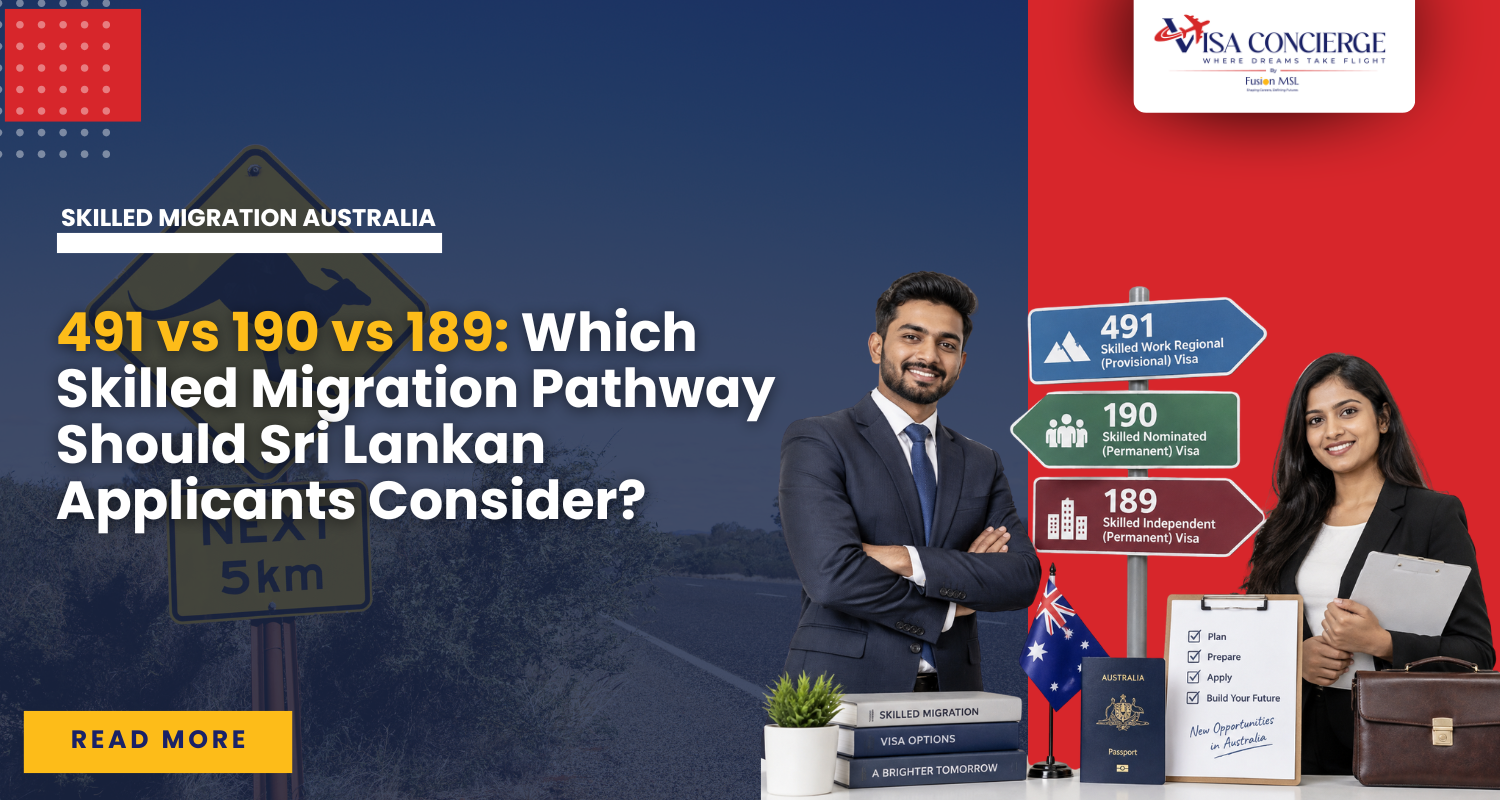
491 vs 190 vs 189: Which Skilled Migration Pathway Should Sri Lankan Applicants Consider?

If you are planning Australia skilled migration from Sri Lanka, you may have already come across three popular visa subclasses:

Subclass 189 Skilled Independent Visa

Subclass 190 Skilled Nominated Visa

Subclass 491 Skilled Work Regional Visa

At first, these pathways may look similar because they are all connected to skilled migration. But they are not the same.

Each pathway has a different purpose, different nomination requirements, different level of competition and different long-term planning approach.

This is where many applicants get confused.

Some applicants only want 189 because they hear it is independent. Some prefer 190 because it is a permanent visa. Some ignore 491 because it is regional, without properly understanding how it works.

But the right question is not, “Which visa is the best?”

The better question is:

“Which pathway is suitable for my profile?”

At Visa Concierge by Fusion MSL, we help Sri Lankan professionals review their profile, occupation, skills assessment pathway, English score, points and documents before deciding whether 189, 190 or 491 should be considered.

This article gives you a clear and simple comparison without making the process unnecessarily technical.

Why This Comparison Matters

Australia skilled migration is not a one-size-fits-all process.

Two applicants may have the same age and education level, but their pathway options can be very different because of their occupation, work experience, English score, points, family situation or state nomination possibilities.

For example, one applicant may have a strong profile for 189. Another may be more suitable for 190 because their occupation matches a state requirement. Another may have better opportunities through 491 because they are open to regional Australia.

This is why choosing a visa based only on what a friend did, what you saw online or what sounds attractive can be risky.

A skilled migration pathway should be selected after a proper profile review.

What Is the Subclass 189 Skilled Independent Visa?

The Subclass 189 Skilled Independent Visa is one of the most attractive Australia skilled migration pathways because it does not require state nomination, employer sponsorship or family sponsorship.

It is a permanent visa pathway for eligible skilled workers who receive an invitation to apply.

Many Sri Lankan applicants like the 189 visa because it offers more flexibility compared to nomination-based or regional pathways.

However, because it is independent, it can also be highly competitive.

To consider the 189 pathway, applicants usually need a strong overall profile. This may include a suitable occupation, positive skills assessment, strong English results, accurate documents and competitive points.

The 189 visa may be suitable for applicants who have a strong skilled migration profile and can compete without depending on state or regional nomination.

But it is important to remember that wanting 189 and being competitive for 189 are not the same thing.

What Is the Subclass 190 Skilled Nominated Visa?

The Subclass 190 Skilled Nominated Visa is a permanent skilled migration pathway that requires nomination by an Australian state or territory.

This means your profile must not only meet general skilled migration requirements, but also match the nomination requirements of a state or territory.

For many Sri Lankan applicants, 190 can be a strong pathway because it allows them to explore state nomination opportunities based on occupation demand and profile suitability.

However, state nomination is not automatic. Each state or territory can have its own criteria. These may change depending on occupation demand, available places, applicant location, work experience, English score and other requirements.

The 190 pathway may be suitable for applicants whose occupation and profile are attractive to a specific state or territory.

This is why proper state nomination research and pathway planning are important before moving forward.

What Is the Subclass 491 Skilled Work Regional Visa?

The Subclass 491 Skilled Work Regional Visa is a provisional regional skilled migration pathway.

It is usually connected to state or territory nomination, or sponsorship by an eligible family member living in a designated regional area of Australia.

Some applicants hesitate when they hear the word “regional.” But regional Australia does not always mean remote or isolated. Many regional areas include developed cities and growing communities with education, healthcare, employment and lifestyle opportunities.

The 491 visa is not a direct permanent visa like 189 or 190. However, it can support a long-term permanent residence pathway if the applicant meets the relevant conditions later.

For Sri Lankan applicants who are open to living and working in regional Australia, 491 can be a practical option to review.

It should not be dismissed without checking whether your profile fits the pathway.

189 vs 190 vs 491: Simple Comparison

Here is a simple way to understand the difference.

Subclass 189

This is an independent skilled visa pathway.

It does not require state nomination or family sponsorship. It is permanent, but it can be very competitive. It may suit applicants with strong points, suitable occupations and strong overall profiles.

Subclass 190

This is a state-nominated skilled visa pathway.

It is permanent, but you need nomination from an Australian state or territory. It may suit applicants whose occupations and profiles match state requirements.

Subclass 491

This is a regional skilled visa pathway.

It is provisional and requires regional commitment. It may suit applicants who are open to regional Australia and want to build a long-term skilled migration plan.

Which Visa Is Better?

There is no single answer.

The 189 visa may sound attractive because it is independent. But if your points are not competitive, waiting only for 189 may not be the best strategy.

The 190 visa may be strong if your occupation matches state nomination requirements. But if no suitable state option is available, it may not be realistic at that time.

The 491 visa may be practical if you are open to regional Australia. But it requires understanding the conditions and planning for the long term.

So instead of asking which visa is better, ask:

  • Which pathway fits my occupation?
  • Which pathway matches my points score?
  • Which pathway is realistic for my English level?
  • Which pathway supports my family plan?
  • Which pathway gives me a better chance based on my profile?
  • Which pathway can I support with proper documents?

This is where professional guidance can help.

Why Occupation Comes First

Before comparing 189, 190 and 491, your occupation must be reviewed properly.

Your job title alone is not enough.

Australian skilled migration looks at your actual duties, qualifications, work experience and supporting documents.

For example, two people may both work in IT, but one may be closer to Software Engineer while another may be closer to ICT Business Analyst or Developer Programmer.

Similarly, someone with a management title may not automatically fit a management occupation. Someone working in construction may need to check whether their profile matches an engineering, technician, trade or project-related occupation.

If your occupation is not matched correctly, your entire skilled migration plan can be affected.

That is why Visa Concierge usually starts with a profile and occupation review before discussing which visa pathway may be suitable.

Why Skills Assessment Matters

A skills assessment is an important step in many Australia skilled migration pathways.

The relevant assessing authority reviews whether your education and work experience support your nominated occupation.

For Sri Lankan applicants, this stage needs careful preparation. Employment letters, salary evidence, EPF/ETF records, academic documents, job duties and work experience claims should be consistent.

A weak skills assessment plan can delay the process or affect your pathway.

Before deciding whether to focus on 189, 190 or 491, applicants should understand whether their skills assessment pathway is realistic.

English Score Can Change the Strategy

English is not just a requirement. It can affect your skilled migration points and overall competitiveness.

Many Sri Lankan applicants delay English preparation because they think they can do it later. But this can slow down the whole process.

A stronger English score may improve your points and open better planning options. A lower score may mean you need to improve first before submitting an EOI or reviewing nomination pathways.

This is why English planning should start early.

At Visa Concierge, we encourage applicants to look at English as part of the full strategy, not as a last-minute step.

Points Are Important, But They Are Not Everything

The 189, 190 and 491 pathways are points-based.

Points may come from age, English, education, work experience, partner factors and other eligible factors.

However, one common mistake is thinking that reaching the minimum points is enough.

It is not.

Your points must be accurate and supported by documents. You must also consider competition, occupation demand, state nomination options and invitation trends.

Some applicants overestimate their points by assuming they can claim work experience or partner points without proper evidence.

This can create problems later.

A realistic points review is always better than an inflated score.

EOI Is Not a Visa Application

For 189, 190 and 491 pathways, applicants usually submit an Expression of Interest through SkillSelect.

Many applicants misunderstand this stage.

An EOI is not the same as a visa application. It is your way of showing interest and presenting your skilled migration profile for possible invitation.

If your EOI is not prepared properly, your claims may not reflect your real profile. If you receive an invitation, you must be able to prove what you claimed.

This is why applicants should avoid submitting an EOI blindly.

A good EOI strategy should be based on proper occupation matching, skills assessment, English score, points calculation and pathway review.

Why Some Applicants Should Not Focus Only on 189

The 189 visa is attractive, but it may not be realistic for every applicant.

Some Sri Lankan applicants spend months waiting for an independent pathway without checking whether 190 or 491 may be more suitable.

This can waste valuable time.

If your occupation has limited independent invitation chances, or your points are not competitive enough, it may be better to review state nomination or regional options.

This does not mean giving up on 189. It means being practical.

A smart migration plan should compare all suitable options instead of depending on only one pathway.

Why Some Applicants Should Not Choose 190 Without Research

The 190 visa is a strong permanent pathway, but it depends on state or territory nomination.

Not every occupation is in demand in every state. Not every applicant will meet state requirements.

Some applicants assume they can choose any state and apply. But the reality is more detailed than that.

Each state may have different rules, occupation lists, work experience requirements, English expectations and nomination priorities.

Before planning a 190 strategy, you should review whether your profile matches suitable state options.

Why Some Applicants Should Not Ignore 491

The 491 visa is sometimes misunderstood.

Because it is provisional and regional, some applicants reject it immediately. But for certain profiles, 491 may be a practical pathway.

If you are open to living and working in regional Australia, and your profile matches nomination or sponsorship requirements, 491 may be worth considering.

The key is to understand the conditions properly.

It should not be selected carelessly, and it should not be rejected blindly.

Common Mistakes Sri Lankan Applicants Make

Many applicants make mistakes because they start without a proper strategy.

Common mistakes include:

  • Choosing a visa based on what a friend applied for
  • Selecting the wrong occupation
  • Overestimating points
  • Delaying English preparation
  • Starting skills assessment without checking the full pathway
  • Submitting an EOI without proper review
  • Ignoring state nomination rules
  • Rejecting 491 without understanding regional options
  • Using weak employment documents
  • Trying to manage the process alone without guidance

These mistakes can lead to delays, wasted money and wrong expectations.

What Visa Concierge Reviews Before Recommending a Pathway

At Visa Concierge by Fusion MSL, we do not recommend a visa pathway only because it sounds popular.

We review your profile first.

This may include:

  • Your age
  • Your occupation
  • Your qualifications
  • Your work experience
  • Your English test status
  • Your points estimate
  • Your spouse or family details
  • Your skills assessment direction
  • Your employment documents
  • Your state nomination possibilities
  • Your willingness to consider regional Australia
  • Your long-term migration goal

After reviewing these areas, we can discuss whether 189, 190 or 491 may be suitable.

This helps applicants avoid confusion and make a more informed decision.

How Visa Concierge Can Help

Australia skilled migration can feel confusing, especially when different people give different advice.

One person may say 189 is the best. Another may say 190 is easier. Another may say 491 is the only option.

But your pathway should not be decided by general opinions.

It should be decided by your profile.

Visa Concierge by Fusion MSL helps Sri Lankan professionals understand their Australia skilled migration options in a structured and realistic way.

Our assistance may include:

  • Initial profile review
  • Occupation matching guidance
  • 189, 190 and 491 pathway comparison
  • Skills assessment document guidance
  • Points calculation discussion
  • English test planning guidance
  • EOI preparation support
  • State or territory nomination guidance where applicable
  • Family document planning
  • Coordination with qualified migration professionals where required

We do not give false promises or guaranteed outcomes.

Our goal is to help clients understand their real options before they spend money on the wrong process.

Final Thoughts

The 189, 190 and 491 visas are all important Australia skilled migration pathways.

But the best pathway depends on your profile.

The 189 visa may be suitable for strong independent skilled migration profiles.

The 190 visa may be suitable for applicants who match state nomination requirements.

The 491 visa may be suitable for applicants who are open to regional Australia and long-term planning.

For Sri Lankan applicants, the most important step is not choosing the visa name first.

The most important step is understanding your occupation, points, skills assessment, English score, EOI strategy and document strength.

A proper pathway review can save time, reduce mistakes and help you move forward with more confidence.

Planning Australia skilled migration from Sri Lanka?

Speak to Visa Concierge by Fusion MSL for a professional 189, 190 and 491 pathway review.

Call or WhatsApp: +94 77 962 9672

Website: www.visaconcierge.lk

Visa Concierge by Fusion MSL

Where your dreams take flight.

Frequently Asked Questions

1. What is the main difference between the 189, 190 and 491 visas?

Subclass 189 is an independent permanent skilled pathway, Subclass 190 is a state-nominated permanent pathway, and Subclass 491 is a provisional regional pathway connected to state or territory nomination or eligible family sponsorship.

2. Which visa is better: 189, 190 or 491?

There is no single best visa for everyone. The suitable pathway depends on your occupation, points, English score, skills assessment, state nomination possibilities, family circumstances and willingness to consider regional Australia.

3. Is the Subclass 189 visa more competitive?

Yes, it can be highly competitive because it does not rely on state nomination, employer sponsorship or family sponsorship. Applicants generally need a strong overall profile and competitive points.

4. Is Subclass 190 a permanent visa?

Yes. Subclass 190 is a permanent skilled migration pathway that requires nomination by an Australian state or territory.

5. Is Subclass 491 a permanent visa?

No. Subclass 491 is a provisional regional skilled migration pathway. It can support a longer-term permanent residence plan if the relevant future requirements are met.

6. Why should occupation matching be reviewed before choosing a visa?

Australian skilled migration looks beyond job titles. Your actual duties, qualifications, work experience and supporting evidence need to support the nominated occupation.

7. Can Visa Concierge help compare 189, 190 and 491 for my profile?

Yes. Visa Concierge reviews your occupation, qualifications, work experience, English status, points, skills assessment direction, state nomination possibilities, family details, documents and regional preferences before discussing suitable pathways.


About the Reviewer

Nimesha Perera is a Senior Consultant – Skilled Migration and Student Visa Services at Visa Concierge by Fusion MSL. She supports clients with profile reviews, occupation and pathway discussions, skilled migration planning and document preparation.

Visa invitations and decisions are made by the relevant Australian authorities. Visa Concierge does not guarantee an invitation or visa approval.

Subclass 189 Skilled Independent Visa What Sri Lankan Applicants Need to Know

189 Visa Australia from Sri Lanka | Skilled Independent Visa Guide

Last reviewed: 25 August 2026  |  Reviewed by: Nimesha Perera, Senior Consultant – Skilled Migration and Student Visa Services

Subclass 189 Skilled Independent Visa for Sri Lankan Applicants

For many Sri Lankan professionals, the dream of migrating to Australia often starts with one goal:

Australian Permanent Residency.

Among the skilled migration pathways, the Subclass 189 Skilled Independent Visa is one of the most attractive options because it does not require state nomination, employer sponsorship or family sponsorship.

However, it is also one of the most competitive skilled migration pathways.

Many applicants hear about the 189 visa and immediately think, “This is the best option for me.” But in reality, whether 189 is suitable depends on your occupation, points score, skills assessment, English results, work experience, documents and invitation chances.

At Visa Concierge by Fusion MSL, we help Sri Lankan professionals understand whether the 189 visa is realistic for their profile, while also reviewing other skilled migration pathways such as 190, 491, and 189 where suitable.

This article explains what Sri Lankan applicants should know before planning the Subclass 189 Skilled Independent Visa.

What Is the Subclass 189 Skilled Independent Visa?

The Subclass 189 Skilled Independent Visa is a permanent skilled migration visa for eligible applicants who have skills needed in Australia.

It is called “independent” because applicants do not need to be nominated by an Australian state or territory, sponsored by an employer or sponsored by a family member.

For many skilled professionals, this makes the 189 visa highly attractive.

If granted, the visa allows eligible applicants to live and work in Australia permanently. It may also allow eligible family members to be included in the application.

However, the 189 visa is not open to everyone. Applicants must meet specific requirements and receive an invitation before applying.

This is why professional guidance is important before starting the process.

Is the 189 Visa the Same as Australia PR?

The 189 visa is a permanent visa pathway. This is why many Sri Lankan applicants refer to it as an “Australia PR visa.”

However, it is important to understand that you cannot simply apply for it whenever you want.

The process usually involves checking your occupation, completing a skills assessment, preparing English test results, submitting an Expression of Interest and waiting for a possible invitation.

Only after receiving an invitation can you submit the visa application.

This is why the 189 visa should be planned carefully from the beginning.

Basic Eligibility Factors for the 189 Visa

Every applicant’s profile must be assessed individually. However, Sri Lankan applicants should usually review the following key areas.

1. Occupation Suitability

Your occupation must be relevant to the skilled migration pathway.

This is where many applicants make mistakes. Your job title alone is not enough. Your actual duties, qualifications, work experience and documents must support the occupation you want to nominate.

For example, two people may both work in IT, but one may be closer to Software Engineer while another may be closer to ICT Business Analyst, Developer Programmer, Systems Analyst or another occupation.

Choosing the wrong occupation can affect your skills assessment and overall skilled migration plan.

2. Skills Assessment

A skills assessment is one of the most important steps for Australia skilled migration.

The relevant assessing authority reviews whether your qualifications and work experience match the occupation you are nominating.

For Sri Lankan applicants, this stage must be planned properly because employment letters, salary evidence, EPF/ETF records, academic documents and job duties may need to be prepared carefully.

If your skills assessment pathway is weak, your 189 plan may not be realistic.

3. English Language

English results can play a major role in your skilled migration strategy.

A stronger English score may improve your points and make your profile more competitive. Many Sri Lankan applicants delay English test preparation, but this can create unnecessary delays later.

If you are serious about 189, English planning should start early.

4. Points Score

The 189 visa is points-tested. Points may be based on factors such as age, English ability, qualifications, skilled employment, partner factors and other eligible criteria.

Meeting the minimum points requirement does not guarantee an invitation.

This is one of the biggest misunderstandings among applicants. Your profile must be competitive enough to receive an invitation, and invitation chances can vary depending on occupation demand and government invitation rounds.

5. Expression of Interest

For the 189 visa, applicants must submit an Expression of Interest through SkillSelect.

An EOI is not a visa application. It is a way of expressing your interest and presenting your profile for possible invitation.

Your EOI must be accurate. The points and claims you include should be supported by documents. If you receive an invitation, you must be ready to prove the information you claimed.

Why Some Sri Lankan Applicants May Not Be Ready for 189 Yet

The 189 visa is attractive, but not every skilled applicant is ready for it immediately.

Some applicants may have a suitable occupation but a low English score. Some may have strong work experience but weak documents. Some may have a degree but their occupation match is unclear. Some may meet minimum points but still not be competitive.

This does not always mean Australia skilled migration is impossible.

It may mean your strategy needs to be adjusted.

For example, you may need to:

  • Improve your English score
  • Prepare stronger employment documents
  • Review a different occupation match
  • Compare 190 or 491 options
  • Consider employer-sponsored pathways
  • Prepare a stronger skills assessment file
  • Review spouse or partner points
  • Build a proper timeline before submitting an EOI

This is why a professional profile review is important before spending money on the wrong step.

Common Mistakes Applicants Make with the 189 Visa

1. Assuming 189 Is the Only Good Pathway

Many applicants focus only on 189 because it is independent and permanent. But for some profiles, 190, 491, 186 or 482 may be more suitable.

2. Choosing an Occupation Based Only on Job Title

Your job title does not automatically decide your occupation. Your actual duties and evidence matter.

3. Overestimating Points

Online points calculators can be useful, but applicants may misunderstand what they can actually claim. Points must be supported with proper evidence.

4. Delaying English Test Preparation

English can strongly affect your points. Waiting too long can delay your whole plan.

5. Submitting an EOI Without a Strategy

An EOI should not be submitted blindly. Your claims must be accurate and your documents should be ready.

6. Using Weak Employment Documents

Basic service letters may not be enough. Employment evidence should clearly support your role, duties, work period and salary history.

7. Trying to Handle Everything Alone

Many applicants research online and try to manage the full skilled migration process by themselves. While research is useful, Australian skilled migration involves occupation matching, points strategy, skills assessment, documents, EOI preparation and visa pathway comparison.

One wrong assumption at the beginning can affect the entire plan.

Why Professional Guidance Matters

The 189 visa may look simple from the outside because it does not require state nomination or employer sponsorship. But the process can still be complex.

You need to understand:

  • Which occupation matches your profile
  • Whether your skills assessment pathway is realistic
  • How many points you can claim
  • Whether your documents support your claims
  • Whether your EOI is prepared correctly
  • Whether 189 is realistic or another pathway should be considered
  • How your spouse or family documents may affect the plan
  • What risks should be addressed before moving forward

This is where Visa Concierge can support you.

We help applicants avoid guesswork and understand their real options before starting the process.

How Visa Concierge Can Help

Visa Concierge by Fusion MSL supports Sri Lankan professionals who are exploring Australia skilled migration options.

Our assistance may include:

  • Initial profile review
  • Occupation matching guidance
  • Skilled migration pathway comparison
  • 189, 190 and 491 review where suitable
  • 186 and 482 employer-sponsored pathway discussion where relevant
  • Skills assessment document guidance
  • Employment evidence checklist
  • CV and job duties review
  • English test planning guidance
  • Points discussion
  • EOI preparation support
  • Family document guidance
  • Coordination with qualified migration professionals where required

Our goal is to help applicants understand their realistic options before spending money on the wrong pathway.

We do not believe in giving false promises. Instead, we help clients plan carefully, prepare correctly and move forward with a clear understanding of the process.

Is the 189 Visa Right for You?

The 189 visa may be suitable if you have a strong skilled migration profile, a suitable occupation, a positive skills assessment pathway, strong English results, accurate documents and competitive points.

But if your profile is not ready yet, that does not mean your Australia migration dream is over.

It may mean you need to review other pathways or strengthen your profile before moving forward.

The best approach is to start with a proper profile assessment.

Final Thoughts

The Subclass 189 Skilled Independent Visa is one of the most attractive Australia skilled migration pathways for Sri Lankan professionals. It offers independence, flexibility and permanent residence opportunities for eligible applicants.

However, it is also competitive.

Before focusing only on 189, take time to understand your occupation, skills assessment, English score, points, EOI strategy and alternative pathways.

The right migration plan is not always the pathway that sounds best. It is the pathway that fits your profile.

Planning Australia skilled migration from Sri Lanka?

Speak to Visa Concierge by Fusion MSL for a professional profile assessment and pathway discussion.

Call or WhatsApp: +94 77 962 9672

Website: www.visaconcierge.lk

Visa Concierge by Fusion MSL

Where your dreams take flight.

Frequently Asked Questions

What is the Subclass 189 Skilled Independent Visa?

The Subclass 189 Skilled Independent Visa is a permanent skilled migration visa for eligible applicants who have skills needed in Australia. It does not require state or territory nomination, employer sponsorship or family sponsorship.

Does meeting the minimum points requirement guarantee an invitation?

No. Meeting the minimum points requirement does not guarantee an invitation. Applicants still need a competitive profile, and invitation chances can vary depending on occupation demand and government invitation rounds.

Do I need a skills assessment for the 189 visa?

A skills assessment is one of the key steps in Australia skilled migration. The relevant assessing authority reviews whether your qualifications and work experience match the occupation you are nominating.

Is an Expression of Interest the same as a visa application?

No. An EOI is not a visa application. It presents your profile for possible invitation, and the points and claims included should be accurate and supported by documents.

Why are English results important for the 189 pathway?

A stronger English score may improve your points and make your profile more competitive. The article recommends starting English planning early.

What if my profile is not competitive for 189 yet?

You may need to strengthen your English score, improve employment documents, review occupation matching, compare 190 or 491 options, consider employer-sponsored pathways or review partner points.

Can Visa Concierge guarantee a 189 invitation or visa approval?

No. Visa Concierge does not give false promises or guarantee outcomes. Its role is to help applicants understand realistic options, prepare correctly and plan the pathway carefully.

Information and Review Note

This article provides general information for Sri Lankan applicants exploring the Subclass 189 Skilled Independent Visa and related Australia skilled migration pathways. Occupation requirements, skills assessment criteria, points settings, invitation processes, visa requirements and government policies may change and may differ according to individual circumstances. Applicants should review the latest official requirements and obtain personalised guidance before proceeding.

Last reviewed: 25 August 2026

About the Reviewer

Nimesha Perera is a Senior Consultant – Skilled Migration and Student Visa Services at Visa Concierge by Fusion MSL. She supports clients with profile reviews, occupation and pathway discussions, skilled migration planning and document preparation.

Visa invitations and decisions are made by the relevant Australian authorities. Visa Concierge does not guarantee an invitation or visa approval.

ANZSCO and Occupation Matching Explained for Australia Skilled Migration Applicants

Occupation Matching for Australia Skilled Migration from Sri Lanka

Last reviewed: 17 August 2026  |  Reviewed by: Nimesha Perera, Senior Consultant – Skilled Migration and Student Visa Services

Planning Australia Skilled Migration from Sri Lanka?

Before you focus only on the visa subclass, there is one important question you should answer first:

Is your occupation correctly matched?

Many Sri Lankan applicants start their Australia migration journey by asking:

  • “Can I apply for 189?”
  • “Can I apply for 190?”
  • “Is 491 suitable for me?”
  • “Can I apply through an employer-sponsored visa like 186 or 482?”

These are all important questions. But before deciding the visa pathway, your occupation must be reviewed properly.

In Australian skilled migration, your job title alone is not enough. Your actual duties, qualifications, work experience and supporting documents must align with the correct occupation pathway. This is where ANZSCO occupation matching becomes important.

At Visa Concierge by Fusion MSL, we help Sri Lankan professionals understand whether their profile is suitable for Australia skilled migration by reviewing their occupation, duties, documents and available visa options before they move forward.

What Is ANZSCO?

ANZSCO stands for Australian and New Zealand Standard Classification of Occupations.

In simple terms, it is a system used to classify occupations. Each occupation has a specific occupation title and occupation code. For Australian skilled migration, this classification helps identify how your role may be recognised and which visa pathways may be relevant.

For example, a person working in IT may not simply apply as an “IT professional.” Their duties may need to be reviewed to understand whether they are closer to Software Engineer, ICT Business Analyst, Developer Programmer, Systems Analyst, Network Administrator or another occupation.

The same applies to engineering, accounting, construction, hospitality, healthcare, education, trades, management and many other fields.

Key point: The first step is not guessing the visa. The first step is understanding your occupation.

Why Occupation Matching Matters for Australia Skilled Migration

Occupation matching is one of the most important parts of Australia skilled migration planning.

Your nominated occupation can affect:

  • Which skilled visa pathways may be suitable
  • Whether your occupation appears on a relevant skilled occupation list
  • Which skills assessment authority may apply
  • What documents you may need
  • Whether your work experience supports the selected occupation
  • Whether your profile is suitable for points-tested migration
  • Whether employer-sponsored options may be realistic
  • How your overall migration strategy should be prepared

A wrong occupation match can lead to confusion, wasted money and delays.

For example, an applicant may assume they are eligible because their job title sounds similar to an occupation on a list. But if their actual duties and documents do not support that occupation, the pathway may not be suitable.

This is why professional occupation mapping is important before starting the process.

Job Title vs Actual Duties

One of the biggest mistakes Sri Lankan applicants make is relying only on their job title.

In Sri Lanka, job titles can vary widely between companies. A “Manager” in one company may perform technical duties, while a “Coordinator” in another company may handle responsibilities that are more senior. An “Executive” title may also mean different things depending on the industry.

Australian skilled migration looks beyond the title.

It considers what you actually do in your role.

For example:

  • A Software Engineer and an ICT Business Analyst may both work in IT, but their duties are different.
  • A Civil Engineer and an Engineering Technologist may both work in engineering, but the correct occupation may depend on qualifications and technical duties.
  • A Chef and a Cook may both work in kitchens, but the occupation classification and evidence may differ.
  • An Accountant and an Auditor may both work in finance, but the pathway may not be the same.
  • A Project Manager and a Construction Project Manager may sound similar, but the duties and industry background can change the occupation direction.

This is why your CV, employment letters and job duties must be reviewed carefully.

Occupation Matching and Skilled Visa Pathways

Australia skilled migration is not limited to one visa category. Different applicants may be suitable for different pathways depending on their profile.

Subclass 189 Skilled Independent Visa

The 189 visa is a points-tested skilled migration pathway. It does not require state nomination, but it can be competitive. Your occupation, skills assessment, English score, points and invitation chances must be reviewed carefully before planning this pathway.

Subclass 190 Skilled Nominated Visa

The 190 visa is a state-nominated skilled migration pathway. Your occupation must be relevant to state or territory requirements, and your profile must match the nomination criteria. A strong occupation match is important before preparing an Expression of Interest or nomination strategy.

Subclass 491 Skilled Work Regional Visa

The 491 visa is a regional skilled migration pathway. It can be suitable for applicants who are open to designated regional areas of Australia. Occupation suitability, skills assessment, points and nomination or sponsorship options must be reviewed before moving forward.

Why Occupation Matching Affects Skills Assessment

A skills assessment is a key stage in many Australia skilled migration pathways.

The relevant assessing authority may review whether your qualifications and work experience support your nominated occupation. This is why choosing the right occupation matters before starting the skills assessment process.

If the occupation is not matched properly, you may prepare the wrong documents or submit under a pathway that does not fit your actual profile.

For Sri Lankan applicants, this can become a major issue because employment evidence may take time to collect. Previous employers may delay reference letters. Some companies may only issue basic service letters. Salary evidence, EPF/ETF records, bank statements and detailed duty descriptions may need to be arranged carefully.

A proper occupation review helps you understand what evidence is important before you spend money on the next step.

Common Occupation Matching Mistakes

1. Choosing an Occupation Based Only on Job Title

Your job title may not fully explain your actual role. Occupation matching should consider your daily duties, responsibilities, qualification background and work evidence.

2. Copying Duties from the Internet

Some applicants copy duties from online occupation descriptions and add them to employment letters. This is risky. Your duties must reflect your real work experience and should be supported by your documents.

3. Ignoring Qualification Relevance

Your education background can matter. If your qualification does not strongly support your selected occupation, your profile may need further review.

4. Assuming All IT Roles Are the Same

IT is a broad field. Software development, business analysis, cybersecurity, systems support, networking, data and project roles may fall under different occupation classifications.

5. Assuming All Engineering Roles Are the Same

Engineering profiles must be reviewed carefully based on qualification, experience and technical duties. The correct occupation cannot be chosen only from the job title.

6. Looking Only at One Visa Pathway

Some applicants focus only on 189, 190, 491, 186 or 482 without checking whether another pathway may be more suitable. A proper review can help identify realistic options based on your profile.

7. Moving Forward Without Professional Guidance

Trying to choose your occupation, pathway and documents alone can lead to mistakes. Skilled migration has multiple steps, and one wrong assumption at the beginning can affect the rest of the process.

What Sri Lankan Applicants Should Prepare Before an Occupation Review

Before contacting Visa Concierge for an occupation mapping discussion, it is helpful to prepare basic information about your profile.

You do not need to know everything in advance. That is what the consultation is for. But the following details can help us understand your case better:

  • Updated CV
  • Current job title
  • Previous job titles
  • Main daily duties
  • Education qualifications
  • Professional qualifications, if any
  • Total years of work experience
  • Industry background
  • English test status, if available
  • Spouse’s basic profile, if applicable
  • Preferred migration goal
  • Any employer offer or employer interest, if applicable

For a stronger review, you can also share a short summary of what you actually do at work. This helps us understand whether your job title and actual duties match the same occupation direction.

Why You Should Not Guess Your Occupation Pathway

Many applicants search online and try to select an occupation by themselves.

While research is useful, choosing your occupation without proper review can create problems.

You may select an occupation that sounds close but does not match your duties. You may miss a better occupation option. You may prepare the wrong employment letters. You may calculate points incorrectly. You may move forward with a skills assessment or visa pathway that is not suitable.

Australia skilled migration is not only about finding an occupation name. It is about building a complete strategy around your profile.

That includes:

  • Occupation matching
  • Skills assessment pathway
  • Evidence strength
  • English planning
  • Points calculation where applicable
  • EOI strategy where applicable
  • Employer-sponsored pathway review where applicable
  • Family document planning
  • Long-term migration goal

This is where professional guidance can make the process clearer and more practical.

How Visa Concierge Can Help

At Visa Concierge by Fusion MSL, we help Sri Lankan professionals avoid guesswork in Australia skilled migration.

Our team can assist with:

  • Initial profile review
  • Occupation mapping discussion
  • CV and job duty review
  • Skilled visa pathway comparison
  • 189, 190 and 491 points-tested pathway review
  • Skills assessment document guidance
  • Employment evidence checklist
  • English test planning guidance
  • EOI preparation support where applicable
  • Family document planning
  • Coordination with qualified migration professionals where required

Our approach is not to promise guaranteed outcomes. Instead, we help applicants understand their realistic options and prepare in a structured way.

For many clients, the most valuable starting point is not submitting an application immediately. It is identifying whether their occupation, documents and profile can support the pathway they are considering.

Why a Professional Review Can Save Time and Money

Trying to handle occupation matching alone may look simple at first. But mistakes at this stage can affect the full skilled migration journey.

If you choose the wrong occupation, you may spend money on the wrong assessment process. If your documents do not support your selected occupation, you may face delays. If your EOI is prepared without a proper strategy, you may not be presenting your profile correctly. If you rely only on an employer offer without checking requirements, you may misunderstand your actual eligibility.

A professional review can help you avoid unnecessary confusion.

It can also help you understand what to improve before starting the main process.

Some applicants may need stronger English results. Some may need better employment letters. Some may need to review a spouse profile. Some may need to compare points-tested and employer-sponsored pathways. Some may need to prepare more evidence before moving forward.

Every applicant is different. That is why personal profile review matters.

Final Thoughts

Occupation matching is one of the first and most important steps in Australia skilled migration.

For Sri Lankan applicants, the right occupation match can shape the entire pathway. It can affect your skills assessment, points-tested visa options, employer-sponsored visa options, EOI strategy, nomination possibilities and document preparation.

Do not choose your occupation based only on your job title.

Do not guess your pathway from online searches.

Do not spend money on the next step without understanding whether your profile is properly matched.

Start with a structured profile review and understand your real options.

Planning Australia skilled migration from Sri Lanka?

Speak to Visa Concierge by Fusion MSL for a professional occupation and pathway review.

Call or WhatsApp: +94 77 962 9672  |  Website: www.visaconcierge.lk

Frequently Asked Questions

What is ANZSCO?

ANZSCO stands for Australian and New Zealand Standard Classification of Occupations. It is a system used to classify occupations using specific occupation titles and codes.

Can I choose my occupation based only on my job title?

No. Your actual duties, responsibilities, qualifications, work experience and supporting documents should be reviewed when considering the correct occupation direction.

Why does occupation matching matter for Australia skilled migration?

Your nominated occupation can affect relevant skilled visa pathways, skills assessment requirements, document preparation, points-tested options, employer-sponsored options and your overall migration strategy.

Can similar job titles lead to different occupation matches?

Yes. Job titles can vary widely between employers and industries, so the duties actually performed in the role are important when reviewing occupation direction.

How can occupation matching affect a skills assessment?

The relevant assessing authority may review whether your qualifications and work experience support your nominated occupation. A poor occupation match can lead to the wrong evidence or an unsuitable assessment pathway.

Which skilled visa pathways are discussed in this guide?

The article discusses the Subclass 189 Skilled Independent Visa, Subclass 190 Skilled Nominated Visa and Subclass 491 Skilled Work Regional Visa, while also noting employer-sponsored options such as 186 and 482.

What should I prepare for an occupation review?

Useful information includes an updated CV, current and previous job titles, daily duties, qualifications, total work experience, English test status, spouse profile where applicable, migration goals and any employer interest or offer.

Does Visa Concierge guarantee an invitation or visa approval?

No. Visa Concierge helps applicants understand realistic options and prepare in a structured way, but visa invitations and decisions are made by the relevant Australian authorities.

Information and Review Note

This article provides general information for Sri Lankan applicants exploring Australia skilled migration. Occupation classifications, skilled occupation lists, skills assessment requirements, state nomination criteria, employer-sponsored requirements, invitation processes and visa conditions may change and may differ according to individual circumstances. Applicants should review current official requirements and obtain personalised guidance before proceeding.

Last reviewed: 17 August 2026

About the Reviewer

Nimesha Perera is a Senior Consultant – Skilled Migration and Student Visa Services at Visa Concierge by Fusion MSL. She supports clients with profile reviews, occupation and pathway discussions, skilled migration planning and document preparation.

Visa invitations and decisions are made by the relevant Australian authorities. Visa Concierge does not guarantee an invitation or visa approval.

Why Regional Australia Can Be a Smart Pathway for Skilled Sri Lankan Professionals

Why Regional Australia Can Be a Smart Pathway for Skilled Sri Lankan Professionals

Last reviewed: 4 September 2026  |  Reviewed by: Nimesha Perera, Senior Consultant – Skilled Migration and Student Visa Services

Why Regional Australia Can Be a Smart Pathway for Skilled Sri Lankan Professionals

For many Sri Lankan professionals, the dream of moving to Australia often starts with one question:

“Can I get Australia PR?”

This is a very common question. However, the better question is:

“Which Australian skilled migration pathway is suitable for my profile?”

Many applicants first think about living in Sydney, Melbourne or Brisbane. These cities are well-known, popular and highly competitive. But Australia is much bigger than its major cities. For skilled professionals, regional Australia can offer a practical and valuable migration pathway, especially through the Subclass 491 Skilled Work Regional Visa.

At Visa Concierge by Fusion MSL, our Australia skilled migration focus is mainly on the 491 pathway, while also reviewing 190 and 189 options where suitable. For many Sri Lankan applicants, understanding regional Australia can open a clearer and more realistic migration plan.

What Does “Regional Australia” Mean?

One of the biggest misunderstandings among Sri Lankan applicants is the word “regional.”

Many people think regional Australia means only remote villages, isolated areas or places with no career opportunities. This is not always true.

For migration purposes, regional Australia includes many areas outside Australia’s major cities. Some regional areas include well-developed cities and major regional centres with universities, hospitals, businesses, industries, public services and growing communities.

Examples of well-known regional or regional-classified areas may include places such as Adelaide, Perth, Gold Coast, Canberra, Hobart, Geelong, Newcastle, Wollongong and other regional centres, depending on the official classification and postcode rules.

So, regional Australia does not automatically mean “no opportunities.” It means you must live, work and study in a designated regional area according to the visa conditions and official rules.

This is why Sri Lankan applicants should not reject the 491 pathway simply because they hear the word “regional.”

What Is the Australia 491 Visa?

The Subclass 491 Skilled Work Regional Visa is a provisional skilled visa for eligible applicants who want to live and work in regional Australia.

This visa is usually connected to either:

1. Nomination by an Australian state or territory government, or

2. Sponsorship by an eligible family member living in a designated regional area of Australia.

The 491 visa is not an immediate permanent residency visa. It is a provisional visa that can support a long-term pathway if the applicant meets the relevant conditions later.

For Sri Lankan professionals, the 491 pathway can be especially important because it may provide more strategic options than only waiting for highly competitive direct permanent pathways.

Why Regional Australia Can Be a Smart Option

Choosing a skilled migration pathway is not only about choosing a visa subclass. It is also about choosing a realistic strategy.

Regional Australia may be a smart option for some Sri Lankan applicants because it can support:

  • Skilled migration planning through the 491 pathway
  • State or territory nomination opportunities
  • Long-term settlement planning
  • Family migration planning
  • Career growth in areas with skill needs
  • A possible pathway to permanent residence through the 191 visa, subject to meeting conditions

For many applicants, the 491 pathway may be worth considering when 189 or 190 options are highly competitive or not immediately suitable.

Regional Australia Is Not Just About Migration

A strong migration decision should not be based only on visa eligibility. You should also think about lifestyle, family, employment, cost of living, education and long-term settlement.

Regional Australia may offer a different lifestyle compared to major cities. Some applicants may prefer smaller communities, less congestion, lower living pressure and a more balanced environment for family life.

For skilled professionals with spouses and children, regional planning can also involve schools, childcare, housing, employment opportunities for the spouse and access to community support.

This is why the 491 visa should not be treated as only a “backup option.” For the right applicant, it can be a practical pathway that supports both career and family goals.

Who Should Consider the 491 Regional Pathway?

The 491 pathway may be suitable for Sri Lankan professionals who:

  • Have a skilled occupation relevant to Australia’s skilled migration framework
  • Are willing to live and work in regional Australia
  • Have qualifications and work experience that can support a skills assessment
  • Can work towards a competitive English score
  • Want to explore state or territory nomination
  • Have eligible family members in regional Australia, where applicable
  • Are open to a long-term pathway rather than expecting immediate PR
  • Want to understand whether 491, 190 or 189 is better for their profile

It may be especially relevant for professionals in areas such as IT, engineering, construction, healthcare, accounting, education, trades, agriculture, hospitality, business and other skilled occupations, depending on the current occupation lists and nomination requirements.

However, eligibility must always be checked properly. Your job title alone is not enough.

The Importance of Occupation Matching

One of the first steps in any Australia skilled migration plan is occupation matching.

Many Sri Lankan applicants use general job titles such as “Manager,” “Engineer,” “IT Executive,” “Accountant,” “Technician” or “Supervisor.” But Australian skilled migration looks deeper than the title.

Your actual duties, responsibilities, qualification background and work experience evidence must match the nominated occupation.

For example, two applicants may both work in IT, but one may be better matched to Software Engineer, while another may be closer to ICT Business Analyst, Developer Programmer or Systems Analyst. Similarly, someone in construction may need to review whether their profile aligns with a technical, professional or trade-related occupation.

This is why a proper profile assessment is important before choosing the visa pathway.

Skills Assessment Comes Before the Visa Plan

For most skilled migration pathways, a positive skills assessment is a major step.

The relevant assessing authority will review whether your qualifications and work experience match the nominated occupation. This can involve academic documents, employment reference letters, salary evidence, EPF/ETF records, job descriptions and other supporting documents.

For Sri Lankan applicants, the skills assessment stage often takes time because documents must be collected from universities, employers and previous workplaces.

If your skills assessment pathway is not realistic, your 491 plan may also become weak. That is why skills assessment should be considered early.

English and Points Matter

The 491 visa is points-tested. Your age, qualifications, English level, skilled employment, partner factors and nomination or sponsorship factors can all affect your points.

Many applicants in Sri Lanka underestimate the importance of English preparation. A stronger English score can improve your points and may make your profile more competitive.

This is why it is better to start English preparation early instead of waiting until the last minute.

A realistic points calculation should be done before lodging an Expression of Interest. Overclaiming points or misunderstanding the points system can create serious issues later.

State or Territory Nomination

For many applicants, the 491 visa may involve state or territory nomination.

Each state or territory can set its own nomination criteria. These requirements can change depending on occupation demand, available places, applicant location, work experience, English level, commitment to the region and other factors.

This means you should not assume that one state’s rules apply to all of Australia.

A good 491 strategy should review:

  • Which states or territories may be suitable
  • Whether your occupation is relevant
  • Whether your work experience supports the application
  • Whether your English score is strong enough
  • Whether your documents are ready
  • Whether your profile matches the nomination requirements

This is why timing and preparation matter.

Family Sponsorship Option

Some applicants may be able to consider the family-sponsored 491 route if they have an eligible relative living in a designated regional area of Australia.

However, this must be reviewed carefully. The sponsor’s relationship, location, eligibility and supporting documents must be checked before assuming this pathway is available.

Having a relative in Australia does not automatically mean you can apply. The correct requirements must be met.

Can the 491 Visa Lead to PR?

The 491 visa may support a pathway to permanent residence through the Subclass 191 Permanent Residence Skilled Regional Visa, if the applicant meets the relevant requirements.

This is one of the reasons the 491 pathway is important for Sri Lankan professionals who are willing to build a long-term plan in regional Australia.

However, applicants must understand that PR is not automatic. You must comply with visa conditions and meet the requirements for the future pathway.

This is why your 491 plan should be built carefully from the beginning. The goal should not only be to get the first visa. The goal should be to understand the full journey.

491 vs 190 vs 189: Why You Should Compare All Three

Even though Visa Concierge’s main Australia skilled migration focus is the 491 pathway, we also review 190 and 189 options where suitable.

The Subclass 189 Skilled Independent Visa is a permanent pathway for invited skilled workers. It does not require state or territory nomination, but it can be highly competitive.

The Subclass 190 Skilled Nominated Visa is a permanent pathway that requires nomination by an Australian state or territory.

The Subclass 491 Skilled Work Regional Visa is a provisional regional pathway that can support long-term PR planning through the 191 visa, subject to meeting conditions.

For many Sri Lankan applicants, it is better to compare 491, 190 and 189 together instead of randomly choosing one visa subclass.

Your profile may be stronger for one pathway than another depending on occupation, points, English, work experience and nomination options.

Common Misunderstandings About Regional Australia

“Regional means no jobs.”

This is not always true. Many regional areas have healthcare, construction, IT, education, engineering, trade, hospitality, business and public sector opportunities. The suitability depends on your occupation and the local labour market.

“491 is not useful because it is not PR immediately.”

The 491 is provisional, but it can be part of a long-term PR pathway if you meet the relevant requirements later. It should be understood as a planned pathway, not dismissed without review.

“I can choose any regional area.”

You must follow the visa conditions and designated regional area requirements. The correct postcode and state/territory rules must be checked.

“If my friend applied, I can also apply.”

Each profile is different. Age, occupation, English, qualification, work experience, partner details and documents can change the strategy.

“I can apply first and prepare documents later.”

This is risky. Skilled migration requires accurate and consistent documents from the beginning.

Documents Sri Lankan Applicants Should Start Preparing

If you are planning for the 491 pathway, you may need to prepare documents such as:

  • Passport
  • Birth certificate
  • Marriage certificate, if applicable
  • Updated CV
  • Degree certificates
  • Academic transcripts
  • Professional qualifications
  • Employment reference letters
  • Appointment letters
  • Promotion letters, if available
  • Salary slips
  • Bank statements showing salary deposits
  • EPF/ETF records, where applicable
  • Tax records, if available
  • English test results
  • Skills assessment documents
  • Partner and dependent documents, if applicable
  • Family sponsorship evidence, if relevant

The exact checklist depends on your occupation, assessing authority and visa pathway.

Why Sri Lankan Applicants Should Start Early

Australia skilled migration is not a quick process. It requires preparation, planning and patience.

Sri Lankan applicants may need time for:

  • English test preparation
  • Skills assessment documents
  • Employer reference letters
  • Academic records
  • Points improvement
  • State nomination research
  • EOI preparation
  • Family document preparation

Waiting too long can reduce your options, especially if age points change or nomination requirements are updated.

Early planning gives you time to build a stronger profile.

How Visa Concierge Can Help

At Visa Concierge by Fusion MSL, we help Sri Lankan professionals understand their Australia skilled migration options through a structured and realistic approach.

Our support may include:

  • Initial profile review
  • 491 eligibility discussion
  • 190 and 189 pathway comparison where suitable
  • Occupation matching guidance
  • Skills assessment document guidance
  • Points calculation guidance
  • English test planning guidance
  • EOI preparation support
  • State or territory nomination guidance
  • Family document checklist support
  • Coordination with qualified migration professionals where required

Our goal is to help applicants make informed decisions before spending money on the wrong pathway or submitting incomplete documents.

Final Thoughts

Regional Australia can be a smart skilled migration pathway for the right Sri Lankan professional. It is not only about moving away from major cities. It is about understanding where your skills may fit, how your profile can be strengthened and whether the 491 pathway can support your long-term migration goal.

If you are serious about Australia skilled migration, do not focus only on “PR” as a word. Focus on the correct pathway, correct occupation, correct documents and correct strategy.

The 491 visa may not be suitable for everyone, but for many skilled Sri Lankan applicants, it is worth reviewing carefully.

Planning to explore the Australia 491 regional skilled pathway?

Speak to Visa Concierge by Fusion MSL for a professional profile assessment and pathway discussion.

Call or WhatsApp: +94 77 962 9672

Website: www.visaconcierge.lk

Visa Concierge by Fusion MSL

Where your dreams take flight.

About the Reviewer

Nimesha Perera is a Senior Consultant – Skilled Migration and Student Visa Services at Visa Concierge by Fusion MSL. She supports clients with profile reviews, occupation and pathway discussions, skilled migration planning and document preparation.

Visa invitations and decisions are made by the relevant Australian authorities. Visa Concierge does not guarantee an invitation or visa approval.

Article Banners (1500 x 800 px)

Skills Assessment for Australia: Why It Comes Before Your Skilled Visa Plan

Last reviewed: 4 September 2026  |  Reviewed by: Nimesha Perera, Senior Consultant – Skilled Migration and Student Visa Services

Australia Skills Assessment Guide for Sri Lankan Applicants

For many Sri Lankan professionals, Australia is one of the most attractive destinations for skilled migration. The opportunity to build a career, settle with family, explore regional pathways and work towards long-term residency makes Australia a popular choice among skilled workers in Sri Lanka.

However, before thinking about applying for the Australia 491, 190 or 189 visa, there is one important step that many applicants must understand clearly:

Skills assessment.

A skills assessment is not just another document. It is one of the foundation points of an Australian skilled migration plan. Without understanding your occupation, assessing authority, qualification background and work experience evidence, it is difficult to build a proper migration strategy.

At Visa Concierge, we often meet applicants who first ask, “Can I apply for Australia PR?” or “Am I eligible for the 491 visa?” These are important questions, but before answering them properly, we need to look at your skills assessment pathway.

What Is a Skills Assessment?

A skills assessment is a formal assessment of your qualifications, skills and work experience by the relevant assessing authority in Australia.

In simple terms, the assessing authority checks whether your education and/or professional experience match the occupation you want to nominate for skilled migration.

For example, if you are applying as an engineer, your profile may need to be assessed by the relevant engineering assessing authority. If you are applying under an IT, accounting, trade, healthcare, construction, business or management-related occupation, a different assessing body may apply.

This is why skills assessment is not the same for every applicant. The process depends on your nominated occupation, your qualifications, your work history and the specific requirements of the assessing authority.

Why Skills Assessment Matters for Sri Lankan Applicants

Many Sri Lankan applicants have strong qualifications and years of professional experience. However, Australian skilled migration does not look only at your job title.

It looks at whether your occupation, duties, qualifications and documents match the Australian requirements.

For example, two applicants may both work in IT, but one may be better matched to Software Engineer while another may be closer to ICT Business Analyst, Developer Programmer or Systems Analyst. Similarly, someone working in construction may not automatically fit every construction-related occupation. The actual duties and evidence matter.

This is why the skills assessment stage is important. It helps confirm whether your profile can support the skilled migration pathway you are planning.

Skills Assessment and the 491 Visa

Visa Concierge’s current skilled migration focus for Australia is mainly the Subclass 491 Skilled Work Regional Visa, while also reviewing suitable 190 and 189 options where possible.

For the 491 visa, skills assessment is a key step because your nominated occupation must be suitable for the pathway you are pursuing. If your occupation is not assessed correctly, your entire migration plan may be affected.

The 491 pathway is often considered by Sri Lankan professionals who are open to regional Australia and want to build a long-term pathway. It can be a strong option for eligible applicants, but it must be planned properly from the beginning.

A positive skills assessment can help support your skilled migration profile, but it does not automatically guarantee a visa invitation or visa approval. It is one important part of a larger process that may include English results, points score, state or territory nomination, Expression of Interest and supporting documents.

Skills Assessment and 190 / 189 Visas

While 491 is an important pathway, some Sri Lankan applicants may also be suitable for the 190 or 189 visa.

The Subclass 190 Skilled Nominated Visa is a state-nominated permanent visa pathway. The Subclass 189 Skilled Independent Visa is an independent skilled visa pathway that does not require state nomination.

For both pathways, a proper occupation match and skills assessment are very important. These visas can be competitive, so applicants must understand their points, occupation demand, English score and documentation strength before deciding which pathway to follow.

This is why Visa Concierge recommends checking 491, 190 and 189 together instead of only looking at one subclass in isolation.

Why Skills Assessment Should Come Before the Visa Plan

Many applicants make the mistake of choosing a visa first and checking the skills assessment later. This can create problems.

A better approach is:
  1. Identify your possible occupation.
  2. Check whether your qualifications and experience match that occupation.
  3. Identify the relevant assessing authority.
  4. Understand the document requirements.
  5. Estimate your points.
  6. Review 491, 190 and 189 options.
  7. Then prepare the visa strategy.

This order is important because your skills assessment can influence your entire skilled migration direction.

If your skills assessment pathway is weak, your visa plan may need to be adjusted. If your occupation match is strong, your profile may have better planning options.

Common Documents Needed for Skills Assessment

The exact document checklist depends on your occupation and assessing authority. However, Sri Lankan applicants are commonly asked to prepare documents such as:

  • Passport bio page
  • Updated CV
  • Degree certificates
  • Academic transcripts
  • Professional qualifications
  • Employment reference letters
  • Job descriptions
  • Appointment letters
  • Promotion letters, if available
  • Salary slips
  • Bank statements showing salary deposits
  • EPF / ETF records, where applicable
  • Tax documents, if available
  • Professional registration documents, if relevant
  • Project evidence, portfolio or technical work samples, depending on the occupation
  • English test results, if required by the assessing authority

Not every applicant will need every document, but the key point is that the evidence must be consistent.

Your CV, employment letters, job duties, salary records and claimed work experience should tell the same story.

Employment Letters: A Major Issue for Sri Lankan Applicants

One of the biggest challenges for Sri Lankan applicants is preparing proper employment reference letters.

Many companies issue basic service letters that only mention job title and employment period. For Australian skills assessment, this may not be enough.

A strong employment reference letter should usually include:

  • Company letterhead
  • Applicant’s full name
  • Job title
  • Employment start and end dates
  • Whether the role was full-time or part-time
  • Weekly working hours
  • Main duties and responsibilities
  • Reporting structure, if relevant
  • Salary details, where possible
  • Name, position and signature of the authorised person
  • Company contact details

The duties section is especially important. It should accurately reflect what you actually did in the role and should support the occupation you are nominating.

Applicants should never copy duties blindly from the internet. Duties must be truthful, accurate and supported by your actual work experience.

Occupation Matching: Job Title vs Actual Duties

A common mistake is assuming your job title is enough.

For example, someone with the title “Manager” may not necessarily match a skilled occupation just because the title sounds senior. Similarly, an “Executive” title in Sri Lanka may not clearly explain the actual skill level or duties.

Australian occupation matching looks deeper than the title. It considers what you actually do in your role.

That is why your job duties, qualification background and work evidence must be reviewed before choosing an occupation.

Incorrect occupation selection can lead to delays, refusal of skills assessment or a weak migration strategy.

Skills Assessment Is Not the Same as Visa Approval

A positive skills assessment is important, but it is not the final visa approval.

It confirms that your skills have been assessed for a nominated occupation by the relevant assessing authority. However, the visa process includes other requirements, such as:

  • Age
  • English language ability
  • Points score
  • Expression of Interest
  • State or territory nomination, if applicable
  • Health requirements
  • Character requirements
  • Family documents
  • Visa conditions
  • Evidence consistency

This is why applicants should avoid thinking, “If I get the skills assessment, I will definitely get the visa.”

A skills assessment supports your pathway, but your full profile must be assessed for the selected visa subclass.

When Should You Start the Skills Assessment Process?

You should start planning your skills assessment early if:

  • You are considering Australia 491, 190 or 189.
  • You are unsure which occupation matches your profile.
  • Your work experience is spread across different roles.
  • Your qualification does not exactly match your job title.
  • Your employment documents are incomplete.
  • You need time to collect EPF, salary or reference evidence.
  • You want to improve your English score and points.
  • You want to avoid wasting money on the wrong pathway.

For many Sri Lankan applicants, gathering documents can take time. Previous employers may delay letters. Some companies may refuse to issue detailed reference letters. Salary evidence may need to be organised. Academic records may need to be collected from universities.

Starting early gives you time to prepare properly.

Common Skills Assessment Mistakes to Avoid

1. Choosing the Wrong Occupation

This is one of the most serious mistakes. If your occupation is not matched correctly, your entire migration plan may be affected.

2. Submitting Weak Employment Letters

Basic service letters may not be enough. Your duties and responsibilities should be clearly explained.

3. Claiming Experience Without Evidence

If you claim work experience, you should be able to support it with proper documents.

4. Ignoring Salary and EPF Records

For Sri Lankan applicants, salary evidence and EPF/ETF records can help support employment claims where relevant.

5. Waiting Until the Last Minute

Skills assessment preparation can take time. Delaying the process can affect your EOI and nomination strategy.

6. Assuming All Assessing Authorities Have the Same Rules

Each assessing authority has its own criteria. What works for one occupation may not work for another.

7. Overclaiming Duties

Your duties must be truthful and accurate. Overstating your responsibilities can create inconsistencies.

How Skills Assessment Connects to Your Points

A skills assessment can also affect how your skilled employment is treated for migration planning.

In many cases, applicants want to claim points for overseas skilled employment. However, not every year of work experience may be accepted in the way the applicant expects. This can depend on the occupation, assessing authority and the way the experience is evaluated.

That is why a realistic points calculation should be done after understanding the skills assessment pathway.

For example, an applicant may think they have eight years of experience, but after reviewing occupation relevance, documentation and assessment rules, the claimable period may be different.

A proper review helps avoid overestimating points.

Should You Do English First or Skills Assessment First?

This depends on your profile.

Some applicants should begin English preparation immediately because a higher English score can improve their points. Others may need to first confirm whether their occupation and skills assessment pathway are realistic.

In many cases, both should be planned together.

A good strategy is to review your occupation and skills assessment pathway first, while also preparing for English. This helps you avoid wasting time and gives you a clearer idea of your expected points score.

How Visa Concierge Can Help

Visa Concierge helps Sri Lankan professionals understand their Australia skilled migration options with a structured approach.

Our support may include:

  • Initial profile review
  • Occupation matching discussion
  • 491, 190 and 189 pathway comparison
  • Skills assessment document checklist
  • Employment letter guidance
  • CV review for migration suitability
  • Points calculation guidance
  • EOI preparation support
  • Coordination with qualified migration professionals where required
  • Ongoing support throughout the process

Our goal is to help applicants prepare correctly from the beginning, instead of starting the wrong process and correcting mistakes later.

Final Thoughts

If you are planning to migrate to Australia through a skilled pathway, your skills assessment should not be treated as a small step. It is one of the most important parts of your migration plan.

For Sri Lankan applicants considering the Australia 491 visa, and also 190 or 189, the right starting point is not the visa application. The right starting point is understanding your occupation, assessing authority, documents and profile strength.

A proper skills assessment strategy can help you avoid confusion, reduce documentation mistakes and build a stronger skilled migration plan.

Planning to apply for Australia skilled migration from Sri Lanka?

Speak to Visa Concierge by Fusion MSL and start with a professional profile and document review.

Call or WhatsApp: +94 77 962 9672

Website: www.visaconcierge.lk

Visa Concierge by Fusion MSL

Where your dreams take flight.

About the Reviewer

Nimesha Perera is a Senior Consultant – Skilled Migration and Student Visa Services at Visa Concierge by Fusion MSL. She supports clients with profile reviews, occupation and pathway discussions, skilled migration planning and document preparation.

Skills assessment outcomes, invitations and visa decisions are made by the relevant Australian assessing bodies and authorities. Visa Concierge does not guarantee a positive skills assessment, invitation or visa approval.

Australia Skilled Migration From Sri Lanka

Australia 491 Visa from Sri Lanka | Skilled Migration Guide

Last reviewed: 4 September 2026  |  Reviewed by: Nimesha Perera, Senior Consultant – Skilled Migration and Student Visa Services

Australia 491 Skilled Work Regional Visa for Sri Lankan Applicants

For many Sri Lankan professionals, Australia remains one of the most attractive destinations for career growth, family settlement, international exposure and long-term migration planning.

However, skilled migration is not simply about wanting to move to Australia. It depends on your occupation, qualifications, work experience, English level, points score, skills assessment, nomination options, and overall profile strength.

One pathway that many skilled applicants should understand is the Subclass 491 Skilled Work Regional Visa.

The 491 visa is designed for skilled workers who are willing to live, work and study in designated regional areas of Australia. It is a provisional visa, but it can become an important part of a long-term permanent residence plan if the applicant meets the required conditions later.

At Visa Concierge, we often meet Sri Lankan professionals who only know about the 189 or 190 visa. While those pathways are important, the 491 visa can also be a strong option for eligible applicants, especially when their occupation, points score or state nomination strategy may support a regional pathway.

What Is the Australia 491 Visa?

The Subclass 491 Skilled Work Regional Visa is a skilled migration visa for eligible workers who want to live and work in regional Australia.

It is generally connected to either:

  1. Nomination by an Australian state or territory government
  2. Sponsorship by an eligible family member living in a designated regional area of Australia

This visa allows eligible applicants to live, work and study in designated regional areas of Australia for up to 5 years.

It is not an immediate permanent residency visa, but it may provide a pathway to permanent residence through the Subclass 191 visa if the applicant meets the relevant requirements.

For Sri Lankan applicants, the 491 visa should not be treated as a “shortcut.” It should be treated as a structured skilled migration pathway that requires proper planning from the beginning.

Why Sri Lankan Applicants Should Consider the 491 Visa

Many Sri Lankan professionals start their Australian migration journey by asking, “Can I apply for PR directly?”

This is a common question, but the better question is:

Which skilled migration pathway fits my profile best right now?

The 491 visa may be worth considering because:

  • It focuses on skilled workers who are open to regional Australia.
  • It can be connected to state or territory nomination.
  • It can support applicants whose profile may not be strong enough for highly competitive independent pathways.
  • It allows eligible family members to be included in the application.
  • It may support a long-term PR plan through the Subclass 191 pathway, subject to meeting the conditions.

For applicants in Sri Lanka, the 491 pathway may be relevant if they have skills in areas such as IT, engineering, construction, healthcare, accounting, education, trades, agriculture, hospitality or other occupations that may appear on relevant skilled occupation lists or state or territory demand lists.

However, occupation demand changes. State nomination requirements can also change.

That is why applicants should not rely only on social media posts, old YouTube videos or general assumptions. A proper eligibility assessment is important before investing money into English tests, skills assessments or documentation.

Basic Eligibility Factors for the 491 Visa

To be eligible for the Australian Skilled Work Regional (Provisional) visa (Subclass 491), a point-based system is followed, while each case must be checked individually.

Sri Lankan applicants should usually review the following areas first. Points may be calculated based on factors such as age, English, qualifications, skilled employment, partner factors, nomination and other eligible criteria.

For the 491 pathway, state or territory nomination or eligible family sponsorship can be an important part of the points strategy.

However, simply reaching the minimum points does not guarantee an invitation. The strength of your profile, occupation demand and nomination availability also matter.

1. Age

Applicants must generally be under the eligible age limit at the time of invitation. Age also affects points. Applicants in stronger age brackets may receive higher points compared to older applicants.

This is why early planning matters. Waiting too long can reduce your points and may affect your available migration options.

2. Occupation

Your occupation must be relevant to the skilled migration pathway you are applying under.

It is not enough to say, “I am a manager,” “I work in IT,” or “I am in finance.” The actual duties, responsibilities, qualification background and work evidence must match the correct occupation classification.

For example, two applicants may both work in the IT field, but one may be closer to a Software Engineer occupation while another may fit an ICT Business Analyst, Developer Programmer, Systems Analyst or another occupation.

The correct occupation match is a critical part of the process.

3. Skills Assessment

A positive skills assessment is one of the most important steps in Australian skilled migration.

The relevant assessing authority checks whether your qualifications and/or work experience meet the required standard for your nominated occupation.

For Sri Lankan applicants, this stage can be challenging because employment letters, EPF/ETF records, salary evidence, job duties, qualification documents and work experience claims must be prepared carefully.

A weak or incomplete skills assessment file can affect the entire migration plan.

4. English Language

English ability is important for eligibility and points. Many applicants delay their English test preparation until the last minute, but this can be a mistake.

A stronger English score can improve your points and may increase your competitiveness.

IELTS and PTE are commonly considered by Sri Lankan applicants, but the required test and score should be checked based on the visa pathway and the current rules.

5. State/Territory Nomination or Family Sponsorship

For many applicants, the 491 visa depends on either nomination by a state or territory government or sponsorship by an eligible family member in regional Australia.

Each state or territory can set its own nomination criteria. These may include occupation demand, work experience, English level, employability, commitment to the region or other factors.

If you are considering the family-sponsored 491 route, your family member’s eligibility, location and relationship to you must be checked carefully.

491 vs 190 vs 189: What Is the Difference?

Sri Lankan applicants often compare the 491, 190 and 189 visas.

The Subclass 189 Skilled Independent Visa is a permanent visa pathway for invited skilled workers. It does not require state or territory nomination. However, it can be highly competitive depending on occupation and points.

The Subclass 190 Skilled Nominated Visa is a permanent visa pathway that requires nomination by an Australian state or territory. It can be a strong option for applicants whose occupation and profile match state requirements.

The Subclass 491 Skilled Work Regional Visa is a provisional regional visa. It requires the applicant to live, work and study in designated regional areas. It can support a long-term PR plan through the 191 pathway if the applicant meets the required conditions.

In simple terms:

  • 189: Independent skilled pathway, permanent, highly competitive.
  • 190: State-nominated skilled pathway, permanent, state-focused.
  • 491: Regional skilled pathway, provisional, can lead to PR later.

At Visa Concierge, we recommend looking at these pathways together instead of focusing only on one visa subclass.

For many Sri Lankan applicants, the best strategy may involve checking 491, 190 and 189 options before deciding which direction to take.

Step-by-Step 491 Visa Planning Process from Sri Lanka

Step 1: Initial Eligibility Assessment

Start with a proper profile review. This should include your age, marital status, qualifications, occupation, years of work experience, English level, partner details and migration goal.

Do not begin with the visa application first. Begin with eligibility.

Step 2: Occupation Mapping

Your job title alone is not enough. Your actual work duties should be compared with the correct occupation classification.

This helps identify whether your occupation may be suitable for a skills assessment and skilled migration pathway.

Step 3: Points Calculation

After reviewing your profile, estimate your possible points. This should include realistic English score assumptions, work experience points, qualification points and possible nomination-related points.

Applicants should avoid overclaiming points. Incorrect points claims can create serious problems later.

Step 4: Skills Assessment Preparation

Once the occupation pathway is clearer, the next step is preparing for the relevant skills assessment.

This may include:

  • Degree certificates and transcripts
  • Detailed CV
  • Employment reference letters
  • Job descriptions
  • Salary slips
  • Bank statements
  • Tax or employment records
  • EPF/ETF evidence where applicable
  • Professional registration or licences, if required
  • Project evidence or portfolio documents, depending on the occupation

Each assessing authority has its own requirements, so documents must be prepared according to the correct standard.

Step 5: English Test Planning

English should be planned early. If your current score is low, you may need time for preparation and retesting.

A stronger English result can improve your points and strengthen your skilled migration strategy.

Step 6: Expression of Interest Through SkillSelect

For skilled migration visas such as 491, applicants generally submit an Expression of Interest through SkillSelect.

This is where your profile, qualifications, work experience and points claims are entered.

An EOI is not the same as a visa application. It is an expression of interest to be considered for an invitation.

Step 7: Nomination or Sponsorship Strategy

If you are pursuing state or territory nomination, your profile must be checked against the current requirements of the relevant state or territory.

If you are considering family sponsorship, the sponsor’s eligibility and regional location must be reviewed.

Step 8: Invitation and Visa Application

If you receive an invitation, the visa application must be prepared carefully within the given timeframe.

This is where all claims made earlier must be supported with accurate documents.

Step 9: Health, Character and Final Checks

Applicants may need to complete health examinations and provide police clearances or character documents.

All information must be consistent across your application, skills assessment, employment records and identity documents.

Common Mistakes Sri Lankan Applicants Make

Mistake 1: Assuming Any Job Title Can Qualify

Your job title is not the only factor. The duties, qualification level and work evidence must match the nominated occupation.

Mistake 2: Calculating Points Incorrectly

Many applicants overestimate their points by misunderstanding English scores, work experience rules, partner points or qualification claims.

Mistake 3: Starting Without a Skills Assessment Strategy

The skills assessment can decide whether your migration pathway is realistic. Starting without understanding the assessment requirements can waste time and money.

Mistake 4: Waiting Too Long to Take English Seriously

English is not just a requirement. It can significantly affect your points and competitiveness.

Mistake 5: Thinking 491 Is the Same as Immediate PR

The 491 is a provisional visa. It may lead to PR later, but applicants must understand the conditions and long-term requirements.

Mistake 6: Using Generic Documents

Australian skilled migration requires detailed and consistent evidence. Generic employment letters or incomplete documents can weaken the application.

Mistake 7: Trusting Guaranteed Visa Claims

No consultant can honestly guarantee a skilled migration visa outcome. Applicants should be careful with anyone promising guaranteed PR, guaranteed jobs or guaranteed invitations.

Document Checklist for Sri Lankan Applicants

A complete document plan may include:

  • Passport
  • Birth certificate
  • Marriage certificate, if applicable
  • Updated CV
  • Degree certificates
  • Academic transcripts
  • Professional qualifications
  • Employment reference letters
  • Salary slips
  • Bank statements
  • EPF/ETF records, where applicable
  • Tax records, if available
  • English test results
  • Skills assessment outcome
  • Police clearance
  • Partner and dependent documents, if applicable
  • Evidence for family sponsorship, if relevant

The exact checklist will depend on your occupation, assessing authority, family situation and visa pathway.

Can the 491 Visa Lead to Permanent Residency?

The 491 visa may support a pathway to permanent residence through the Subclass 191 visa, provided the applicant meets the relevant requirements.

This is one of the main reasons many skilled workers consider the 491 pathway.

However, applicants should understand that the 491 is not automatic PR. You must comply with visa conditions and meet the requirements for the future PR pathway.

This is why your migration plan should be built from the beginning with long-term compliance in mind.

Who Should Consider a 491 Eligibility Assessment?

You may consider a 491 eligibility assessment if:

  • You are a skilled professional in Sri Lanka.
  • You are under the eligible age limit.
  • You have a recognised qualification or strong work experience.
  • You are willing to live and work in regional Australia.
  • You want to understand whether your occupation is suitable.
  • You are unsure whether 491, 190 or 189 is better for your profile.
  • You want professional guidance before spending money on tests or assessments.
  • You have a spouse or dependents and need to understand family options.
  • You have relatives in regional Australia and want to check family sponsorship possibilities.

How Visa Concierge Can Help

At Visa Concierge by Fusion MSL, we help Sri Lankan professionals understand their skilled migration options with a structured and realistic approach.

Our support may include:

  • Initial profile review
  • Occupation and pathway discussion
  • 491, 190 and 189 comparison guidance
  • Document checklist preparation
  • Skills assessment guidance
  • English test planning guidance
  • EOI preparation support
  • Coordination with qualified migration professionals where required
  • Ongoing communication throughout the process

Our goal is to help applicants avoid confusion, reduce documentation mistakes and make informed decisions before starting the skilled migration journey.

Final Thoughts

The Australia 491 visa can be a valuable skilled migration pathway for eligible Sri Lankan professionals who are open to building their future in regional Australia.

It is especially worth considering if your profile aligns with a nominated occupation, you can build a strong points score and you are willing to follow the regional requirements.

However, skilled migration is not a one-size-fits-all process. Your occupation, points, English, skills assessment, nomination options and long-term PR goals must all be reviewed carefully.

Before you begin, get your profile checked properly.

Planning to apply for the Australia 491 visa from Sri Lanka? Speak to Visa Concierge by Fusion MSL for a professional eligibility assessment and pathway discussion.

Call or WhatsApp: +94 77 962 9672  |  Website: www.visaconcierge.lk

About the Reviewer

Nimesha Perera is a Senior Consultant – Skilled Migration and Student Visa Services at Visa Concierge by Fusion MSL. She supports clients with profile reviews, occupation and pathway discussions, skilled migration planning and document preparation.

Visa invitations and decisions are made by the relevant Australian authorities. Visa Concierge does not guarantee an invitation or visa approval.