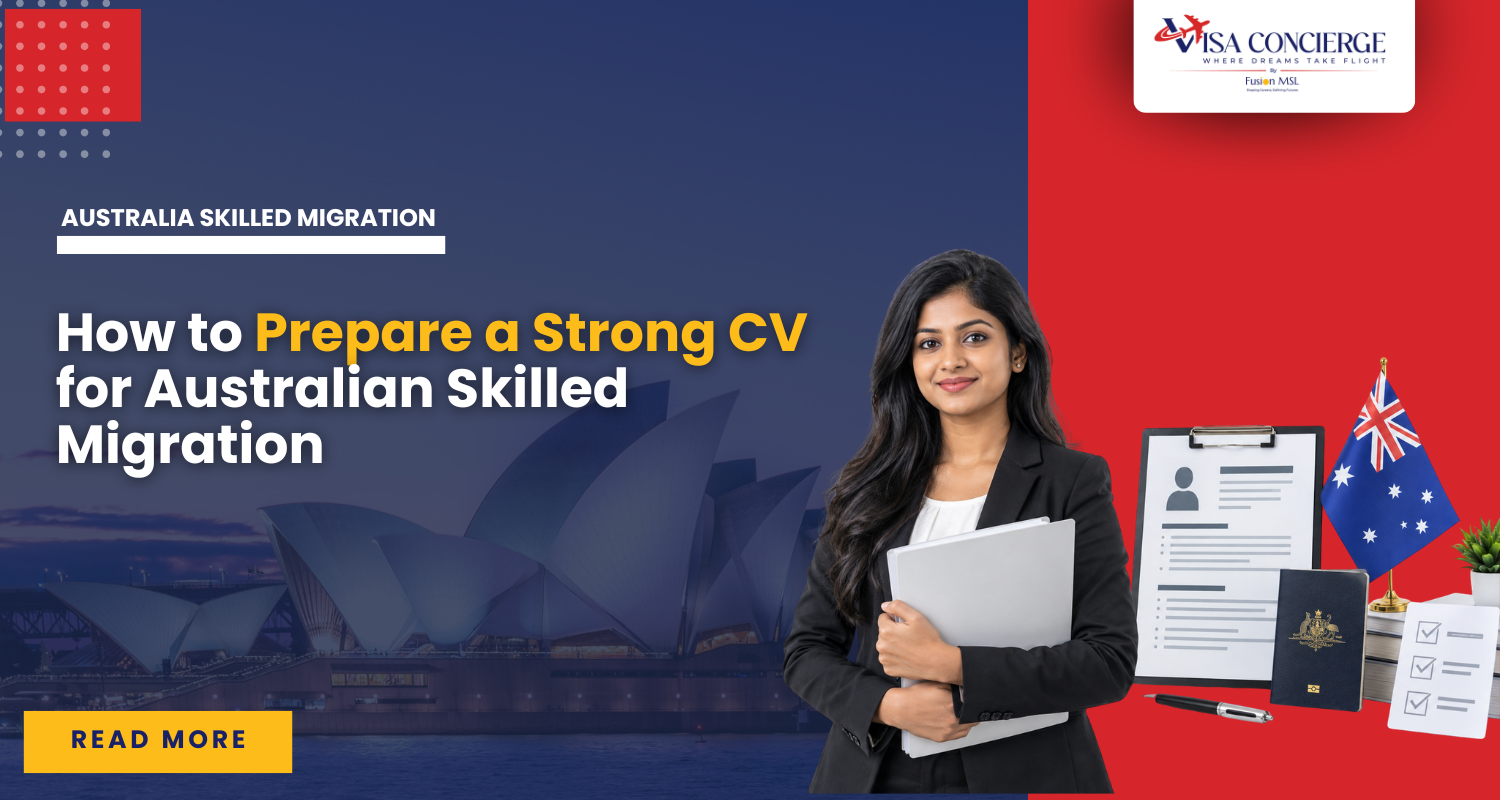
How to Prepare a Strong CV for Australian Skilled Migration
If you are planning Australia skilled migration from Sri Lanka, your CV is one of the first documents you should prepare properly.
Many applicants think a CV is only needed to apply for jobs. But in skilled migration planning, your CV plays a much bigger role.
It helps show your professional background, qualifications, work experience, career progression, job duties and possible occupation pathway. It can also help a consultant understand whether your profile may be suitable for pathways such as 189, 190, 491, 186 or 482.
At Visa Concierge by Fusion MSL, we often ask skilled migration clients to share their CV at the very beginning. This is not just for record purposes. It helps us understand your profile before discussing the most suitable direction.
Why Your CV Matters in Australia Skilled Migration
Australian skilled migration is not based only on your job title.
Your occupation, duties, qualifications, experience, skills assessment pathway, points, employer sponsorship options and documents must be reviewed together.
Your CV helps connect these areas.
For example, if you are planning a points-tested pathway such as 189, 190 or 491, your CV can help review your occupation direction, work history and possible skills assessment route.
This is why your CV should not be written casually. It should be clear, consistent and aligned with your actual professional experience.
A Migration CV Is Different from a Job-Hunting CV
A job-hunting CV is usually written to impress an employer quickly. It may highlight achievements, keywords and career goals.
A migration-focused CV should be more structured.
It should clearly explain:
- What you studied
- Where you worked
- What roles you held
- What duties you performed
- How long you worked in each role
- Whether your work was full-time or part-time
- What technical or professional responsibilities you handled
- Whether your experience supports a skilled occupation pathway
This does not mean your CV should be overloaded with unnecessary details. It means the right information should be presented clearly.
Start with a Clear Professional Summary
Your CV should begin with a short professional summary.
This section should explain who you are professionally, your industry background, years of experience and main areas of expertise.
For example, instead of writing something very general like:
“I am a hardworking and dedicated professional looking for growth opportunities,”
it is better to write something more specific, such as:
“Experienced finance professional with over six years of experience in accounting operations, financial reporting and audit coordination within the private sector.”
This gives a clearer picture of your background.
However, avoid exaggeration. Your summary should match the rest of your CV and supporting documents.
Mention Your Employment History Clearly
Your employment history is one of the most important parts of your CV.
For each role, include:
- Company name
- Job title
- Employment period
- Location
- Full-time or part-time status, if relevant
- Short company or department context, where helpful
- Main duties and responsibilities
- Key achievements, if relevant
The dates should be accurate. If there are gaps, overlapping roles or career changes, they should be presented clearly.
Many Sri Lankan applicants have worked in different roles, changed industries or had promotions within the same company. If this is not shown clearly, it can make the profile difficult to assess.
Your CV should help the reader understand your career journey without confusion.
Focus on Actual Duties, Not Just Job Titles
One of the biggest mistakes applicants make is listing only job titles.
For Australian skilled migration, your actual duties matter.
For example, a title such as “Executive,” “Manager,” “Coordinator,” “Analyst” or “Consultant” can mean different things depending on the company and industry.
A “Manager” in one company may handle strategic decision-making. In another company, the same title may involve mostly administrative tasks.
This is why your CV should explain what you actually did in each role.
Your duties should be truthful, specific and connected to your real work. Do not copy duties from the internet or from another person’s CV. If your duties are not genuine, they may not match your employment evidence later.
Keep Your Occupation Direction in Mind
A strong migration CV should make it easier to understand your possible occupation direction.
This does not mean you should force your CV to fit an occupation. It means your experience should be written accurately so that the correct occupation can be reviewed.
For example:
- An IT applicant may need to show whether their work is closer to software development, business analysis, systems support, cybersecurity, networking or data.
- An engineering applicant may need to show technical responsibilities, project involvement and industry exposure.
- A finance applicant may need to show accounting, auditing, reporting, taxation or analytical duties.
- A chef or hospitality applicant may need to show kitchen operations, menu planning, food preparation, team supervision or compliance-related duties.
- A construction applicant may need to show site coordination, cost control, project planning, technical drawings, supervision or quantity-related duties.
Each profile is different. That is why occupation matching should be done carefully.
Include Your Education and Professional Qualifications
Your education section should include your academic and professional qualifications.
Mention:
- Qualification name
- Institution name
- Country
- Study period or completion year
- Main area of study
- Professional memberships or licences, if relevant
For Sri Lankan applicants, this may include university degrees, diplomas, higher national diplomas, NVQ qualifications, professional qualifications and industry certifications.
Do not leave out important qualifications simply because you think they are not relevant. A consultant can review whether they support your profile.
At the same time, avoid adding unrelated short courses that do not add value to your skilled migration profile.
Make Your CV Consistent with Your Documents
Your CV should match your supporting documents.
This is very important.
Your employment dates should match your employment letters. Your job titles should match your appointment or promotion letters. Your qualifications should match your certificates and transcripts. Your claimed experience should be supported by salary evidence, EPF/ETF records, bank statements or other relevant documents where applicable.
If your CV says one thing and your documents say something else, it can create confusion.
Before moving forward, check whether your CV is consistent with:
- Employment reference letters
- Appointment letters
- Promotion letters
- Salary slips
- Bank statements
- EPF/ETF records
- Academic certificates
- Transcripts
- Professional qualification documents
This is one of the areas where Visa Concierge can help clients identify gaps before they proceed further.
Do Not Overcomplicate the CV
Some applicants think a longer CV is better.
That is not always true.
A strong CV should be detailed enough to explain your profile, but not so lengthy that the important information gets lost.
For most applicants, a clear and structured CV is better than a heavily designed document with too many graphics, colours or unnecessary personal details.
Avoid:
- Overdesigned layouts
- Long paragraphs without structure
- Unclear job duties
- Missing employment dates
- Repeated responsibilities
- Exaggerated claims
- Unrelated personal information
- Spelling and grammar mistakes
- Inconsistent formatting
Common CV Mistakes Sri Lankan Applicants Make
1. Using a Generic CV for Every Purpose
A job application CV and a migration review CV are not always the same. For skilled migration, your CV should clearly show experience, duties, qualifications and occupation direction.
2. Not Explaining Duties Properly
Many applicants only list job titles and company names. This is not enough to understand whether the work experience supports a skilled occupation.
3. Adding Duties That Are Not True
Trying to make your CV look stronger by adding duties you did not perform can create problems later. Your CV should match your real work and documents.
4. Leaving Out Older Relevant Experience
Some applicants remove older experience because they think it is not important. But older skilled experience may still help understand your career pathway.
5. Not Showing Promotions Clearly
If you were promoted, your CV should show the different roles and periods clearly. Otherwise, your experience may look confusing.
6. Ignoring Employment Gaps
If there are gaps, career breaks or overseas work periods, they should be handled clearly and honestly.
7. Using Poor Grammar or Unclear Wording
Your CV is often the first document reviewed. Poor wording can make a strong profile look weak.
CV and Skills Assessment Planning
For many skilled migration pathways, skills assessment may be an important step.
Your CV can help identify which occupation and assessing authority may be relevant. It can also help identify what employment documents may be needed later.
However, a CV alone is not enough for a skills assessment. It should be supported by proper documents.
This is why applicants should not prepare a CV in isolation. It should be part of a complete profile review.
At Visa Concierge, we help applicants understand whether their CV, job duties and documents are moving in the same direction.
Should You Prepare the CV Yourself?
You can prepare your first CV yourself. In fact, it is helpful because you know your work history better than anyone else.
But before using it for skilled migration planning, it is better to have it reviewed professionally.
A consultant can help identify:
- Whether your duties are clear
- Whether your occupation direction is understandable
- Whether your work experience is properly presented
- Whether your education section is complete
- Whether your documents may support the CV
- Whether the CV creates any confusion
- Whether your profile should be reviewed for 189, 190 or 491
This can save time before you spend money on the wrong step.
What to Send Visa Concierge for a CV Review
If you are planning Australia skilled migration, you can send us:
- Your updated CV
- A short summary of your current job duties
- Your highest qualification details
- Total years of work experience
- Current English test status, if available
- Spouse’s basic profile, if applicable
- Any employer interest or job offer, if applicable
- Your preferred migration goal
You do not need to know the correct pathway before contacting us. That is what the review is for.
Our role is to help you understand where your profile may stand and what next steps should be considered.
How Visa Concierge Can Help
At Visa Concierge by Fusion MSL, we help Sri Lankan professionals prepare for Australia skilled migration with a structured approach.
Our support may include:
- Initial CV and profile review
- Occupation matching discussion
- Skilled migration pathway comparison
- Skills assessment document guidance
- Employment evidence checklist
- English test planning guidance
- EOI preparation support where applicable
- Family document planning
- Coordination with qualified migration professionals where required
We do not believe in giving false promises. We believe in helping clients understand their real options before they spend money on the wrong process.
Final Thoughts
Your CV is more than a career document. For Australia skilled migration, it can be the starting point of your entire pathway review.
A well-prepared CV can help identify your occupation direction, skills assessment pathway, employment evidence gaps and possible visa options.
A weak CV can create confusion and lead to wrong assumptions.
If you are serious about Australia skilled migration from Sri Lanka, do not use a generic CV and hope for the best. Prepare it properly, review it carefully and connect it with the right migration strategy.
Planning Australia skilled migration from Sri Lanka?
Send your CV to Visa Concierge by Fusion MSL for a professional profile review and pathway discussion.
Call or WhatsApp: +94 77 962 9672
Website: www.visaconcierge.lk
Visa Concierge by Fusion MSL
Where your dreams take flight.
Frequently Asked Questions
1. Why is a CV important for Australian skilled migration?
It helps present your qualifications, work history, duties, career progression and possible occupation direction so your skilled migration profile can be reviewed more clearly.
2. Is a migration CV different from a job application CV?
Yes. A migration-focused CV should clearly show your education, employment periods, duties, responsibilities and how your experience may relate to a skilled occupation.
3. Should I copy occupation duties from the internet into my CV?
No. Your duties should truthfully reflect the work you actually performed and should be consistent with your supporting employment evidence.
4. What documents should match my CV?
Your CV should be consistent with employment reference letters, appointment and promotion letters, salary evidence, EPF or ETF records, bank statements, academic certificates and transcripts where applicable.
5. How long should a migration CV be?
There is no fixed length. It should be detailed enough to explain your profile clearly without unnecessary graphics, repeated content or unrelated personal information.
6. Can my CV help identify the right skilled occupation?
Yes. A properly prepared CV can help a consultant review your duties, qualifications and experience and discuss possible occupation directions as part of a full profile assessment.
7. Can Visa Concierge review my CV before I start the migration process?
Yes. Visa Concierge can review your CV and profile, discuss occupation direction, compare skilled migration pathways and identify possible document gaps before later stages.