
Bachelor’s Pathway After A/Ls to Canada | Guide for Sri Lankan Students

Last reviewed: 4 September 2026  |  Reviewed by: Priyadharshan, Head of Visa Concierge

Bachelor’s Pathway After A/Ls to Canada: Guide for Sri Lankan Students

Completing A/Ls is a major step for every Sri Lankan student. After results, many students and parents start thinking about the next stage: local higher education, private university options in Sri Lanka, or studying abroad.

For students who want international exposure, practical education and a globally recognised qualification, Canada is one of the countries many Sri Lankan families consider for bachelor’s studies.

However, studying in Canada after A/Ls is not only about selecting a course and applying online. Students need to understand the right study level, suitable institution, course direction, financial planning and student visa requirements before making a decision.

At Visa Concierge by Fusion MSL, we guide Sri Lankan students and parents through the Canada study process, from pathway selection to institution application guidance and student visa documentation support.

Why Do Sri Lankan Students Consider Canada After A/Ls?

Canada is popular among international students because of its recognised education system, multicultural environment and wide range of study options. For Sri Lankan students, Canada can be attractive because it offers bachelor’s degree programs, diplomas, pathway programs and career-focused study options in different provinces.

Students often consider Canada after A/Ls for reasons such as:

  • Quality education
  • International exposure
  • Multicultural student life
  • Bachelor’s and diploma pathways
  • Career-focused programs
  • Future study or work planning depending on eligibility

But Canada is also a country where students must plan carefully. The rules around study permits, institution selection and financial documents can change. That is why students should not choose a course only because it is popular or because a friend selected it.

Can Sri Lankan Students Study in Canada After A/Ls?

Yes. Sri Lankan students can apply to study in Canada after completing A/Ls if they meet the academic, English language, financial and visa requirements.

Students must usually apply to a Designated Learning Institution, also known as a DLI. A DLI is an institution approved by a Canadian provincial or territorial government to host international students. IRCC states that if a student applies for a study permit with a letter of acceptance from an institution that is not designated for international students, the application will be refused.

This makes institution selection very important. Before applying, students should check whether the selected institution is suitable for international study and future planning.

Main Study Options After A/Ls

After A/Ls, Sri Lankan students may have several study options in Canada depending on their results, subject stream, budget and long-term goals.

1. Bachelor’s Degree Programs

A bachelor’s degree is a common option for students who want a full undergraduate qualification in Canada.

Students may explore bachelor’s programs in areas such as:

Business, Accounting, Finance, Marketing, Computer Science, Information Technology, Engineering, Psychology, Health Sciences, Hospitality, Tourism, Environmental Studies, Data Analytics and Social Sciences.

Bachelor’s degrees are suitable for students who have a clear academic direction and want to build a strong foundation for future career or postgraduate studies.

2. Diploma or Advanced Diploma Programs

Some students consider diploma or advanced diploma programs after A/Ls, especially when they want more practical and career-focused education.

These programs may be available in areas such as:

Business Administration, Computer Programming, Hospitality Management, Early Childhood Education, Supply Chain, Design, Healthcare Administration and Engineering Technology.

However, students should not choose a diploma only because it looks affordable or easier. The program should match the student’s education background, future goals and visa profile.

3. Pathway or Foundation Options

Some students may need a pathway program before entering a full bachelor’s degree, depending on academic results, English level or course requirements.

Pathway options should be reviewed carefully because progression rules, total study duration and costs can differ from one institution to another.

This is one area where professional guidance is very important, especially for students and parents comparing multiple offers.

---

How to Choose the Right Program After A/Ls

Choosing the right program is one of the most important parts of the Canada study journey.

Students should ask:

  • Does this course match my A/L stream?
  • Does it support my future career goal?
  • Is the institution suitable for international students?
  • Can my family manage the full cost?
  • Does the program make sense for my study permit application?
  • Does it support my future academic or career direction?

For example, a student from the Commerce stream may look at Business, Accounting, Finance, Marketing or Supply Chain. A student from the Maths stream may consider IT, Computer Science, Engineering Technology, Data Analytics or Business Analytics. A Science stream student may explore Health Sciences, Psychology, Biotechnology, Public Health or related fields depending on eligibility.

The course should not be selected only based on trend. It should create a logical and genuine study plan.

Why DLI Selection Matters

In Canada, institution selection is very important because students usually need a letter of acceptance from a DLI before applying for a study permit. IRCC explains that a study permit is the document issued to foreign nationals allowing them to study at designated learning institutions in Canada.

Students should be careful when selecting a college or university. The institution, program, location and future pathway should be reviewed before accepting an offer.

At Visa Concierge, we help students and parents understand the importance of choosing the right institution instead of applying randomly.

Understanding PAL/TAL for Canada Study Permits

Many Canada study permit applicants may need a Provincial Attestation Letter or Territorial Attestation Letter, commonly known as PAL or TAL.

IRCC explains that a PAL/TAL is a letter from the province or territory where the student plans to study, confirming there is a space for the student under that province or territory’s allocation. The official IRCC page also notes validity details for the 2026 study permit cap year.

Students should not leave this stage until the last moment. PAL/TAL requirements can affect the overall application timeline, so students should begin early and follow the correct process through the institution.

Financial Planning for Canada Studies

Studying in Canada requires proper financial planning. Students and parents should understand the full cost before applying.

This may include tuition fees, living expenses, accommodation, travel, insurance, visa-related costs and other personal expenses.

IRCC’s financial support guidance explains that study permit applicants must show they meet financial capacity requirements. It lists accepted types of financial evidence such as bank documents, education loans and scholarship evidence, depending on the student’s situation.

For Sri Lankan families, this stage should not be rushed. Sudden fund arrangements, unclear sources or incomplete financial explanations can create concerns during visa preparation.

At Visa Concierge, we guide families on financial document preparation in a structured way without making students guess what to submit.

Can Students Work While Studying in Canada?

Many Sri Lankan students and parents ask about part-time work in Canada.

Canada allows eligible international students to work off campus if they meet the required conditions. IRCC states that eligible students may work up to 24 hours per week off campus while classes are in session, and full-time during regular scheduled breaks if they meet the criteria.

However, students should not depend fully on part-time work to fund their education. Canada’s immigration regulations require students to have sufficient and available financial resources without relying on work in Canada.

Part-time work can support student exposure and experience, but the main financial plan should be prepared before applying.

Student Visa Planning After A/Ls

A Canada study permit application is not just a form submission. The student’s course, institution, funds, academic history and future intention should all connect clearly.

Students should be ready to explain why they selected Canada, why the chosen program is suitable, how it connects to their A/L background and future goals, and how they will manage their studies financially.

This is why applying through proper guidance is important. A weak course choice or unclear financial plan can affect the strength of the overall application.

Common Mistakes Sri Lankan Students Should Avoid

Many students make mistakes because they start without a proper plan.

Common mistakes include choosing a course only because a friend chose it, selecting the cheapest option without checking future relevance, ignoring DLI importance, misunderstanding PAL/TAL, depending too much on part-time work, waiting too long to prepare funds, and applying without checking whether the course fits the student’s background.

A Canada study application should not be rushed. It should be planned carefully from the beginning.

When Should Students Start?

Students planning to study in Canada after A/Ls should start as early as possible, ideally several months before the intended intake.

Early planning gives students more time to compare institutions, check course suitability, prepare documents, arrange finances, understand PAL/TAL requirements and prepare the study permit application properly.

Late planning can reduce options and create unnecessary stress for both students and parents.

Why Choose Visa Concierge?

At Visa Concierge by Fusion MSL, we help Sri Lankan students and parents understand the Canada bachelor’s pathway after A/Ls.

Our support includes:

  • Student profile assessment
  • Course and pathway guidance
  • DLI selection guidance
  • Institution application support
  • Offer process guidance
  • Financial document guidance
  • PAL/TAL process guidance where applicable
  • Canada study permit documentation support

Our goal is to help students make informed decisions before investing in their education abroad.

Canada can be a strong option, but the right pathway depends on the student’s individual profile.

Are Students at Public–Private Partnership Colleges in Canada Eligible for a PGWP?

For many Sri Lankan students planning to study in Canada, the opportunity to obtain a Post-Graduation Work Permit (PGWP) is an important consideration. However, not every Canadian college, campus or study program leads to PGWP eligibility.

One area that often causes confusion is studying through a public–private partnership, commonly known as a PPP college arrangement.

What is a public–private partnership college program?

Under this arrangement, a public college licenses its curriculum to a private college. Students normally attend classes at the private college campus but may receive a qualification connected to the public institution.

Although the qualification may carry the name of a public college, this does not automatically make the student eligible for a PGWP.

Are PPP college graduates eligible for a PGWP?

According to Immigration, Refugees and Citizenship Canada (IRCC), students who began a college program delivered through a public–private curriculum licensing arrangement after May 15, 2024, are generally not eligible for a Post-Graduation Work Permit.

The rule can be summarised as follows:

  • Students who started the PPP program on or before May 15, 2024, may still qualify for a PGWP if they meet all the other eligibility requirements.
  • Students who started the PPP program after May 15, 2024, are not eligible for a PGWP under this arrangement.
  • Separate rules and earlier cut-off dates may apply to certain programs delivered through partnerships between different provinces.

The important date is normally when the student began the study program—not simply the date they applied to the college or received the offer letter.

What about public universities and public colleges?

A student studying directly at an eligible public university or public college may qualify for a PGWP, but eligibility is not automatic.

The student must confirm:

  • Whether the institution is a Designated Learning Institution
  • Whether the specific program is PGWP-eligible
  • Whether the program is delivered at an eligible campus
  • Whether the student meets the applicable language requirement
  • Whether a field-of-study requirement applies
  • Whether all study, attendance and application requirements are satisfied

A college appearing on Canada’s DLI list does not necessarily mean that every course or campus operated under its name is eligible for a PGWP.

Why students must check before accepting an offer

Choosing a Canadian institution based only on tuition fees, location or the name of the awarding college can create serious problems later.

Before paying a deposit, students should verify the institution, program, delivery campus and PGWP status. Written confirmation from the institution may also be helpful, but the final decision on a PGWP application is made by IRCC.

If post-study work opportunities are part of your long-term plan, selecting the correct program from the beginning is essential.

Planning to study in Canada from Sri Lanka?

At Visa Concierge by Fusion MSL, we help Sri Lankan students evaluate their Canadian study options before proceeding with an application. Our guidance covers institution and program selection, admission preparation, study-permit documentation and the overall application process.

Final Thoughts

Studying in Canada after A/Ls can be a valuable opportunity for Sri Lankan students, but the process should be planned carefully.

The right pathway is not always the cheapest course or the most popular institution. It should match the student’s academic background, career goal, financial plan and study permit profile.

If you have completed A/Ls and are planning to study in Canada, start with a proper profile review before applying.

Start your Canada study journey with Visa Concierge today.

Call or WhatsApp: +94 77 962 9672

Visa Concierge by Fusion MSL

No. 14, Sir Baron Jayathilake Mawatha, Colombo 01

Website: www.visaconcierge.lk

Frequently Asked Questions

1. Can Sri Lankan students study in Canada after A/Ls?

Yes. Sri Lankan students can apply for bachelor’s, diploma, advanced diploma or pathway programs in Canada after A/Ls, depending on their academic results, English language ability, budget and the admission requirements of the selected institution.

2. Are Sri Lankan A/L qualifications accepted for Canadian bachelor’s programs?

Many Canadian institutions assess Sri Lankan A/L qualifications for undergraduate admission. However, entry requirements vary by institution and program, so students should confirm their eligibility before applying.

3. What is a DLI in Canada?

A DLI is a Designated Learning Institution approved by a Canadian provincial or territorial government to host international students. Students generally need a letter of acceptance from a DLI when applying for a Canada study permit.

4. What are PAL and TAL for Canada study permits?

PAL and TAL refer to a Provincial Attestation Letter or Territorial Attestation Letter. Many study permit applicants may need one from the province or territory where they plan to study, depending on the applicable requirements.

5. Can international students work while studying in Canada?

Eligible international students may work up to 24 hours per week off campus while classes are in session and may work full-time during regular scheduled breaks, subject to the applicable IRCC conditions.

6. Should I choose a diploma or a bachelor’s degree after A/Ls?

The better option depends on your academic background, career goals, budget, chosen field and overall study permit profile. Students should compare the program level, institution, future pathway and course relevance before making a decision.

7. Are students at public–private partnership colleges eligible for a PGWP?

Students who began a college program delivered through a public–private curriculum licensing arrangement after May 15, 2024 are generally not eligible for a Post-Graduation Work Permit under that arrangement. Students who began on or before that date may still qualify if they meet the other applicable PGWP requirements. Program, campus and institution eligibility should be checked carefully before accepting an offer.

8. Can Visa Concierge help with Canada study applications?

Yes. Visa Concierge by Fusion MSL supports Sri Lankan students with course and pathway guidance, DLI selection, institution applications, financial document preparation, PAL/TAL guidance where applicable, and Canada study permit documentation support.
About the Reviewer

Priyadharshan is the Head of Visa Concierge at Visa Concierge by Fusion MSL and supports students and families with international study pathway guidance, application planning and visa documentation coordination.

Admission, study permit and post-graduation work permit decisions are made by the relevant Canadian education providers and immigration authorities. Visa Concierge does not guarantee admission, visa approval or PGWP eligibility.

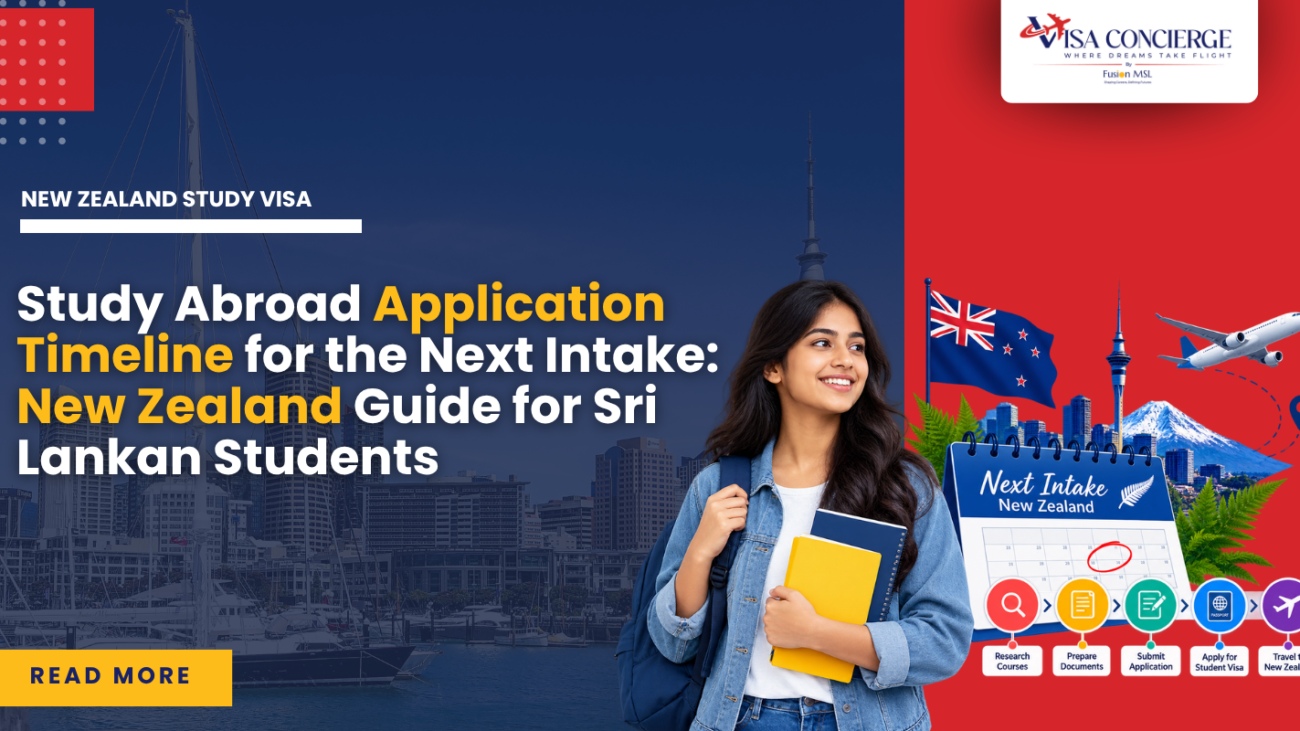
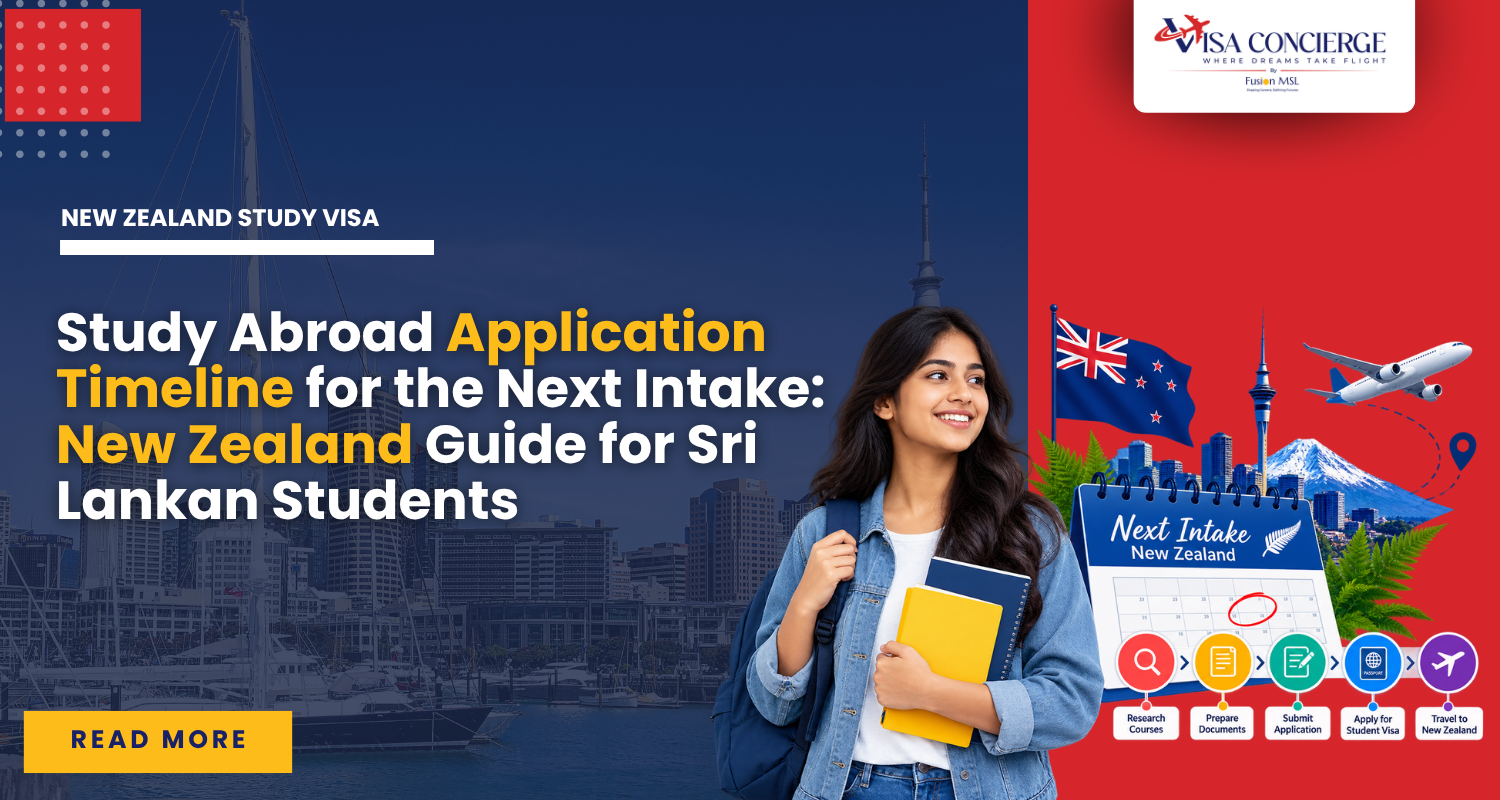
Study Abroad Application Timeline for the Next Intake New Zealand Guide for Sri Lankan Students

New Zealand Study Abroad Application Timeline for Sri Lankan Students | Next Intake Guide

Last reviewed: 31 August 2026  |  Reviewed by: Shahla Reezar

Planning for the Next New Zealand Intake?

Planning to study in New Zealand is an exciting decision. For many Sri Lankan students, New Zealand offers quality education, a safe environment, practical learning and a peaceful lifestyle. But one of the most important parts of a successful study abroad journey is timing.

Many students start thinking about New Zealand only a few weeks before the intake. By that time, course options may be limited, financial documents may not be ready, and the student visa process may become stressful.

If you are planning for the next New Zealand intake, it is always better to start early.

At Visa Concierge by Fusion MSL, we guide Sri Lankan students and parents through the New Zealand study process, from course selection to university application guidance and student visa documentation support.

This article explains a simple application timeline to help you understand when to begin and why early planning matters.

Why Timing Matters for New Zealand Study Applications

Studying in New Zealand is not only about selecting a course and waiting for an offer. Students must also consider course availability, entry requirements, financial readiness, English language requirements, genuine study intention and student visa processing time.

Immigration New Zealand strongly encourages international students to apply for a student visa 3 months before their intended travel date. It also reminds students that late applications may not be processed in time before the intended study start date.

This is why students should not treat the student visa as the final small step. Visa preparation should be considered from the beginning of the study abroad plan.

What Is the Main New Zealand Intake?

New Zealand generally has two major academic intake periods for many international students:

February / March intake — usually the main intake

July intake — mid-year intake for selected programs

Some institutions may also offer other start dates depending on the course. However, the availability of programs can vary, especially for bachelor’s and master’s students.

For Sri Lankan students, the February/March intake is usually one of the most important planning periods because many programs begin during the first semester of the academic year. Immigration New Zealand has also stated that the peak student visa processing period typically runs from October to March, as many students prepare for first-half-of-the-year study.

Ideal Timeline for the Next New Zealand Intake

The best timeline depends on the course, institution and student profile. However, as a general guide, Sri Lankan students should begin planning at least 6 to 8 months before the intended intake.

Here is a simple timeline to understand the process.

6–8 Months Before Intake: Start with Profile Review

This is the best stage to begin.

At this point, students should review their academic background, previous study history, work experience if any, English level, budget and future career goals.

This stage helps answer important questions such as:

  • Which study level is suitable?
  • Which course direction makes sense?
  • Is New Zealand the right country for this student?
  • Is the student ready for the next intake?
  • Are there any academic or visa concerns to identify early?

Students should avoid choosing a course only because a friend selected it or because it sounds popular. The selected program should match the student’s background and future plan.

At Visa Concierge, this is where we help students understand whether their study plan is realistic before moving forward.

5–6 Months Before Intake: Course and Institution Selection

Once the student’s profile is reviewed, the next stage is choosing suitable course options.

New Zealand offers study options in areas such as business, IT, engineering, health sciences, hospitality, education, environmental studies, agriculture and management.

Students should compare programs based on entry requirements, course structure, location, tuition fees, career relevance and pathway suitability.

This is also the stage where parents should be involved, especially when planning finances and understanding the full study route.

Choosing the wrong course can create problems later. A weak course match may affect both the admission process and the student visa explanation.

4–5 Months Before Intake: Submit Applications

After selecting suitable options, students should begin submitting applications to education providers.

This stage may include reviewing academic documents, English requirements, course-specific conditions and offer processing timelines.

Students should not wait until the last moment to apply. Some courses may close early, and some institutions may need extra time to assess international applications.

Early applications also give students more time to compare offers instead of accepting the first available option under pressure.

3–4 Months Before Intake: Offer Review and Financial Planning

Once an offer is received, students and parents should carefully review the conditions before accepting it.

This is also the time to plan finances properly. New Zealand student visa applicants must be able to show that they have enough funds to support their tuition, living expenses and other study-related costs. Immigration New Zealand also provides guidance on student fund requirements, including information relevant to students from Sri Lanka through the Funds Transfer Scheme.

Financial planning should not be rushed. Sudden deposits, unclear fund sources or incomplete explanations can create concerns during visa preparation.

At Visa Concierge, we guide students and parents on how to approach financial preparation in a structured way.

Around 3 Months Before Travel: Student Visa Preparation

Immigration New Zealand encourages students to apply for their student visa around 3 months before their intended travel date. This gives students a better chance of receiving a decision before the course begins.

Visa preparation is not only about filling out an online form. Students must make sure their study plan, financial documents, academic history and future intentions are consistent.

Immigration New Zealand also checks whether applicants have genuine intentions to study in New Zealand. This means the selected course and study plan should make sense based on the student’s background and goals.

This is one of the main reasons why professional guidance can be valuable.

1–2 Months Before Intake: Final Preparation

If the visa process is on track, students can begin preparing for travel, accommodation, insurance, university orientation and pre-departure planning.

This stage should be less stressful if the application was started early.

Students who delay everything until this point may face unnecessary pressure, limited course options, rushed documentation and uncertainty about arrival timelines.

Why Students Should Not Wait Until the Last Month

Waiting until the final month is one of the most common mistakes students make.

Late planning can lead to:

  • Limited course options
  • delayed offers
  • rushed financial arrangements
  • visa processing pressure
  • missed intake deadlines and unnecessary stress for both students and parents

Immigration New Zealand has reminded prospective students that late applications may not have enough time to be processed before the intended study start date.

For Sri Lankan students, it is always safer to start early and prepare the application properly.

Can You Apply Very Early?

In some cases, students may begin planning even earlier than 6 months before intake. Immigration New Zealand has noted that when offshore students apply very early, for example 6 months or more before the study period, the application may be assessed and approved in principle, subject to later confirmation of funds and study details.

This does not mean every student should rush the visa application too early. The timing should be decided based on the student’s course start date, offer status, financial readiness and overall profile.

This is why guidance is important before deciding when to move to each stage.

Best Time to Start for the February/March Intake

For students targeting the February/March intake, planning should ideally start around the middle of the previous year.

This gives enough time for:

  • Profile assessment
  • course selection
  • institution applications
  • offer review
  • financial planning
  • student visa preparation and pre-departure arrangements

The October to March period can be a busy time for student visa processing, so students should avoid leaving everything to the last moment.

Best Time to Start for the July Intake

For students targeting the July intake, it is better to begin planning around January or February of the same year.

The July intake may have fewer course options compared with the main intake, depending on the institution and program. That is why early course selection is important.

Students who miss the February/March intake may still explore July options, but they should not delay the application process.

Why Choose Visa Concierge?

At Visa Concierge by Fusion MSL, we help Sri Lankan students and parents plan their New Zealand study journey with proper timing and guidance.

Our support includes:

  • Profile assessment
  • course selection guidance
  • education provider application support
  • offer review guidance
  • financial document guidance
  • student visa documentation support and application timeline planning

We do not recommend applying blindly. Our goal is to help students choose a study pathway that matches their academic background, budget, career goal and visa profile.

A successful New Zealand study journey begins with the right plan.

Frequently Asked Questions

When should I start applying to study in New Zealand?

Students should ideally start planning around 6 to 8 months before the intended intake. This gives enough time for course selection, applications, offer processing, financial planning and student visa preparation.

When should I apply for a New Zealand student visa?

Immigration New Zealand strongly encourages international students to apply around 3 months before their intended travel date.

What is the main intake for New Zealand?

The February/March intake is usually the main intake for many programs. The July intake is also available for selected courses and institutions.

Is July intake available in New Zealand?

Yes, many institutions offer a July intake for selected programs. However, course availability may be more limited than the main intake, so students should check options early.

Can I apply late for New Zealand study?

Late applications may be possible in some cases, but they can be risky. Immigration New Zealand has warned that late visa applications may not be processed in time before the intended study start date.

Final Thoughts

If you are planning to study in New Zealand for the next intake, the best decision is to start early.

A strong study abroad plan takes time. Students need to choose the right course, apply to the right institution, plan finances properly and prepare the student visa application with care.

Do not wait until the last month to start your New Zealand study journey.

Start your New Zealand intake planning with Visa Concierge today.

Call or WhatsApp: +94 77 962 9672

Visa Concierge by Fusion MSL

No. 14, Sir Baron Jayathilake Mawatha, Colombo 01

Website: www.visaconcierge.lk

Can Visa Concierge help with New Zealand student visa planning?

Yes. Visa Concierge by Fusion MSL supports Sri Lankan students with New Zealand course selection guidance, education provider application support and student visa documentation guidance.

Information and Review Note

This article provides general information for Sri Lankan students planning to study in New Zealand. Intake dates, course availability, education provider requirements, financial requirements, student visa processing guidance and Immigration New Zealand procedures may change and may differ according to individual circumstances. Students should check the latest requirements before applying.

Last reviewed: 31 August 2026

About the Reviewer

Shahla Reezar reviews study-abroad guidance prepared by Visa Concierge by Fusion MSL, including information for Sri Lankan students considering New Zealand study pathways.

Admission and visa decisions are made by the relevant education providers and New Zealand authorities. Visa Concierge does not guarantee admission or visa approval.

How to Choose a Master’s Program in Australia Guide for Sri Lankan Students

How to Choose a Master’s Program in Australia | Guide for Sri Lankan Students

Last reviewed: 21 August 2026  |  Reviewed by: Shahla Reezar

Choosing a Master’s Program in Australia

Choosing a master’s program in Australia is a major decision for many Sri Lankan graduates and working professionals. Australia is popular among international students because of its recognised universities, practical education system, multicultural environment and wide range of postgraduate study options.

But choosing the right master’s program is not only about selecting a famous university or choosing the course your friend selected. Your decision should match your academic background, work experience, career goals, budget, English level and student visa profile.

At Visa Concierge by Fusion MSL, we guide Sri Lankan students step by step with Australia master’s program selection, university application guidance and student visa documentation support.

This guide explains what Sri Lankan students should check before choosing a master’s program in Australia.

Why Study a Master’s in Australia?

Australia offers many postgraduate study options for international students in areas such as business, information technology, engineering, healthcare, education, data analytics, cybersecurity, construction, project management, finance and hospitality.

The Australian Government states that students planning to study in Australia should use CRICOS to choose where and what to study. CRICOS is the official register of Australian education providers and courses available to international students.

This is important because international students applying for a Student visa must study a course registered on CRICOS. The Department of Home Affairs states that Student visa applicants must be enrolled in a full-time course registered on CRICOS and hold a valid Confirmation of Enrolment, known as CoE, when the visa is decided.

1. Start with Your Career Goal

Before choosing a master’s program, ask yourself:

What career do I want after this qualification?

Your master’s should support your future direction. For example, if you want to grow in the IT field, you may consider options such as:

  • Master of Information Technology
  • Master of Data Science
  • Master of Cyber Security
  • Master of Artificial Intelligence
  • Master of Software Engineering

If your goal is business or management, you may consider:

  • Master of Business Administration
  • Master of Management
  • Master of International Business
  • Master of Project Management
  • Master of Business Analytics
  • Master of Marketing

If your background is engineering, healthcare, education or finance, your course should be selected carefully based on your previous qualification and future plan.

Do not choose a master’s program only because it sounds popular. The course should make sense for your long-term career.

2. Check Whether the Course Matches Your Previous Studies

A strong master’s application should show a clear connection between your previous education and your chosen course.

Some Australian master’s programs require a related bachelor’s degree. This is common in fields such as engineering, health sciences, education, IT and professional programs.

Other programs may accept students from different academic backgrounds, especially in areas such as management, business, marketing or project management.

Before applying, check whether:

  • Your bachelor’s degree is relevant to the course
  • Your academic results meet the entry requirement
  • Work experience is required
  • The course allows students from different academic backgrounds
  • You need a bridging or pathway program

This step is important because a course mismatch can affect both admission and visa preparation.

3. Make Sure the Course Is CRICOS Registered

This is one of the most important checks for international students.

CRICOS is the official Australian Government register that lists education providers and courses approved for international students. The official CRICOS website states that it lists Australian education providers that offer courses to people studying in Australia on student visas.

Before accepting an offer, students should check whether:

  • The education provider is CRICOS registered
  • The selected course is CRICOS registered
  • The course duration and location are correct
  • The course level matches the student’s study plan

A course may look attractive online, but if it is not suitable for an international student visa pathway, it can create serious issues.

4. Compare Course Content, Not Only the Course Name

Two universities may offer master’s programs with similar names, but the content can be very different.

For example, one Master of Data Science may focus more on statistics and programming, while another may include artificial intelligence, machine learning or business analytics.

One Master of Project Management may focus on construction and engineering, while another may be more general and business-focused.

Before choosing, review:

  • Core modules
  • Elective subjects
  • Practical projects
  • Internship or placement options
  • Research or coursework structure
  • Industry relevance
  • Assessment methods

A strong course should not only sound good. It should teach skills that match your career goal.

5. Understand the Genuine Student Requirement

Australia student visa applications are assessed under the Genuine Student, or GS, requirement.

The Department of Home Affairs states that applicants should be able to demonstrate that studying in Australia is their primary reason for applying for a Student visa. The GS requirement also looks at areas such as why the student wants to study the selected course with that particular provider, whether the course is consistent with the student’s current education level, and whether it can help improve employment prospects.

This means your master’s program should be logical.

For example, if your bachelor’s degree, work experience and selected master’s program are not connected, you may need to explain your study plan very clearly.

A proper course choice can make your student visa story stronger.

6. Check Entry Requirements and English Requirements

Australian universities and institutions may have different entry requirements for master’s programs.

Students should check:

  • Minimum academic results
  • Required bachelor’s background
  • English language requirements
  • Work experience requirements
  • Portfolio or professional registration requirements, if applicable

For the Student visa, the Department of Home Affairs also provides English language guidance and notes that applicants may need to provide English evidence depending on their circumstances and course.

Do not assume that every university has the same requirements. A student may qualify for one university but not another.

7. Compare Tuition Fees and Living Costs

Budget is a major factor when choosing a master’s program in Australia.

Students and parents should calculate:

  • Tuition fees
  • Initial deposit
  • Living expenses
  • Accommodation
  • Transport
  • Overseas Student Health Cover
  • Visa application cost
  • Air tickets
  • Personal expenses

Study Australia explains that students must prove they have enough savings to cover costs connected with their course, including travel, course fees and rent. It also notes that living costs vary across Australia and may be higher than the minimum amount required for the visa application.

This is why students should not choose a university only based on tuition fees. Location and lifestyle costs also matter.

8. Think About Location

Australia has many study destinations, including Sydney, Melbourne, Brisbane, Perth, Adelaide, Canberra and regional areas.

Each location has different advantages.

Larger cities may offer more networking opportunities, larger student communities and more part-time work exposure. Regional areas may offer a calmer lifestyle, different cost structures and selected future pathway advantages depending on rules at the time.

When choosing the location, consider:

  • Cost of living
  • University reputation
  • Accommodation availability
  • Transport
  • Student support
  • Career opportunities
  • Lifestyle preference
  • Regional study considerations

The best city is not always the most popular city. It should fit your budget, course and long-term plan.

10. Understand Post-Study Options Carefully

Many Sri Lankan students consider Australia because of future career and post-study possibilities. However, students should not assume that every master’s program leads to the same outcome.

Study Australia explains that students with a bachelor’s, master’s or doctoral degree may be eligible for the Temporary Graduate visa, subclass 485, Post-Higher Education Work stream, depending on eligibility.

Rules can change, and eligibility depends on factors such as qualification type, course, location, visa conditions and government requirements at the time.

Students should choose a course because it fits their education and career goals first. Future migration or post-study planning should be considered carefully and realistically.

11. Do Not Choose a Course Only Because of PR

This is a common mistake among Sri Lankan students.

Some students choose courses only because they hear it may help with permanent residency. But this can be risky if the course does not match their background, interest or ability.

The correct approach is to choose a program that:

  • Matches your academic background
  • Supports your career goal
  • Makes sense for the student visa
  • Has genuine study value
  • Can support future employability
  • Fits your budget
A PR pathway should never be guessed. It should be planned carefully with updated rules and professional guidance.

12. Get Professional Guidance Before Applying

Choosing a master’s program in Australia involves more than searching course names online.

You need to check course suitability, CRICOS registration, entry requirements, English requirements, tuition fees, living costs, visa requirements, financial readiness and future plans.

At Visa Concierge by Fusion MSL, we help Sri Lankan students make informed decisions before applying.

Our support includes:

  • Australia master’s program guidance
  • University and course selection support
  • CRICOS course guidance
  • Application coordination
  • Document preparation guidance
  • Student visa documentation support
  • Financial document guidance
  • Intake planning

Our goal is to help students avoid unsuitable course choices, weak applications and unnecessary delays.

Frequently Asked Questions

How do I choose the right master’s program in Australia?

Start with your career goal, academic background, budget and visa profile. Then compare CRICOS-registered courses, course content, university support and future opportunities.

What is CRICOS and why is it important?

CRICOS is the official Australian Government register of institutions and courses approved for international students. Student visa applicants must be enrolled in a full-time CRICOS-registered course.

Can Sri Lankan students apply for master’s programs in Australia?

Yes. Sri Lankan graduates can apply for master’s programs in Australia if they meet the academic, English language, financial and visa requirements.

Should I choose a course based on PR options?

No. PR should not be the only reason for choosing a course. Your program should match your academic background, career goals and Genuine Student requirement.

What is the Genuine Student requirement?

The Genuine Student requirement is part of Australia’s Student visa assessment. Applicants should show that studying in Australia is their primary reason and explain why the chosen course and provider are suitable for their background and goals.

Can I work after completing a master’s in Australia?

Some graduates may be eligible for the Temporary Graduate visa, subclass 485, depending on their qualification and other eligibility requirements. Rules can change, so students should check current requirements before planning.

What are popular master’s programs in Australia for Sri Lankan students?

Popular areas include IT, Data Science, Cyber Security, Business Analytics, MBA, Project Management, Engineering Management, Public Health, Education, Accounting and Finance.

Final Thoughts

Choosing the right master’s program in Australia is an important decision that should be made carefully.

The best course is not always the most popular course. It is the course that fits your academic background, career goal, budget, visa profile and future plan.

If you are planning to study a master’s in Australia from Sri Lanka, start with a proper profile review before applying.

Start your Australia master’s journey with Visa Concierge today.

Call or WhatsApp: +94 77 962 9672

Visa Concierge by Fusion MSL

No. 14, Sir Baron Jayathilake Mawatha, Colombo 01

Website: www.visaconcierge.lk

When should I start applying for a master’s in Australia?

Students should ideally start several months before the intake to allow enough time for course selection, applications, offer processing, financial preparation, CoE issuance and visa documentation.

Information and Review Note

This article provides general information for Sri Lankan students considering a master’s degree in Australia. University entry requirements, CRICOS registrations, tuition fees, living costs, Genuine Student requirements, Student visa rules, English requirements, post-study options and migration settings may change and may differ according to individual circumstances. Students should check the latest requirements from their selected education provider and the Australian Department of Home Affairs before applying.

Last reviewed: 21 August 2026

About the Reviewer

Shahla Reezar reviews study-abroad guidance prepared by Visa Concierge by Fusion MSL, including information for Sri Lankan students considering Australia study pathways.

Admission and visa decisions are made by the relevant education providers and Australian authorities. Visa Concierge does not guarantee admission or visa approval.

Complete Guide to Studying in New Zealand from Sri Lanka

Study in New Zealand from Sri Lanka | Complete Student Visa & University Guide

Last reviewed: 19 August 2026  |  Reviewed by: Shahla Reezar

Study in New Zealand from Sri Lanka

New Zealand is becoming a strong study destination for Sri Lankan students who are looking for quality education, a peaceful lifestyle, globally recognised qualifications and a student-friendly environment.

For students planning bachelor’s or master’s studies, New Zealand offers a wide range of academic options in areas such as business, IT, engineering, health sciences, hospitality, education, agriculture, environmental studies and more.

However, studying in New Zealand is not only about choosing a university. Students must also understand the right course pathway, entry requirements, tuition fees, living costs, financial planning, genuine study intentions, part-time work rules and student visa process.

At Visa Concierge by Fusion MSL, we guide Sri Lankan students and parents step by step, from course selection to university application guidance and New Zealand student visa documentation support.

Why Choose New Zealand for Higher Studies?

New Zealand is known for its safe environment, practical education system and supportive international student experience. For many Sri Lankan students and parents, it is an attractive alternative to larger study destinations because it offers quality education with a calmer lifestyle.

Official New Zealand study resources highlight student visas, scholarships, study options and guidance for international students through government-supported platforms such as Study with New Zealand and NauMai NZ.

Students often consider New Zealand because of:

  • Globally recognised qualifications
  • Practical and career-focused learning
  • Safe and welcoming environment
  • Multicultural student communities
  • Smaller class environments in many institutions
  • Study options for bachelor’s, master’s and pathway programs
  • Part-time work rights for eligible students
  • Post-study and career planning opportunities depending on eligibility

For Sri Lankan families, New Zealand can be a good option for students who want international exposure without choosing an overly crowded destination.

Can Sri Lankan Students Study in New Zealand?

Yes. Sri Lankan students can apply to study in New Zealand if they meet the academic, English language, financial and visa requirements.

If a student wants to study full-time in New Zealand for more than 3 months, they usually need a student visa. The New Zealand Government states that students applying for a student visa need an offer of place from a New Zealand education provider.

This means students should first choose the correct course and institution before starting the visa process.

Choosing the Right Course in New Zealand

One of the biggest mistakes students make is choosing a course only because it sounds popular or because a friend selected it.

Your course should match your:

  • Academic background
  • Career goal
  • Work experience, if any
  • Budget
  • English level
  • Visa profile
  • Future plans

For example, a student with a background in IT may consider Software Engineering, Data Analytics, Cyber Security or Information Technology. A student with a business background may consider Management, Marketing, Accounting, Business Analytics or Supply Chain Management.

Choosing the right program is very important because your study plan should look logical and genuine when preparing your student visa application.

Immigration New Zealand states that student visa applicants must have genuine intentions to study in New Zealand and must answer truthfully in their application.

New Zealand Student Visa for Sri Lankan Students

Most Sri Lankan students applying for full-time study in New Zealand will apply for a student visa based on their course and education provider.

A common route is the Fee Paying Student Visa, which is for students who pay the full cost of their course. Immigration New Zealand explains that this visa is for full-time study and includes requirements such as having an offer of place, funds for tuition fees and living costs, and meeting other visa conditions.

Students may also need to provide evidence related to their offer, tuition fees, living costs, travel support, academic background, English ability and genuine study intention.

Requirements can differ depending on the student’s age, course type, duration and personal situation.

Financial Requirements for New Zealand Student Visa

Financial planning is one of the most important parts of studying in New Zealand.

Immigration New Zealand states that student visa applicants need to show they have enough money to live on and cover expenses while in New Zealand.

Students may need to show funds for tuition fees, living costs, travel, accommodation, insurance and other study-related expenses.

For students from Sri Lanka, Immigration New Zealand also refers to the Funds Transfer Scheme, known as FTS, which is available for students from selected countries including Sri Lanka. The FTS is run through ANZ Bank New Zealand and can be used to transfer required funds to support the student while in New Zealand.

Because financial evidence is closely reviewed, students should avoid last-minute deposits, unclear fund sources or incomplete financial explanations. A strong financial file should be properly planned and clearly explained.

Part-Time Work Rights for International Students in New Zealand

Many Sri Lankan students ask whether they can work while studying in New Zealand.

The answer is: some international students may be allowed to work, depending on their student visa conditions and course of study.

According to Immigration New Zealand, students may be able to work while on a student visa depending on the type of course they are studying. Students must always follow the exact work conditions printed on their visa.

From the official New Zealand Government guidance, eligible students may be allowed to work up to 25 hours per week while studying. Some students may also be allowed to work full-time during scheduled holidays, depending on their visa conditions and course eligibility.

However, students should understand a few important points:

  • Work rights are not automatic for every student.
  • The student’s course and education provider can affect work rights.
  • Students must follow the work conditions listed on their visa.
  • International students cannot be self-employed while on a student visa.
  • Students aged 15 or younger cannot work on a student visa.
  • Students aged 16 or 17 may need permission to be granted work rights.
  • Part-time work should not be the main financial plan for studying in New Zealand.

Students should choose New Zealand mainly for education, not only for part-time work. A proper financial plan is still required before applying for a student visa.

For Sri Lankan students, part-time work can help with gaining exposure, improving communication skills and understanding the New Zealand work environment. But it should be managed carefully without affecting studies.

English Language Requirements

English requirements depend on the education provider, course and study level.

Many institutions accept English tests such as IELTS, PTE or other recognised qualifications. Some students may qualify for an English waiver depending on previous education, but this depends entirely on the institution’s policy.

Students should check English requirements before applying because some courses, especially health, education and professional programs, may have higher English requirements.

New Zealand Student Visa Processing Time

Visa processing times can change depending on the season, application volume and completeness of documents.

Immigration New Zealand provides student visa wait time information based on applications processed in recent weeks. INZ has also advised prospective students to apply as early as possible, especially during busy intake periods.

For Sri Lankan students, the safest approach is to start early and avoid waiting until the final month before course commencement.

When Should Sri Lankan Students Apply?

Students should ideally begin planning several months before the intended intake.

Early preparation gives enough time to:

  • Compare course options
  • Check entry requirements
  • Apply to education providers
  • Receive an offer
  • Arrange tuition payment
  • Prepare financial documents
  • Complete medical or police requirements if needed
  • Prepare the student visa application
  • Plan accommodation and travel

Waiting too long can reduce course options, increase stress and create avoidable visa delays.

Post-Study Opportunities in New Zealand

New Zealand may offer post-study work opportunities for eligible graduates depending on the qualification, level of study, course duration and immigration rules at the time of application.

Students should not assume that every course automatically leads to the same post-study or future migration outcome. The course, institution, qualification level and occupation relevance can all matter.

This is why students should plan carefully before choosing a program.

At Visa Concierge, we always advise students to select a course that makes sense academically and professionally, not only because it sounds popular.

Cost of Studying in New Zealand

The total cost depends on the institution, course, city and lifestyle.

Students and parents should calculate tuition fees, initial deposit, living expenses, accommodation, food, transport, insurance, visa fees, medical examination cost if applicable, police certificate cost if applicable, air tickets and personal expenses.

New Zealand may be more peaceful and less crowded than some larger destinations, but it still requires careful financial planning.

Parents should review the full cost before confirming the application.

Common Mistakes Sri Lankan Students Should Avoid

Many student visa issues happen because students start without a clear plan.

Common mistakes include:

  • Choosing a course without checking career relevance
  • Applying to an unsuitable institution
  • Not understanding financial requirements
  • Preparing weak or unclear fund documents
  • Waiting until the last moment
  • Giving inconsistent information
  • Not explaining study gaps properly
  • Choosing a course only because friends chose it
  • Assuming all study options lead to post-study work or residence pathways
  • Depending only on expected part-time income
  • Submitting incomplete or unclear information
A study abroad application should be planned, not guessed.

How Visa Concierge Can Help

At Visa Concierge by Fusion MSL, we help Sri Lankan students and parents understand the New Zealand study process clearly.

Our support includes:

  • Student profile assessment
  • Course and pathway guidance
  • Bachelor’s and master’s program selection support
  • Education provider application guidance
  • Financial document guidance
  • Student visa documentation guidance
  • Application timeline planning
  • Pre-departure guidance

Our goal is to help students choose the right pathway with confidence and avoid common mistakes that can delay or weaken an application.

Frequently Asked Questions

Can Sri Lankan students study in New Zealand?

Yes. Sri Lankan students can apply to study in New Zealand if they meet the academic, English language, financial and visa requirements.

Do I need a student visa to study in New Zealand?

If you plan to study full-time in New Zealand for more than 3 months, you usually need a student visa. You also need an offer of place from a New Zealand education provider.

Can international students work while studying in New Zealand?

Some international students can work while studying, depending on their visa conditions and course of study. Eligible students may be allowed to work up to 25 hours per week, and some may work full-time during scheduled holidays depending on their visa conditions.

Can all New Zealand student visa holders work part-time?

No. Work rights are not automatic for every student. Students must check the conditions printed on their student visa.

Can international students be self-employed in New Zealand?

No. Immigration New Zealand states that international students cannot be self-employed while on a student visa.

What are popular courses in New Zealand for Sri Lankan students?

Popular areas include Business, IT, Engineering, Hospitality, Health Sciences, Education, Data Analytics, Environmental Studies and Management.

How much money do I need for a New Zealand student visa?

You must show enough money to cover living costs and expenses while studying in New Zealand. Immigration New Zealand provides student fund requirement guidance and also refers to the Funds Transfer Scheme for students from countries including Sri Lanka.

How long does a New Zealand student visa take?

Processing times can change. Immigration New Zealand publishes student visa wait times and recommends applying early, especially during busy intake periods.

Can I apply for a master’s in New Zealand from Sri Lanka?

Yes. Sri Lankan graduates can apply for master’s programs if they meet the academic, English and course-specific requirements of the selected institution.

Is New Zealand good for Sri Lankan students?

New Zealand can be a good option for Sri Lankan students who want quality education, a safe environment, practical learning and a peaceful lifestyle. The right decision depends on the student’s profile, budget and career goal.

Final Thoughts

Studying in New Zealand from Sri Lanka can be a valuable opportunity for students who want international education in a safe, practical and student-friendly destination.

However, success depends on choosing the right course, preparing strong financial documents, understanding part-time work rules, planning funds properly and applying for the student visa at the right time.

If you are planning to study in New Zealand for a bachelor’s or master’s program, start early and get professional guidance before applying.

Start your New Zealand study journey with Visa Concierge today.

Call / WhatsApp: +94 77 962 9672

Visa Concierge by Fusion MSL

No. 14, Sir Baron Jayathilake Mawatha, Colombo 01

Website: www.visaconcierge.lk

Information and Review Note

This article provides general information for Sri Lankan students considering study in New Zealand. Entry requirements, tuition fees, living-cost requirements, student visa rules, work rights, post-study options, processing times and education provider policies may change and may differ according to individual circumstances. Students should check the latest requirements from Immigration New Zealand and their selected education provider before applying.

Last reviewed: 19 August 2026

About the Reviewer

Shahla Reezar reviewed this article for Visa Concierge by Fusion MSL.

Admission and visa decisions are made by the relevant education providers and New Zealand authorities. Visa Concierge does not guarantee admission or visa approval.

Study in the UK After OLs Bachelor’s Pathway Guide for Sri Lankan Students

Study in the UK After O/Ls | Bachelor’s Pathway Guide for Sri Lankan Students

Last reviewed: 4 September 2026  |  Reviewed by: Ilyas Hamdoon

Completing O/Ls is an important milestone for every Sri Lankan student. After O/L results, many students and parents start thinking about the next step. Some students continue with A/Ls in Sri Lanka, while others explore international study options.

One of the popular destinations for Sri Lankan students is the United Kingdom. The UK offers globally recognised education, a wide range of bachelor’s degree pathways, multicultural student life and strong academic support for international students.

However, students who complete O/Ls usually do not enter directly into a bachelor’s degree. Most students need to follow a foundation program or pre-university pathway before progressing to a bachelor’s degree.

This guide explains how Sri Lankan students can plan their UK study journey after O/Ls.

Can Sri Lankan Students Study in the UK After O/Ls?

Yes, Sri Lankan students can explore study options in the UK after completing O/Ls.

But the usual route is not direct bachelor’s entry. Since O/Ls are considered a school-level qualification, students normally need to complete a preparation pathway before entering university-level studies.

This pathway is commonly known as a:

  • Foundation Program
  • International Foundation Year
  • Pre-University Pathway
  • Foundation with Bachelor’s Progression

After completing the foundation program and meeting the required grades, students can progress into a bachelor’s degree.

What Is a Foundation Program?

A foundation program is a preparatory course designed for international students who want to enter a bachelor’s degree but do not yet meet direct university entry requirements.

It helps students improve their academic knowledge, English language skills, study skills and subject understanding before starting a full degree.

Foundation programs are available in many subject areas, including:

  • Business
  • Computing
  • Engineering
  • Law
  • Psychology
  • Social Sciences
  • Health Sciences
  • Media
  • Hospitality
  • Tourism
  • Art and Design

For students after O/Ls, a foundation program can be a strong route into UK higher education if selected properly.

How Does the UK Bachelor’s Pathway Work After O/Ls?

A common pathway after O/Ls may look like this:

Step 1

Complete O/Ls in Sri Lanka

Step 2

Apply for a UK foundation program

Step 3

Complete the foundation year successfully

Step 4

Progress to a related bachelor’s degree

Step 5

Complete the bachelor’s degree in the UK

The total study duration depends on the course, university and pathway. In many cases, the foundation year plus bachelor’s degree may take around four years in total.

Before applying, students and parents should clearly understand the full route, progression requirements and total cost.

Who Is This Pathway Suitable For?

The UK foundation pathway after O/Ls may be suitable for students who:

  • Want to start international education early
  • Have a clear interest in studying abroad
  • Are ready to live and study in a new environment
  • Have family support
  • Can meet English requirements
  • Have a proper financial plan

This pathway is especially useful for students who already know the direction they want to take for their future studies.

However, it may not be suitable for every student. Some students may benefit from completing A/Ls first before applying to the UK.

That is why a proper student profile review is important before making a decision.

What Should Parents Check Before Applying?

For parents, sending a child abroad after O/Ls is a major decision. Since students may be younger, parents should carefully check the pathway before confirming anything.

Parents should ask:

Is the institution recognised?

Does the pathway lead to a proper bachelor’s degree?

What are the progression requirements?

What is the total cost?

Is accommodation available and safe?

What student support does the institution provide?

What documents are needed for the visa?

Is the student ready to live abroad?

Choosing the right pathway is not only about admission. It is also about safety, planning, affordability and long-term success.

Cost Planning for UK Studies After O/Ls

Studying in the UK requires proper financial planning.

Parents should calculate the full cost, including:

  • Foundation program fees
  • Bachelor’s tuition fees
  • Accommodation
  • Food
  • Transport
  • Study materials
  • Visa application fee
  • Immigration Health Surcharge
  • Flight tickets
  • Personal expenses

Costs can vary depending on the university, course and city. London is usually more expensive than many regional cities, so location should also be considered when planning the budget.

Some institutions may offer scholarships or tuition discounts, but families should not depend only on scholarships. A realistic financial plan is important before applying.

English Language Requirements

Most UK institutions require proof of English ability. This may be through IELTS, PTE or another accepted English test.

Some institutions may consider English waivers depending on the student’s O/L English result or previous education background. However, this depends on the institution’s policy.

Students should check English requirements early because this can affect admission and visa preparation.

UK Student Visa Preparation

After receiving an offer and meeting the required conditions, students will need to prepare for the UK Student visa process.

Visa preparation may include academic documents, passport, financial documents, parental consent documents if applicable, accommodation details and other supporting documents.

Students applying after O/Ls should be especially careful because age, accommodation and parental support may become important factors.

A strong visa file should clearly show that the student has a genuine study plan, proper financial support and a suitable academic pathway.

Common Mistakes to Avoid

Many students and parents make mistakes when planning UK studies after O/Ls.

Common mistakes include:

  • Choosing a pathway without checking progression
  • Selecting a course only because friends chose it
  • Ignoring the total cost
  • Applying too late
  • Not checking English requirements
  • Submitting incomplete documents
  • Not understanding the visa process properly

These mistakes can lead to delays, confusion or unnecessary financial loss.

Before applying, it is always better to get professional guidance.

Why Choose Visa Concierge?

At Visa Concierge by Fusion MSL, we help Sri Lankan students and parents understand the right UK study pathway after O/Ls.

Our support includes:

  • Foundation pathway guidance
  • Course selection support
  • University application guidance
  • Document preparation support
  • Student visa documentation guidance
  • Step-by-step support throughout the process

We help families make informed decisions before investing in international education.

Final Thoughts

Studying in the UK after O/Ls can be a great opportunity for Sri Lankan students, but it must be planned carefully.

Most students will need to begin with a foundation program or pre-university pathway before progressing to a bachelor’s degree. The right pathway depends on the student’s academic results, English ability, maturity, budget and future career goal.

Parents and students should not rush the decision. With the right guidance, students can choose a pathway that supports their future.

Start your UK study journey after O/Ls with Visa Concierge today.

Call or WhatsApp: +94 77 962 9672

Location: No. 14, Sir Baron Jayathilake Mawatha, Colombo 01

Website: www.visaconcierge.lk

Frequently Asked Questions

Can Sri Lankan students go to the UK after O/Ls?

Yes. Sri Lankan students can explore UK study options after O/Ls, but the usual route is through a foundation or pre-university pathway rather than direct entry to a bachelor’s degree.

Can I enter a UK bachelor’s degree directly after O/Ls?

Usually not. Students generally need to complete a foundation program or another suitable pre-university pathway before progressing to a bachelor’s degree.

How long can the full pathway take?

The article notes that the foundation year plus the bachelor’s degree may take around four years in many cases, although the exact duration depends on the course, university and pathway.

What subjects can students study through a foundation pathway?

Options may include business, computing, engineering, law, psychology, social sciences, health sciences, media, hospitality, tourism, art and design, depending on the institution.

Do students need IELTS after O/Ls?

English requirements depend on the institution. Some students may need IELTS, PTE or another accepted test, while some institutions may consider a waiver based on previous education or O/L English results.

What should parents check before choosing a pathway?

Parents should review recognition, progression to the bachelor’s degree, total cost, accommodation and safety, student support, visa requirements and whether the student is ready to live abroad.

Can Visa Concierge help with UK foundation applications?

Yes. Visa Concierge supports students and parents with foundation pathway guidance, course selection, university applications, document preparation and UK student visa documentation guidance.

About the Reviewer

Ilyas Hamdoon reviews UK study-abroad guidance prepared by Visa Concierge by Fusion MSL, including foundation and bachelor’s pathway information for Sri Lankan students.

Admission and visa decisions are made by the relevant education providers and UK authorities. Visa Concierge does not guarantee admission or visa approval.